


Atrial Natriuretic Peptide and Acute Changes in Central Blood Volume by Hyperthermia in Healthy Humans
- PMID: 28018493
- PMCID: PMC5178974
- DOI: 10.2174/1876528901205010001
Atrial Natriuretic Peptide and Acute Changes in Central Blood Volume by Hyperthermia in Healthy Humans
Abstract
Background: Hyperthermia induces vasodilatation that reduces central blood volume (CBV), central venous pressure (CVP) and mean arterial pressure (MAP). Inhibition of atrial natriuretic peptide (ANP) could be a relevant homeostatic defense mechanism during hyperthermia with a decrease in CBV. The present study evaluated how changes in plasma ANP reflect the changes in CBV during hyperthermia.
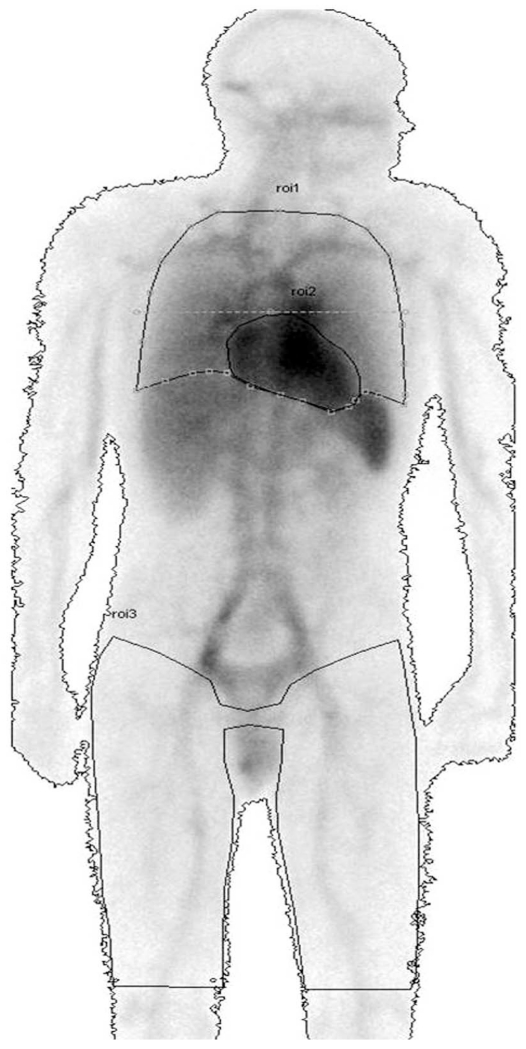
Methods: Ten healthy subjects provided with a water perfused body suit increased body core temperature 1 °C. In situ labeled autologous red blood cells were used to measure the CBV with a gamma camera. Regions of interest were traced manually on the images of the whole body blood pool scans. Two measures of CBV were used: Heart/whole body ratio and thorax/whole body ratio. CVP and MAP were recorded. Arterial (ANPart) and venous plasma ANP were determined by radioimmunoassay.
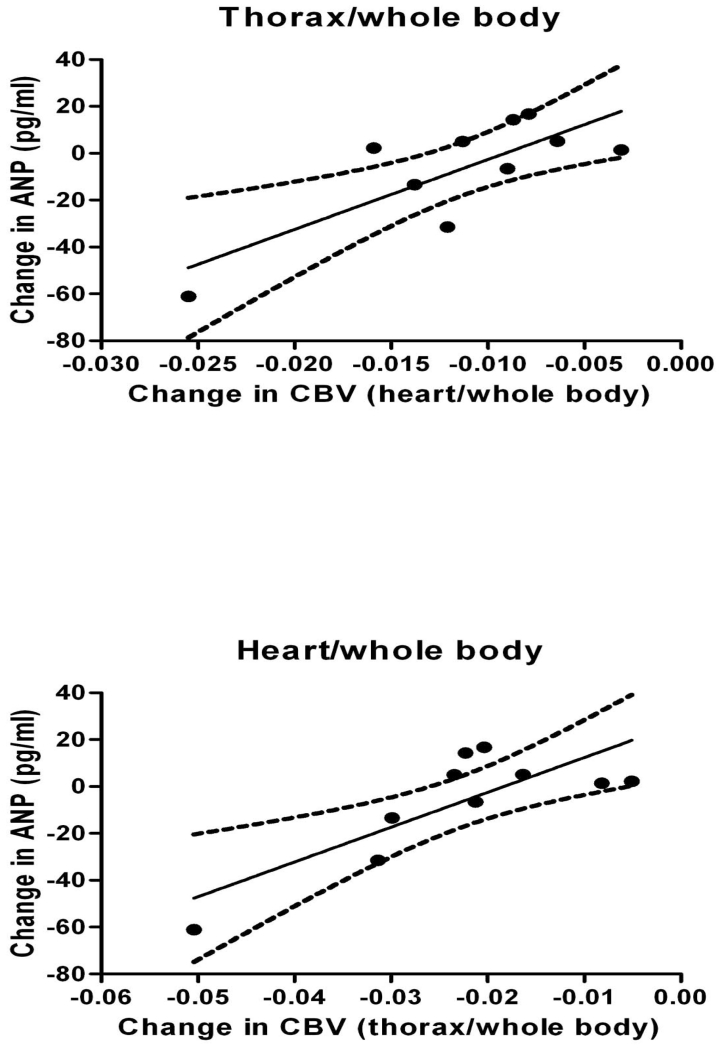
Results: The ratio thorax/whole body and heart/whole body decreased 7 % and 11 %, respectively (p<0.001). MAP and CVP decreased during hyperthermia by 6.8 and 5.0 mmHg, respectively (p<0.05; p<0.001). Changes in both thorax/whole body (R=0.80; p<0.01) and heart/whole body ratios (R=0.78; p<0.01) were correlated with changes in ANPart. However, there was no correlation between venous ANP and changes in CBV, nor between ANPart and MAP or CVP.
Conclusion: Arterial but not venous plasma concentration of ANP, is correlated to changes in CBV, but not to pressures. We suggest that plasma ANPart may be used as a surrogate marker of acute CBV changes.
Keywords: ANP; blood pool imaging; central blood volume; heating; natriuretic peptides; nuclear medicine.
Figures
References
-
- Rowell LB, Brengelmann GL, Murray JA. Cardiovascular responses to sustained high skin temperature in resting man. J Appl Physiol. 1969;27(5):673–80. - PubMed
-
- Crandall CG, Levine BD, Etzel RA. Effect of increasing central venous pressure during passive heating on skin blood flow. J Appl Physiol. 1999;86(2):605–10. - PubMed
-
- Low DA, Purvis AJ, Reilly T, Cable NT. The prolactin responses to active and passive heating in man. Exp Physiol. 2005;90(6):909–17. - PubMed
-
- Minson CT, Wladkowski SL, Cardell AF, Pawelczyk JA, Kenney WL. Age alters the cardiovascular response to direct passive heating. J Appl Physiol. 1998;84(4):1323–32. - PubMed
-
- Stein BC, Levin RI. Natriuretic peptides: physiology, therapeutic potential, and risk stratification in ischemic heart disease. Am Heart J. 1998;135(5 Pt 1):914–23. - PubMed
Grants and funding
LinkOut - more resources
Full Text Sources