


A continuous ideal free distribution approach to the dynamics of selfish, cooperative and kleptoparasitic populations
- PMID: 28018667
- PMCID: PMC5180165
- DOI: 10.1098/rsos.160788
A continuous ideal free distribution approach to the dynamics of selfish, cooperative and kleptoparasitic populations
Abstract
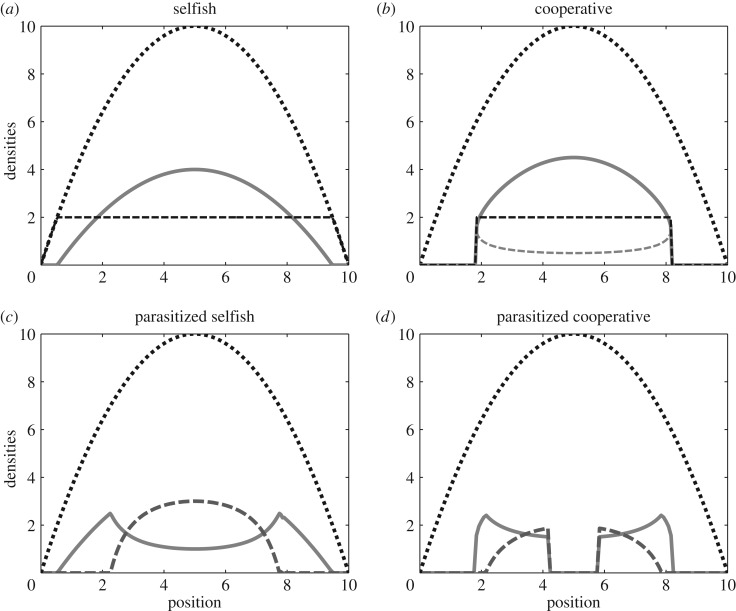
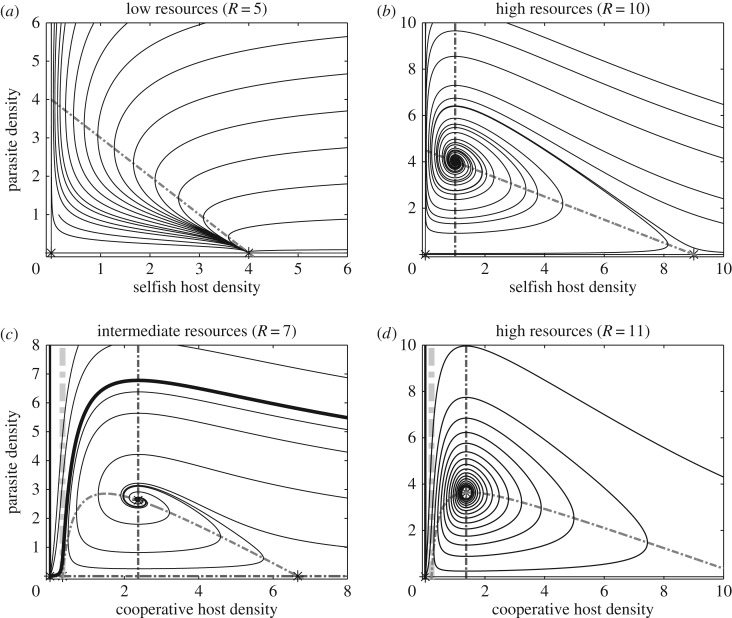
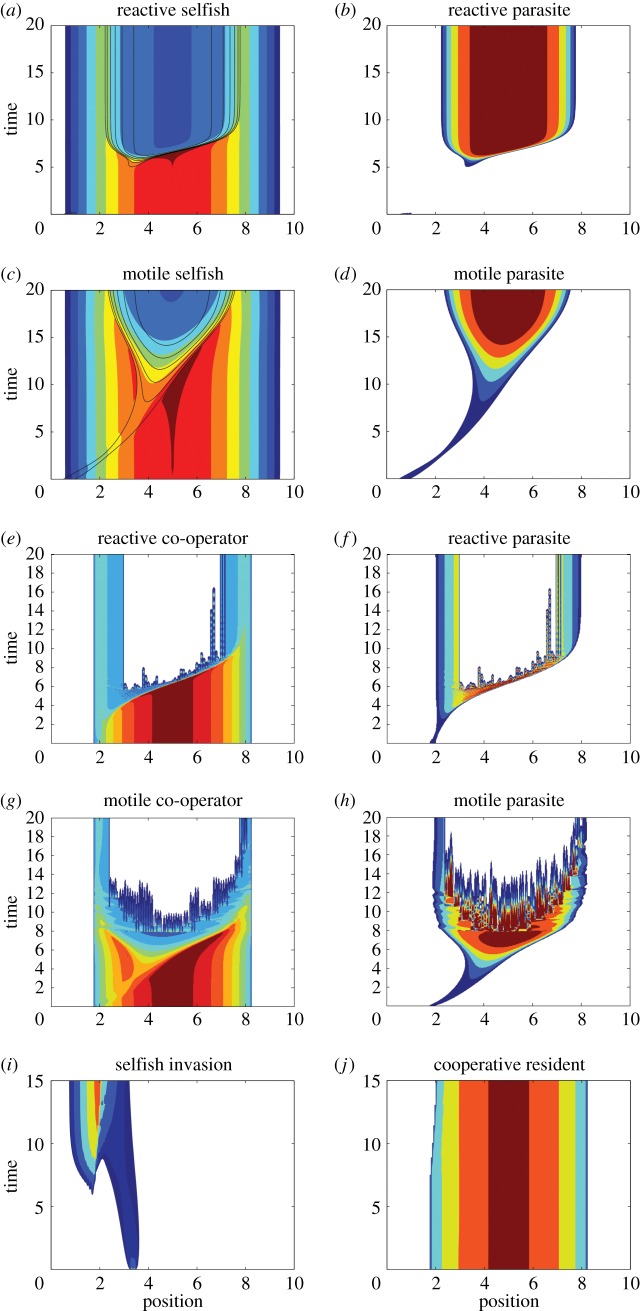
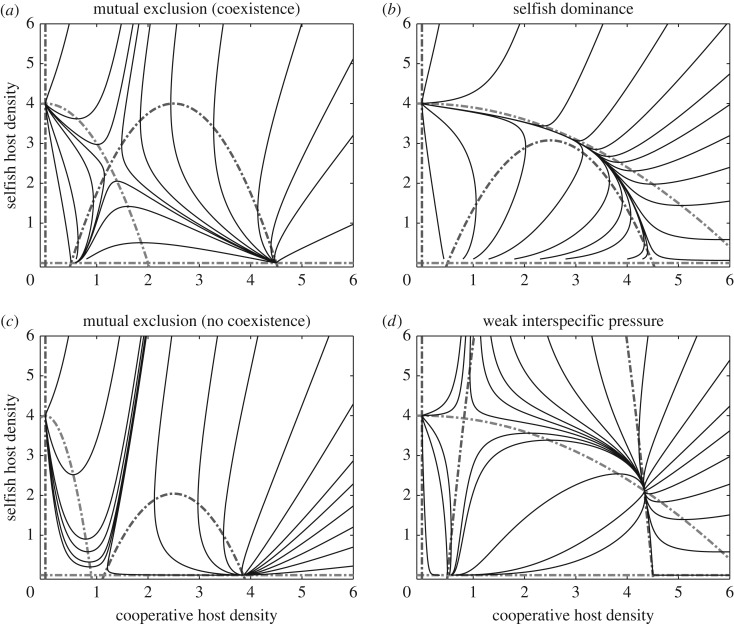
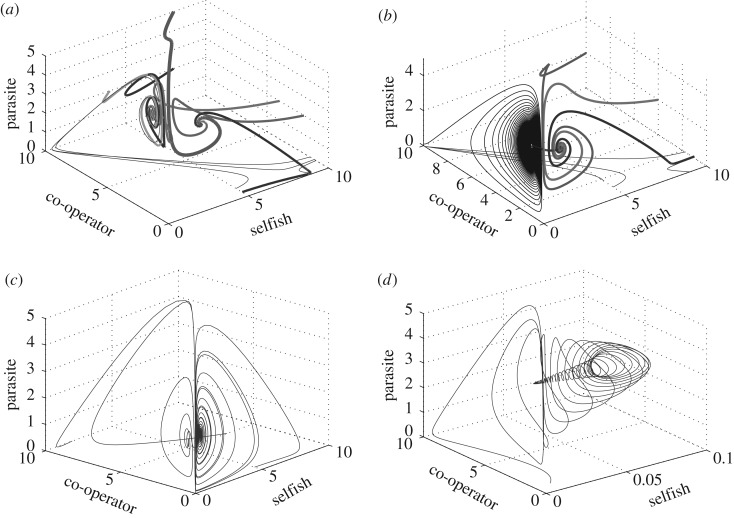
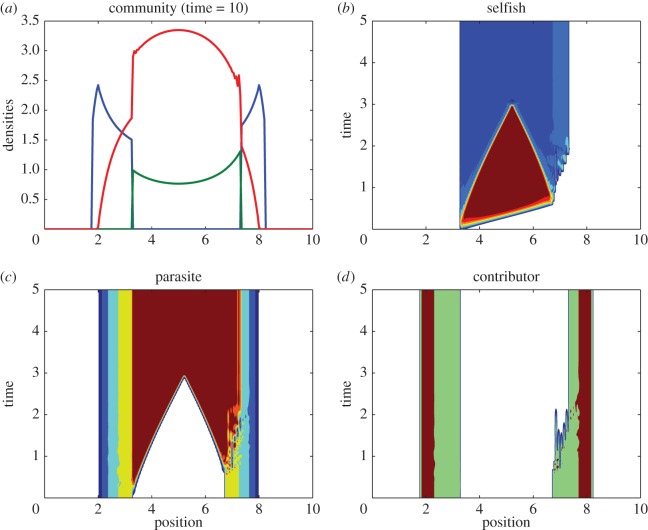
Population distributions depend upon the aggregate behavioural responses of individuals to a range of environmental factors. We extend a model of ideally motivated populations to describe the local and regional consequences of interactions between three populations distinguished by their levels of cooperation and exploitation. Inspired by the classic prisoner's dilemma game, stereotypical fitness functions describe a baseline non-cooperative population whose per capita fitness decreases with density, obligate co-operators who initially benefit from the presence of conspecifics, and kleptoparasites who require heterospecifics to extract resources from the environment. We examine these populations in multiple combinations, determine where both local and regional coexistence is permitted, and investigate conditions under which one population will invade another. When they invade co-operators in resource-rich areas, kleptoparasites initiate a dynamic instability that leads to the loss of both populations; however, selfish hosts, who can persist at low densities, are immune to this risk. Furthermore, adaptive movement may delay the onset of instability as dispersal relieves dynamic stress. Selfish and cooperative populations default to mutual exclusion, but asymmetric variations in interference strength may relax this condition and permit limited sympatry within the environment. Distinct sub-communities characterize the overall spatial structure.
Keywords: cooperation; ideal free movement; interference competition; kleptoparasitism; spatial structure; sympatry.
Figures
References
-
- Cressman R, Křivan V, Garay J. 2004. Ideal free distributions, evolutionary games, and population dynamics in multiple-species environments. Am. Nat. 164, 473–489. (doi:10.1086/423827) - DOI - PubMed
-
- Rowell JT. 2009. The limitation of species range: a consequence of searching along resource gradients. Theor. Popul. Biol. 75, 216–227. (doi:10.1016/j.tpb.2009.03.001) - DOI - PMC - PubMed
-
- Rowell JT. 2010. Tactical population movements and distributions for ideally motivated competitors. Am. Nat. 176, 638–650. (doi:10.1086/656494) - DOI - PubMed
-
- Cosner C. 2005. A dynamic model for the ideal-free distribution as a partial differential equation. Theor. Popul. Biol. 67, 101–108. (doi:10.1016/j.tpb.2004.09.002) - DOI - PubMed
-
- Cosner C, Winkler M. 2014. Well-posedness and qualitative properties of a dynamical model for the ideal free distribution. J. Math. Biol. 69, 1343–1382. (doi:10.1007/s00285-013-0733-z) - DOI - PubMed
LinkOut - more resources
Full Text Sources
Other Literature Sources
