


Association of the polymorphism 12109g>A from the REN gene as a risk factor for preterm birth
- PMID: 28019132
- PMCID: PMC5843887
- DOI: 10.1177/1470320316678159
Association of the polymorphism 12109g>A from the REN gene as a risk factor for preterm birth
Abstract
Introduction: Preterm birth is the most important cause of neonatal mortality and morbidity. It is a multifactorial disease with different etiologies, including genetic factors. Genetic variability is represented by single nucleotide polymorphisms (SNPs) in genes of proteins involved in the contractile activity. We determine the association between SNP 12109G> A in REN associated with preterm birth and premature rupture of membrane.
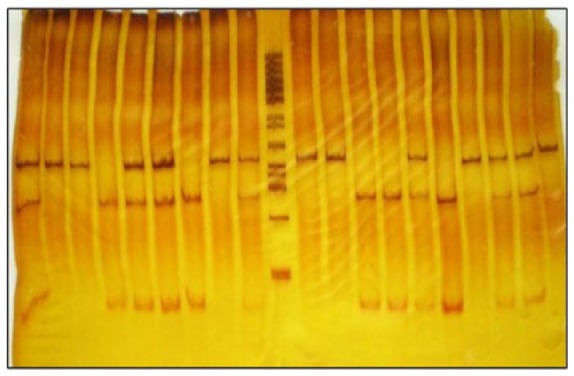
Materials and methods: A study of cases ( N=112, 22-36 weeks of gestation; mean: 31, 95% confidence interval 30.7-32.2) and controls ( N=66; 38-40 weeks of gestation from the last menstrual period; mean: 39.8, 95% confidence interval 38.9-39.4) was performed. Genomic DNA was isolated in all patients from peripheral blood. The SNP 12109G> A ( Mbo I) in REN was typified by PCR-restriction fragment length polymorphism.
Results: A significant difference in the case group for the SNP 12109G>A was observed. The A allele was increased in women with preterm birth (81% cases vs. 15% control, p<0.0000004). There was also a significant difference between genotypes, mainly an excess of G/A heterozygotes in women with preterm birth (60% cases vs. 23% controls). The phenotype 12109G> A has odds ratio 6.62 (95% confidence interval 3.14-14.15), which means a high risk of preterm birth/premature rupture of membrane in presence of allele A, both in homozygotes and in heterozygotes.
Conclusion: Allelic frequency of A of SNP 12109G>A was higher in women with preterm birth than in women with normal vaginal delivery and could be considered a risk factor.
Keywords: Mbo I; PCR-RFLP; Preterm birth; REN gene; SNPs.
Conflict of interest statement
Figures
References
-
- Saling E. Basic aspects of prematurity prevention and results achieved by a suitable, simple program. J Perinat Med 1998; 26: 466–468. - PubMed
-
- Challis JRG. Mechanism of parturition and preterm labor. Obstet Gynecol Surv 2005; 55: 650–660. - PubMed
-
- Reichetzeder C, Dwi Putra SE, Li J, et al. Developmental origins of disease. Crisis precipitates change. Cell Physiol Biochem 2016; 39: 919–938. - PubMed
-
- Mancilla J. Ruptura prematura de membranas y parto pretérmino I. Mediadores inflamatorios en la ruptura prematura de membranas. Gaceta Medica Mexicana 1998; 134: 423–426. - PubMed
-
- Rchetzeder C, Chen H, Föller M, et al. Maternal vitamin D deficiency and fetal programming – lessons learned from humans and mice. Kidney Blood Press Res 2014; 39: 315–329. - PubMed
MeSH terms
Substances
LinkOut - more resources
Full Text Sources
Other Literature Sources
