


Effects of a community-based nutrition promotion programme on child feeding and hygiene practices among caregivers in rural Eastern Ethiopia
- PMID: 28025956
- PMCID: PMC10261560
- DOI: 10.1017/S1368980016003347
Effects of a community-based nutrition promotion programme on child feeding and hygiene practices among caregivers in rural Eastern Ethiopia
Abstract
Objective: To evaluate the effectiveness of a community-based participatory nutrition promotion (CPNP) programme involving a 2-week group nutrition session in improving child feeding and hygiene practices among caregivers.
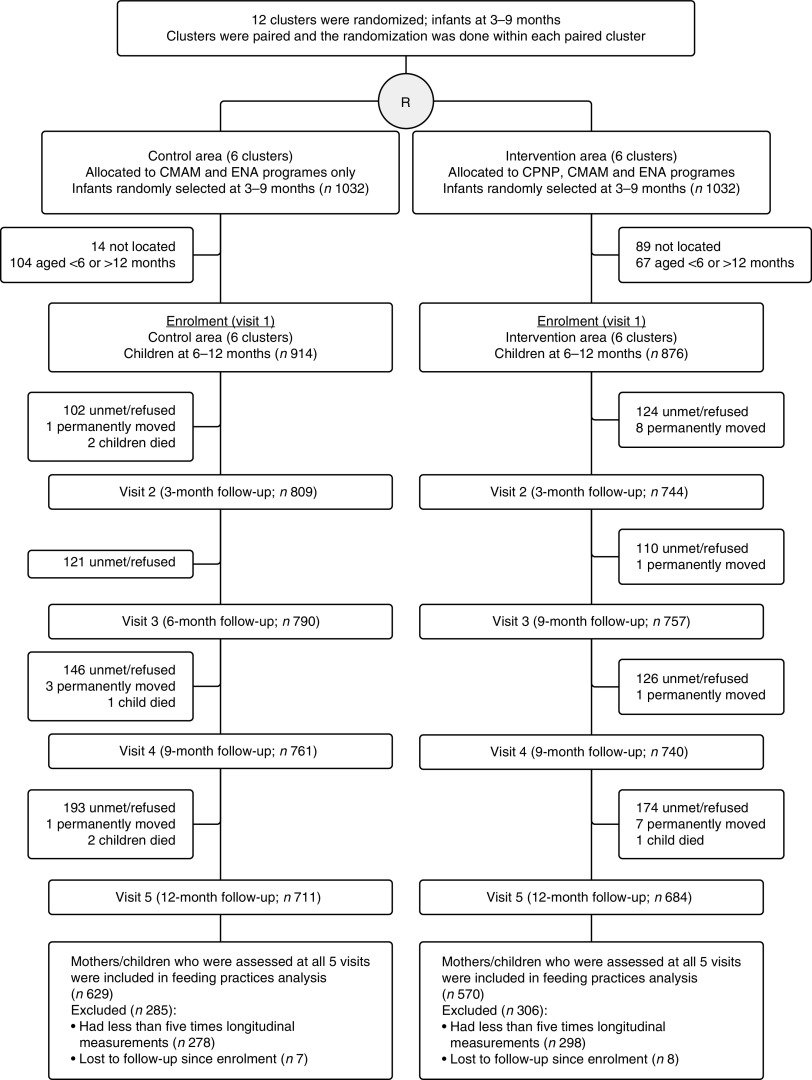
Design: Cluster randomized trial. In the intervention area (six clusters), the CPNP programme was added to the context of government nutrition programmes; the control area (six clusters) received the government programme only. Child feeding practices were assessed every 3 months using a 24 h dietary recall questionnaire, and hand washing with soap was assessed every 6 months, over a period of 12 months. Feeding and hygiene measures at each visit were scored and the scores summed up for the entire follow-up period.
Setting: Habro and Melka Bello districts, Ethiopia.
Subjects: Randomly selected mothers with a child aged 6-12 months (n 1790).
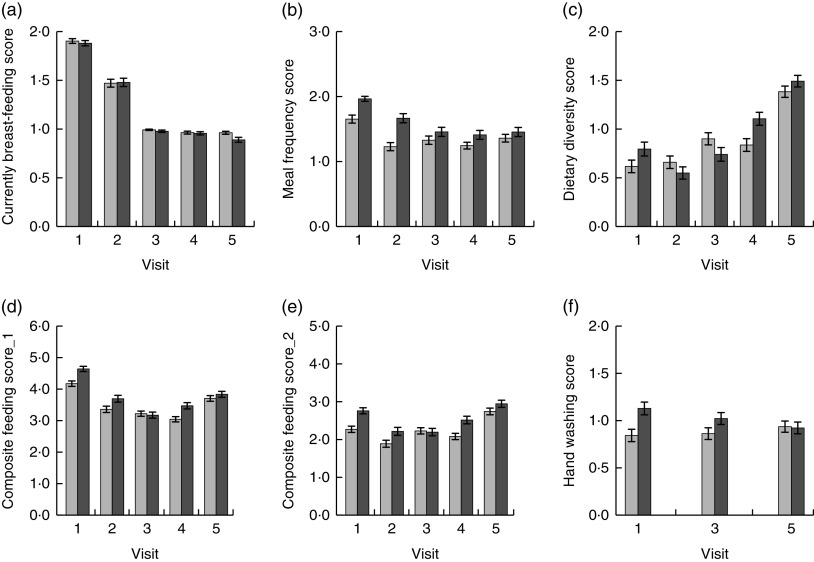
Results: A total of 1199 mothers, 629 in the control and 570 in the intervention areas, were assessed at all visits and included in the analysis. Mothers in the intervention area showed higher scores than those in the control area regarding meal frequency (difference: 1·04, 95 % CI 0·35, 1·73), composite feeding score_1 (difference: 1·25, 95 % CI 0·37, 2·13; a summing score of currently breast-feeding, meal frequency and dietary diversity) and composite feeding score_2 (difference: 1·40, 95 % CI 0·49, 2·32; a summing score of meal frequency and dietary diversity). However, there were no differences in the scores of breast-feeding, dietary diversity and hand washing between the two areas (all P>0·05).
Conclusions: The CPNP programme was effective in improving some child feeding behaviours in rural Eastern Ethiopia.
Keywords: Community-based participatory nutrition promotion; Composite feeding scores; Effectiveness evaluation; Ethiopia; Infant and young child feeding.
Figures
 ) and intervention area (
 ), Habro and Melka Bello districts, Ethiopia (2012–2014). Values are unadjusted means with their 95 % confidence intervals represented by vertical bars for: (a) currently breast-feeding score; (b) meal frequency score; (c) dietary diversity score; (d) composite feeding score_1 (score_1); (e) composite feeding score_2 (score_2); and (f) hand washing score. n 1199 for (a), (b), (c), (d) and (e); n 1350 for (f). Score_1 was constructed based on scores of breast-feeding, dietary diversity and meal frequency; score_2 was based on scores of dietary diversity and meal frequency
References
-
- UNICEF/World Health Organization/World Bank Group (2016) Levels and Trends in Child Malnutrition: UNICEF/WHO/World Bank Group Joint Child Malnutrition Estimates, Key Findings of the 2016 Edition. New York, Geneva and Washington, DC: UNICEF, WHO and World Bank.
-
- Bhutta ZA, Das JK, Rizvi A et al.. (2013) Evidence-based interventions for improvement of maternal and child nutrition: what can be done and at what cost? Lancet 382, 452–477. - PubMed
-
- Central Statistical Agency (2014) Ethiopia Mini Demographic and Health Survey 2014. Addis Ababa: Ethiopian Central Statistical Agency.
-
- UNICEF (2013) Improving Child Nutrition: The Achievable Imperative for Global Progress. New York: UNICEF.
Publication types
MeSH terms
LinkOut - more resources
Full Text Sources
Other Literature Sources
Medical
