. 2016 Dec 27;12(12):e1006066.
doi: 10.1371/journal.ppat.1006066. eCollection 2016 Dec.

Non-human Primate Schlafen11 Inhibits Production of Both Host and Viral Proteins

Affiliations

Non-human Primate Schlafen11 Inhibits Production of Both Host and Viral Proteins

Alex C Stabell et al. PLoS Pathog. .

Abstract

Schlafen11 (encoded by the SLFN11 gene) has been shown to inhibit the accumulation of HIV-1 proteins. We show that the SLFN11 gene is under positive selection in simian primates and is species-specific in its activity against HIV-1. The activity of human Schlafen11 is relatively weak compared to that of some other primate versions of this protein, with the versions encoded by chimpanzee, orangutan, gibbon, and marmoset being particularly potent inhibitors of HIV-1 protein production. Interestingly, we find that Schlafen11 is functional in the absence of infection and reduces protein production from certain non-viral (GFP) and even host (Vinculin and GAPDH) transcripts. This suggests that Schlafen11 may just generally block protein production from non-codon optimized transcripts. Because Schlafen11 is an interferon-stimulated gene with a broad ability to inhibit protein production from many host and viral transcripts, its role may be to create a general antiviral state in the cell. Interestingly, the strong inhibitors such as marmoset Schlafen11 consistently block protein production better than weak primate Schlafen11 proteins, regardless of the virus or host target being analyzed. Further, we show that the residues to which species-specific differences in Schlafen11 potency map are distinct from residues that have been targeted by positive selection. We speculate that the positive selection of SLFN11 could have been driven by a number of different factors, including interaction with one or more viral antagonists that have yet to be identified.


Conflict of interest statement

The authors have declared that no competing interests exist.

Figures
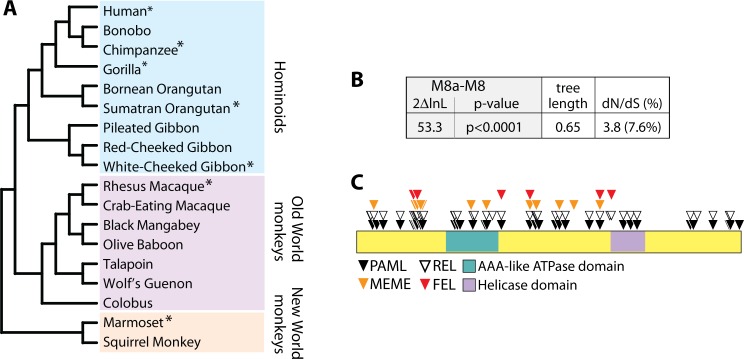
Fig 1
Fig 1. The SLFN11 gene has evolved under positive selection in primates.
(A) A phylogeny of the primate SLFN11 gene sequences used in this analysis. Sequences obtained from online databases are indicated with asterisks, the others were generated in this study. (B) Table summarizing the likelihood ratio test between the M8 and M8a models in PAML. The 2ΔlnL value (twice the difference in the natural log of the likelihoods) for M8 versus M8a is shown, along with the p-value with which the neutral model M8a is rejected in favor of the model of positive selection. The tree length of the SLFN11 gene alignment was 0.65, and 7.6% of codons were assigned a dN/dS = 3.8. PAML analysis was repeated using different codon models (f61, 3x4) and different ω0 seed values, and in all cases results converged. (C) Residues corresponding to codons with dN/dS > 1 are indicated on a schematic of the Schlafen11 protein.
Fig 2
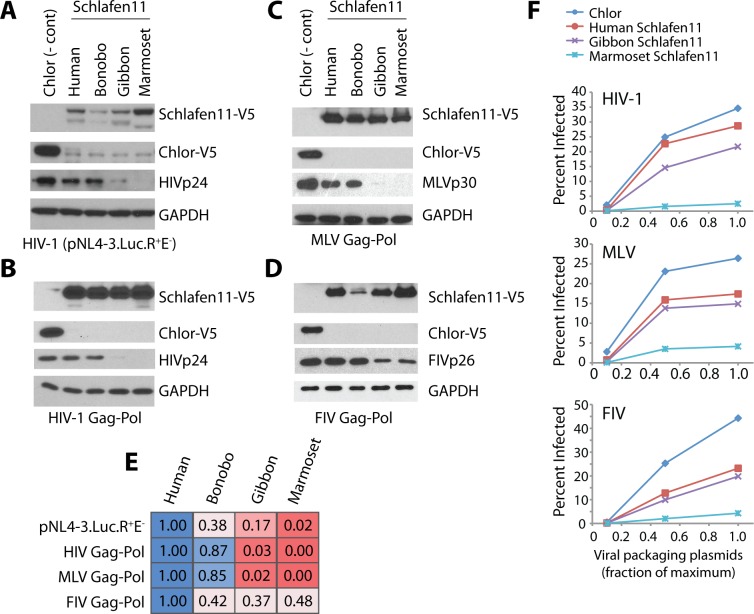
Fig 2. Primate versions of Schlafen11 differentially inhibit retroviral protein production.
Plasmids encoding Schlafen11-V5 from the indicated primate species, or a V5-tagged chloramphenichol acetyltransferase (Chlor) gene as a negative control, were co-transfected into 293T cells along with plasmids encoding (A) a nearly full-length HIV clone (pNL4-3.Luc.R+E-), (B) HIV-1 Gag-Pol-RRE and HIV-1 Rev, (C) MLV Gag-Pol, (D) FIV Gag-Pol. Immunoblotting was used to monitor protein production of chloramphenichol acetyltransferase (Chlor-V5), Schlafen11-V5, GAPDH, and viral proteins. Panels A-D are representative blots from 3 or more experimental replicates. (E) Bands from panels A-D were quantified to show the relative effect of each Schlafen11 homolog. Each experiment was normalized to human Schlafen11. As increasing Schlafen11 activity as seen, the color of the box changes linearly along the blue to red color spectrum (see materials and methods for quantification procedure). (F) Viruses were packaged in 293T cells in the presence or absence of Schlafen11. Increasing amounts of the plasmids necessary for virus packaging were co-transfected along with a constant amount of plasmid expressing human, gibbon, or marmoset Schlafen11 (or Chlor as a negative control). The resulting virions were then used to infect 2.5x10⁵ 293T cells and the percentage of infected cells was scored by flow cytometry (GFP+). These data are representative of two independent experiments. Herein, “Chlor” is used as an abbreviation instead of the standard “CAT,” since the latter is also the name of another mammal and could therefore cause confusion.
Fig 3
Fig 3. Schlafen11 reduces protein production from non-viral transcripts.
(A) Schlafen11 or Chlor (negative control) expressing plasmids were cotransfected into 293T cells along with plasmids expressing either a V5-tagged GFP or myc-tagged eGFP. Total protein was harvested 48 hours post transfection and probed for the indicated proteins. The blot is representative of 3 independent experiments. (B) Either GFP or eGFP (untagged) expressing plasmids were cotransfected along with plasmids encoding Schlafen11 as in (A). 48 hours post transfection, flow cytometric analysis was performed to measure the mean fluorescence intensity (MFI) of the GFP signal. All values reported are relative the the Chlor control. Error bars are standard error from 3 independent experiments.
Fig 4
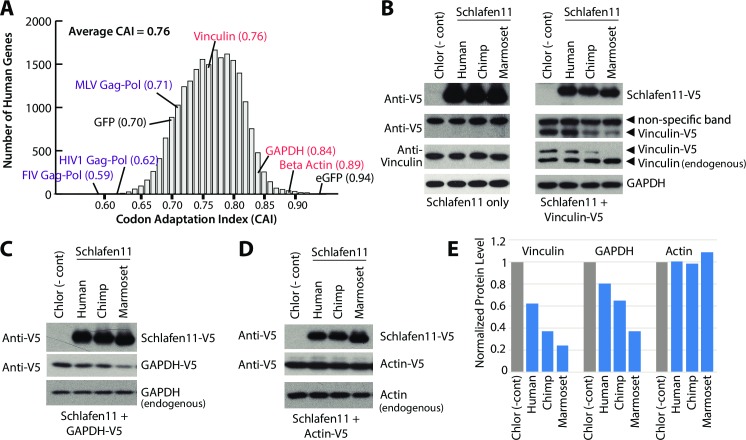
Fig 4. Schlafen11 inhibits production of human proteins.
(A) Codon adaptation index (CAI) is plotted for all human genes, and for select other genes (viral and GFP/eGFP) used in this study. Human genes analyzed in this study are indicated in red, viral genes in purple. (B,C,D) Plasmids encoding the indicated Schlafen11-V5 proteins, or Chlor, were cotransfected into 293T cells (B) with or without a Vinculin-V5 expressing plasmid, (C) with a GAPDH-V5 expressing plasmid, or (D) with an Actin-V5 expressing plasmid. Cell lysates were subject to immunoblotting as indicated. Blots are representative from two independent experiments. (E) Quantification of the V5-tagged proteins detected in panels B-D. All bands are normalized to the quantification of endogenous GAPDH.
Fig 5
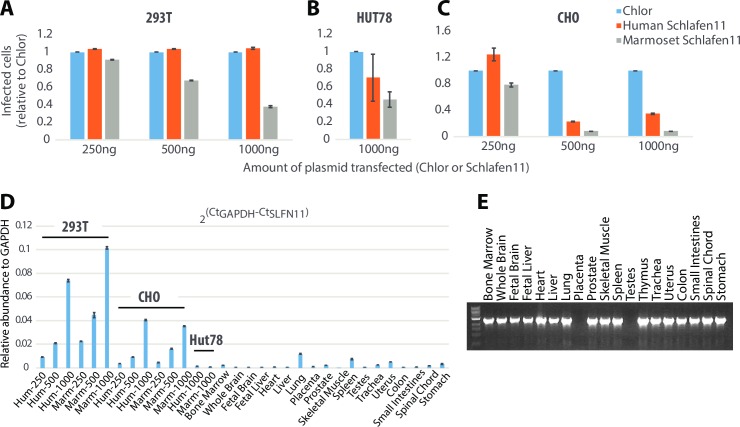
Fig 5. Schlafen11 is expressed in various human tissues and is active at physiologically-relevant levels.
(A) 293T cells were cotransfected with viral packaging plasmids required to create VSV G-pseudotyped MLV along with increasing amounts of pcDNA6.2 encoding the indicated Schlafen11 or Chlor. Pseudotyped MLV produced was measured on 293T cells and the relative amount of virus production (standardized to Chlor) was determined. (B) Identical to (A), except performed in HUT78 cells (a T-cell line). Only the results from 1000ng is shown as other experiments did not yield replicable results. (C) Identical to (A), except performed in Chinese Hamster Ovary (CHO) cells. (D) Quantitative PCR was used to measure SLFN11 expression levels in cDNA from transfection conditions in panels A-C, and from a set of human tissues. Error bars represent the standard error of three independent replicate experiments. (E) SLFN11 was amplified by non-quantitative PCR from a cDNA panel representing the human tissues indicated.
Fig 6
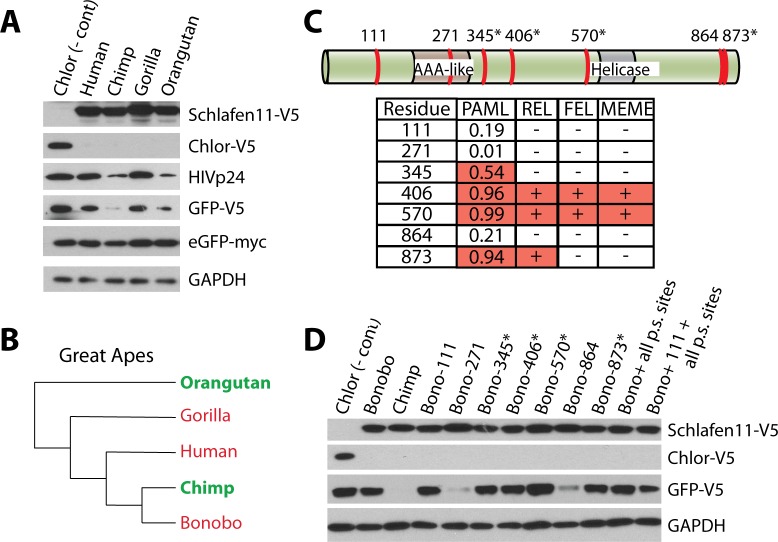
Fig 6. Sites under positive selection do not govern species-specific differences in activity of Schlafen11.
(A) Plasmids encoding HIV-Gag-Pol, HIV-Rev, GFP, and eGFP were cotransfected into 293T cells along with a plasmid encoding the indicated great ape Schlafen11, or Chlor as a negative control. Cell lysates were subject to immunoblotting. (B) A phylogeny of the great apes is shown, with the activity of the Schlafen11 of each species indicated. Those in green have strong ability to suppress protein production when expressed in human cells, while those in red are weaker. (C) The seven amino acid positions that differ between chimpanzee and bonobo Schlafen11 are illustrated on a protein schematic (see S3 Fig for an alignment). Asterisks indicate sites under positive selection. The table shows the posterior probability of each site being under positive selection (PAML), as well as which sites were determined to be under positive selection by the other three tests. We liberally included position 345 in this group because it was detected in our PAML analysis with a posterior probability of >0.5, providing only weak support for selection (i.e. there is a 54% chance that this codon was correctly assigned to the dN/dS > 1 site class by PAML). (D) Site directed mutagenesis was performed on bonobo Schlafen11 at the indicated sites, changing them to the amino acids encoded by chimpanzee Schlafen11. Plasmids encoding wild-type or mutant Schlafen11, or chloramphenicol acetyltransferase (Chlor) as a negative control, were cotransfected into 293T cells along with a plasmid encoding GFP. Cell lysates were subject to immunoblotting. “p.s. sites” refers to positively selected sites and, in these two clones, all positions under positive selection were simultaneously changed in bonobo Schafen11 to the residues encoded in chimpanzee Schlafen11. The blots in panels A and D are representative of two independent experiments.

References

    1. Nichol ST, Arikawa J, Kawaoka Y. Emerging viral diseases. Proc Natl Acad Sci USA. 2000;97: 12411–12412. 10.1073/pnas.210382297 - DOI - PMC - PubMed
    1. Harris RS, Hultquist JF, Evans DT. The Restriction Factors of Human Immunodeficiency Virus. Journal of Biological Chemistry. 2012;287: 40875–40883. 10.1074/jbc.R112.416925 - DOI - PMC - PubMed
    1. Stremlau M, Owens CM, Perron MJ, Kiessling M, Autissier P, Sodroski J. The cytoplasmic body component TRIM5alpha restricts HIV-1 infection in Old World monkeys. Nature. 2004;427: 848–853. 10.1038/nature02343 - DOI - PubMed
    1. Mangeat B, Turelli P, Caron G, Friedli M, Perrin L, Trono D. Broad antiretroviral defence by human APOBEC3G through lethal editing of nascent reverse transcripts. Nature. 2003;424: 99–103. 10.1038/nature01709 - DOI - PubMed
    1. Zhang H, Yang B, Pomerantz RJ, Zhang C, Arunachalam SC, Gao L. The cytidine deaminase CEM15 induces hypermutation in newly synthesized HIV-1 DNA. Nature. 2003;424: 94–98. 10.1038/nature01707 - DOI - PMC - PubMed

MeSH terms