


Haemophilus ducreyi Cutaneous Ulcer Strains Diverged from Both Class I and Class II Genital Ulcer Strains: Implications for Epidemiological Studies
- PMID: 28027326
- PMCID: PMC5222509
- DOI: 10.1371/journal.pntd.0005259
Haemophilus ducreyi Cutaneous Ulcer Strains Diverged from Both Class I and Class II Genital Ulcer Strains: Implications for Epidemiological Studies
Abstract
Background: Haemophilus ducreyi has emerged as a major cause of cutaneous ulcers (CU) in yaws-endemic regions of the tropics in the South Pacific, South East Asia and Africa. H. ducreyi was once thought only to cause the genital ulcer (GU) disease chancroid; GU strains belong to 2 distinct classes, class I and class II. Using whole-genome sequencing of 4 CU strains from Samoa, 1 from Vanuatu and 1 from Papua New Guinea, we showed that CU strains diverged from the class I strain 35000HP and that one CU strain expressed β-lactamase. Recently, the Center for Disease Control and Prevention released the genomes of 11 additional CU strains from Vanuatu and Ghana; however, the evolutionary relationship of these CU strains to previously-characterized CU and GU strains is unknown.
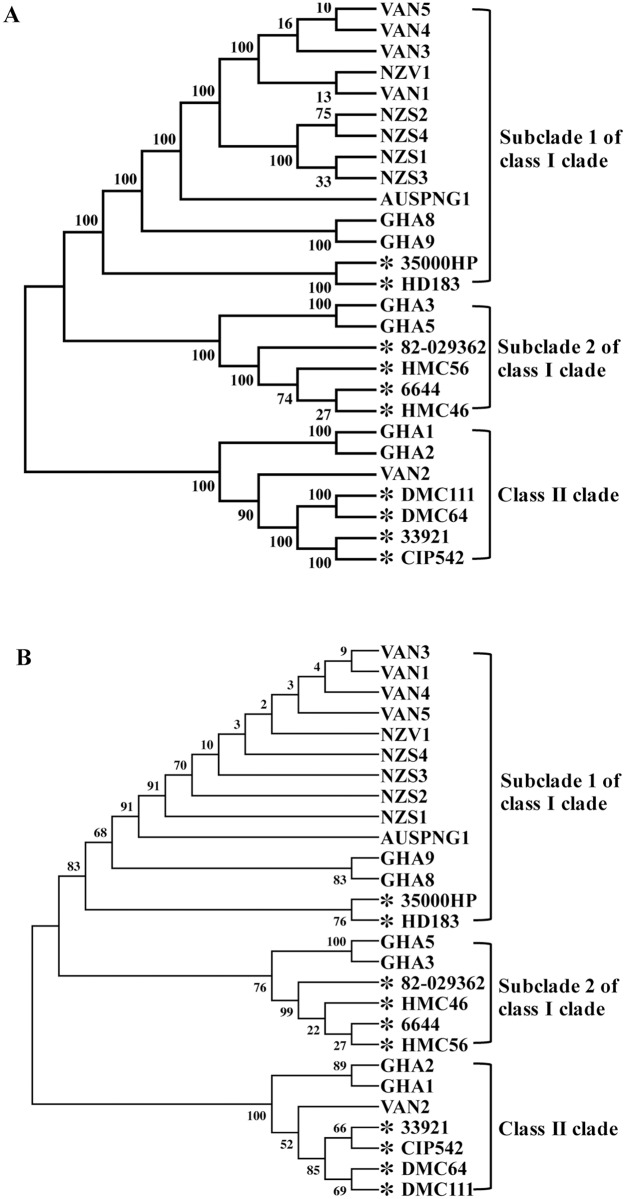
Methodology/principal findings: We performed phylogenetic analysis of 17 CU and 10 GU strains. Class I and class II GU strains formed two distinct clades. The class I strains formed two subclades, one containing 35000HP and HD183 and the other containing the remainder of the class I strains. Twelve of the CU strains formed a subclone under the class I 35000HP subclade, while 2 CU strains formed a subclone under the other class I subclade. Unexpectedly, 3 of the CU strains formed a subclone under the class II clade. Phylogenetic analysis of dsrA-hgbA-ncaA sequences yielded a tree similar to that of whole-genome phylogenetic tree.
Conclusions/significance: CU strains diverged from multiple lineages within both class I and class II GU strains. Multilocus sequence typing of dsrA-hgbA-ncaA could be reliably used for epidemiological investigation of CU and GU strains. As class II strains grow relatively poorly and are relatively more susceptible to vancomycin than class I strains, these findings have implications for methods to recover CU strains. Comparison of contemporary CU and GU isolates would help clarify the relationship between these entities.
Conflict of interest statement
The authors have declared that no competing interests exist.
Figures
References
-
- Scheffler NK, Falick AM, Hall SC, Ray WC, Post DM, Munson RS Jr., et al. Proteome of Haemophilus ducreyi by 2-D SDS-page and mass spectrometry: strain variation, virulence, and carbohydrate expression. J Proteome Res. 2003;2:523–33. - PubMed
MeSH terms
Grants and funding
LinkOut - more resources
Full Text Sources
Other Literature Sources
Research Materials
