Association of State Recreational Marijuana Laws With Adolescent Marijuana Use
- PMID: 28027345
- PMCID: PMC5365078
- DOI: 10.1001/jamapediatrics.2016.3624
Association of State Recreational Marijuana Laws With Adolescent Marijuana Use
Abstract
Importance: Historical shifts are occurring in marijuana policy. The effect of legalizing marijuana for recreational use on rates of adolescent marijuana use is a topic of considerable debate.
Objective: To examine the association between the legalization of recreational marijuana use in Washington and Colorado in 2012 and the subsequent perceived harmfulness and use of marijuana by adolescents.
Design, setting, and participants: We used data of 253 902 students in eighth, 10th, and 12th grades from 2010 to 2015 from Monitoring the Future, a national, annual, cross-sectional survey of students in secondary schools in the contiguous United States. Difference-in-difference estimates compared changes in perceived harmfulness of marijuana use and in past-month marijuana use in Washington and Colorado prior to recreational marijuana legalization (2010-2012) with postlegalization (2013-2015) vs the contemporaneous trends in other states that did not legalize recreational marijuana use in this period.
Main outcomes and measures: Perceived harmfulness of marijuana use (great or moderate risk to health from smoking marijuana occasionally) and marijuana use (past 30 days).
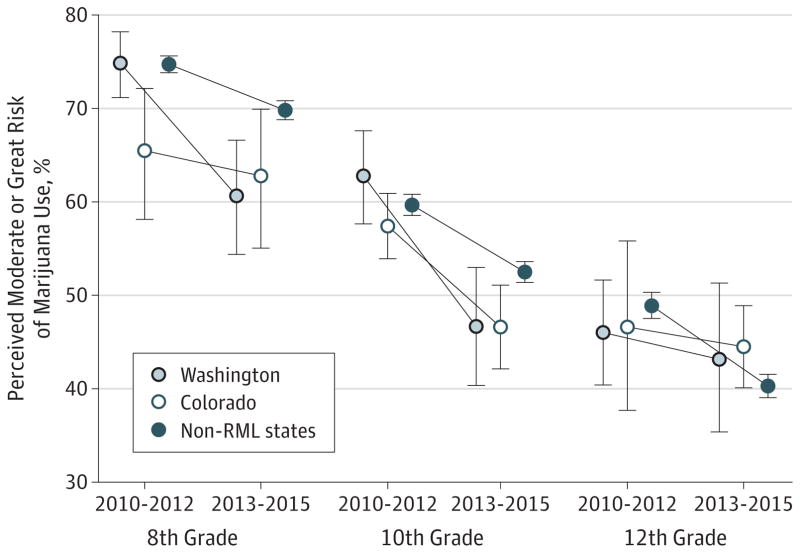
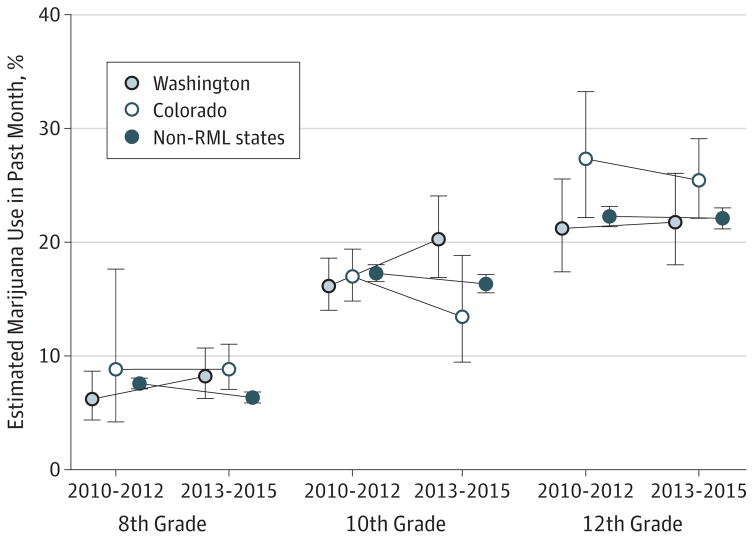
Results: Of the 253 902 participants, 120 590 of 245 065(49.2%) were male, and the mean (SD) age was 15.6 (1.7) years. In Washington, perceived harmfulness declined 14.2% and 16.1% among eighth and 10th graders, respectively, while marijuana use increased 2.0% and 4.1% from 2010-2012 to 2013-2015. In contrast, among states that did not legalize recreational marijuana use, perceived harmfulness decreased by 4.9% and 7.2% among eighth and 10th graders, respectively, and marijuana use decreased by 1.3% and 0.9% over the same period. Difference-in-difference estimates comparing Washington vs states that did not legalize recreational drug use indicated that these differences were significant for perceived harmfulness (eighth graders: % [SD], -9.3 [3.5]; P = .01; 10th graders: % [SD], -9.0 [3.8]; P = .02) and marijuana use (eighth graders: % [SD], 5.0 [1.9]; P = .03; 10th graders: % [SD], 3.2 [1.5]; P = .007). No significant differences were found in perceived harmfulness or marijuana use among 12th graders in Washington or for any of the 3 grades in Colorado.
Conclusions and relevance: Among eighth and 10th graders in Washington, perceived harmfulness of marijuana use decreased and marijuana use increased following legalization of recreational marijuana use. In contrast, Colorado did not exhibit any differential change in perceived harmfulness or past-month adolescent marijuana use following legalization. A cautious interpretation of the findings suggests investment in evidence-based adolescent substance use prevention programs in any additional states that may legalize recreational marijuana use.
Conflict of interest statement
Figures
Comment in
-
Has Marijuana Legalization Increased Marijuana Use Among US Youth?JAMA Pediatr. 2017 Feb 1;171(2):116-118. doi: 10.1001/jamapediatrics.2016.3917. JAMA Pediatr. 2017. PMID: 28027335 No abstract available.
-
Understanding the Full Effect of the Changing Legal Status of Marijuana on Youth: Getting It Right.JAMA Pediatr. 2017 Feb 1;171(2):115-116. doi: 10.1001/jamapediatrics.2016.3920. JAMA Pediatr. 2017. PMID: 28027336 No abstract available.
References
-
- Center for Behavioral Health Statistics and Quality. Results From the 2012 National Survey on Drug Use and Health: Summary of National Findings. Rockville, MD: Substance Abuse and Mental Health Services Administration; 2013. [Accessed April 1, 2016]. http://www.samhsa.gov/data/sites/default/files/NSDUHresults2012/NSDUHres....
-
- Jones JM Gallup. [Accessed April 19, 2016];US, 58%back legal marijuana use. http://www.gallup.com/poll/186260/back-legal-marijuana.aspx.
-
- NORML. [Accessed November 29, 2016];Medical marijuana. http://norml.org/legal/medical-marijuana-2.
-
- NORML. [Accessed August 25, 2016];Election 2016: marijuana ballot results. http://norml.org/election-2016.
-
- Hall W, Lynskey M. The challenges in developing a rational cannabis policy. Curr Opin Psychiatry. 2009;22(3):258–262. - PubMed
Publication types
MeSH terms
Grants and funding
LinkOut - more resources
Full Text Sources
Other Literature Sources
Medical
Miscellaneous