. 2017 May;28(5):1642-1650.
doi: 10.1681/ASN.2016060644. Epub 2016 Dec 27.

HLA-DRB1*15:01 and HLA-DRB3*02:02 in PLA2R-Related Membranous Nephropathy

Affiliations

HLA-DRB1*15:01 and HLA-DRB3*02:02 in PLA2R-Related Membranous Nephropathy

Wei-Bo Le et al. J Am Soc Nephrol. 2017 May.

Abstract

Idiopathic membranous nephropathy (MN) is associated with HLA; however, the HLA allele involved remains unknown. To identify the HLA risk alleles associated with phospholipase A2 receptor (PLA2R)-related MN in the Chinese population, we sequenced the entire MHC region in DNA samples from 99 patients with PLA2R-related MN, 50 patients with PLA2R-unrelated MN, and 100 healthy subjects. Two HLA risk alleles, HLA-DRB1*15:01 and HLA-DRB3*02:02, independently and strongly associated with an increased risk of PLA2R-related MN. After adjusting for HLA-DRB1*15:01 and HLA-DRB3*02:02, no other alleles showed significant association with PLA2R-related MN. A replication study in an independent cohort of 293 participants with PLA2R-related MN and 285 healthy controls validated these findings. In a joint analysis, a multivariate logistic regression model confirmed that HLA-DRB1*15:01 (odds ratio [OR], 24.9; 95% confidence interval [95% CI], 15.3 to 42.6; P=2.3×10⁻³⁵) and HLA-DRB3*02:02 (OR, 17.7; 95% CI, 11.0 to 30.3; P=8.0×10⁻²⁹) independently and strongly associated with PLA2R-related MN. As many as 98.7% of patients with PLA2R-related MN, compared with 43.9% of control subjects, carried at least one HLA risk allele. Subjects with either risk allele had higher odds of developing PLA2R-related MN than those without a risk allele (OR, 98.9; 95% CI, 44.4 to 281.7; P=2.5×10⁻²³). These HLA risk alleles also associated with the age at disease onset in patients with PLA2R-related MN. In conclusion, our findings provide clear evidence that the HLA-DRB1*15:01 and HLA-DRB3*02:02 alleles independently and strongly associate with PLA2R-related MN in the Chinese population.

Keywords: HLA Typing; Target sequencing; autoimmune disease; human leukocyte antigen; membranous nephropathy.


Figures

Figure 1.
Figure 1.
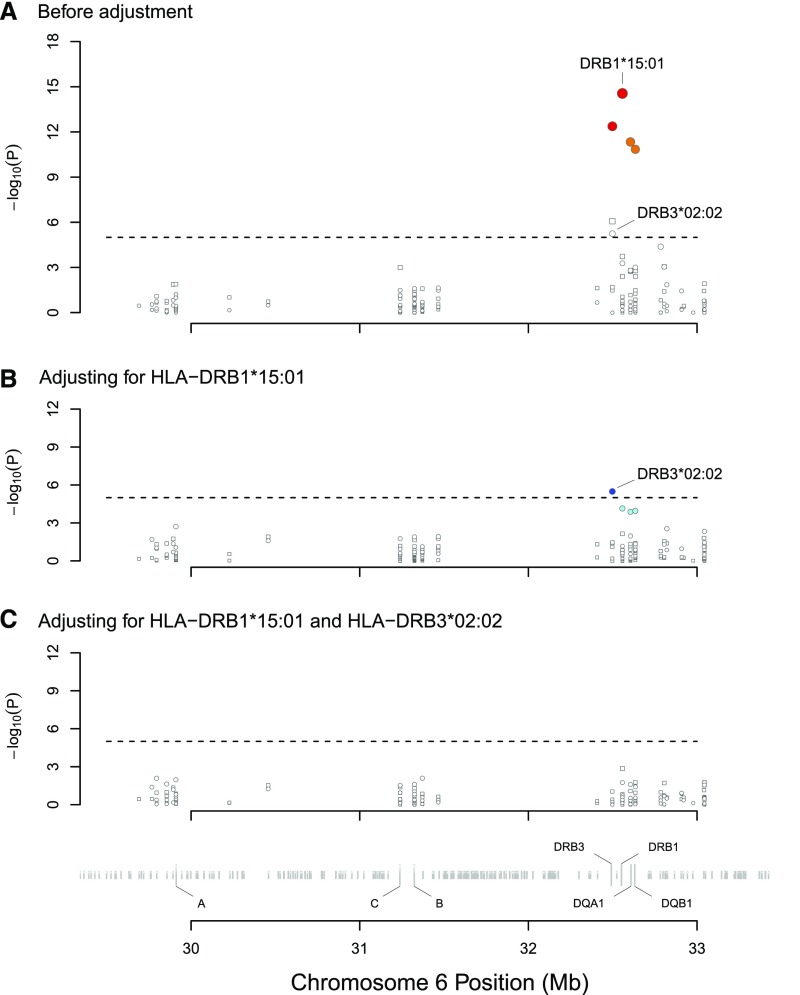
Association tests between all HLA alleles and PLA2R-related MN in the discovery dataset. Circles denote alleles with an OR>1, whereas squares denote alleles with an OR≤1. (A) shows that the significant signals (P<1×10⁻⁵) were aggregated in the HLA class 2 region; no significant signals were found in the HLA class 1 region. HLA-DRB1*15:01 (OR, 16.9; 95% CI, 8.4 to 34.2; P=2.7×10⁻¹⁵) showed the strongest signal. Colors denote the strength of the LD of the alleles compared with HLA-DRB1*15:01. Red denotes an R2 value of 0.8 or more, orange denotes an R2 value of 0.5 to <0.8, and white denotes an R2 value of <0.25. Three alleles that were tightly linked to HLA-DRB1*15:01 (DRB5*01:01, DQA*01:02, and DQB1*06:02) also showed significant associations. The HLA-DRB3*02:02 (OR, 4.0; 95% CI, 2.2 to 7.2; P=5.7×10⁻⁶) was also significantly associated with PLA2R-related MN. (B) shows the association plot after adjusting for HLA-DRB1*15:01. The allele HLA-DRB3*02:02 maintained its independent significant association. Colors denote the strength of the LD of the alleles compared with HLA-DRB3*02:02. Blue denotes an R2 value of 0.8 or more, cyan denotes an R2 value of 0.25 to <0.5, and white denotes an R2 value of <0.25. (C) shows that none of the other alleles were independently associated with the disease after adjusting for HLA-DRB1*15:01 and HLA-DRB3*02:02.
Figure 2.
Figure 2.
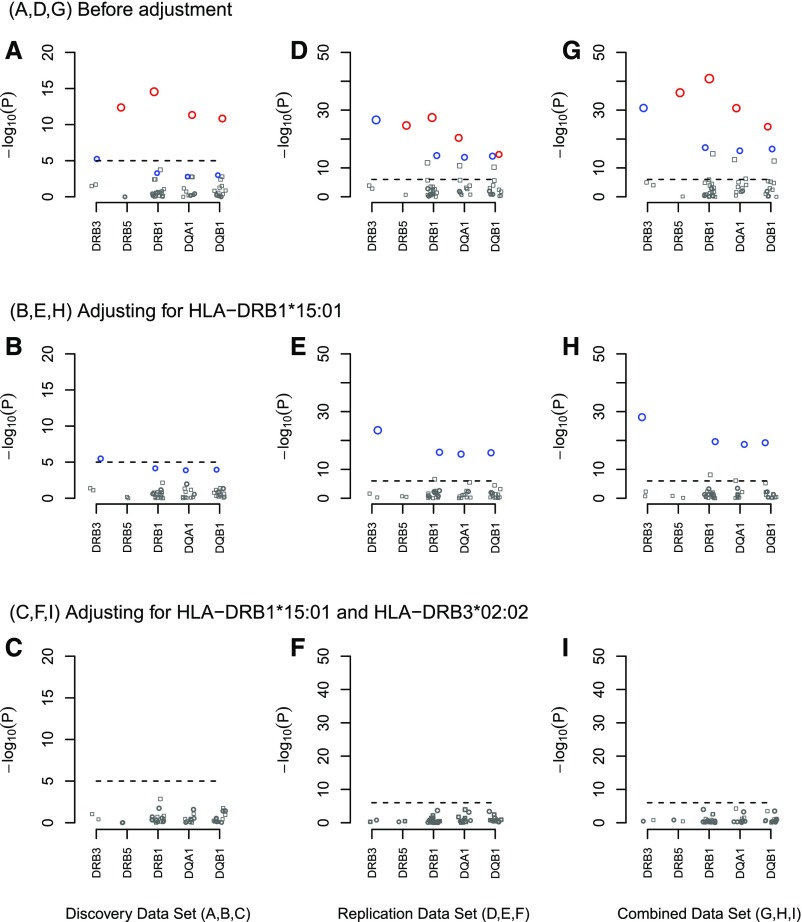
Association tests for the five most significant HLA genes in PLA2R-related MN. Circles denote alleles with an OR>1, whereas squares denote alleles with an OR≤1. Red circles denote the HLA-DRB1*15:01 allele and its linked alleles, and blue circles denote the HLA-DRB3*02:02 allele and its linked alleles. (A–C) highlight the five most significant HLA genes in the discovery study as shown in Figure 1. (D–F) show the independent replication analysis of the five selected HLA genes. (G–I) show the combined analysis. (B, E, and H) After adjusting for HLA-DRB1*15:01, the effects of the HLA-DRB1*15:01–linked HLA alleles were eliminated, whereas the effects of the HLA-DRB3*02:02 allele and its linked HLA alleles remained significant. (C, F, and I) After adjusting for both HLA-DRB1*15:01 and HLA-DRB3*02:02, we found that none of the alleles were associated with PLA2R-related MN.
Figure 3.
Figure 3.
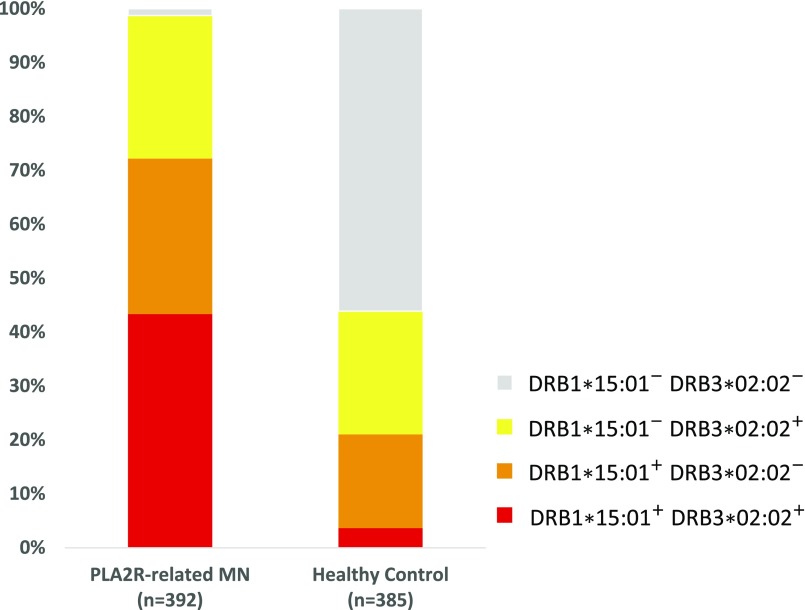
Distribution of the two HLA risk alleles in patients with PLA2R-related MN and healthy controls. As many as 98.7% of patients with PLA2R-related MN carried at least one HLA risk allele compared with 43.9% of healthy controls. Of the 392 patients with PLA2R-related MN, 283 patients (72.2%) carried the HLA-DRB1*15:01 allele, 274 patients (69.9%) carried the HLA-DRB3*02:02 allele, 387 patients (98.7%) carried at least one of the two HLA risk alleles, and only five patients (1.7%) carried neither of the HLA risk alleles. Of the 385 healthy controls, 81 individuals (21.0%) carried HLA-DRB1*15:01, 102 individuals (26.5%) carried HLA-DRB3*02:02, 169 individuals (43.8%) carried at least one of the two HLA risk alleles, and 216 individuals (56.1%) carried neither of the HLA risk alleles.

Comment in

References

    1. Debiec H, Ronco P: PLA2R autoantibodies and PLA2R glomerular deposits in membranous nephropathy. N Engl J Med 364: 689–690, 2011 - PubMed
    1. Qin W, Beck LH Jr., Zeng C, Chen Z, Li S, Zuo K, Salant DJ, Liu Z: Anti-phospholipase A2 receptor antibody in membranous nephropathy. J Am Soc Nephrol 22: 1137–1143, 2011 - PMC - PubMed
    1. Ronco P, Debiec H: Pathogenesis of membranous nephropathy: Recent advances and future challenges. Nat Rev Nephrol 8: 203–213, 2012 - PubMed
    1. Sollid LM, Pos W, Wucherpfennig KW: Molecular mechanisms for contribution of MHC molecules to autoimmune diseases. Curr Opin Immunol 31: 24–30, 2014 - PMC - PubMed
    1. Salant DJ: Genetic variants in membranous nephropathy: Perhaps a perfect storm rather than a straightforward conformeropathy? J Am Soc Nephrol 24: 525–528, 2013 - PubMed

LinkOut - more resources