. 2017 Jan 10;114(2):E255-E264.
doi: 10.1073/pnas.1611064114. Epub 2016 Dec 27.

Impact of mosquito gene drive on malaria elimination in a computational model with explicit spatial and temporal dynamics

Affiliations

Impact of mosquito gene drive on malaria elimination in a computational model with explicit spatial and temporal dynamics

Philip A Eckhoff et al. Proc Natl Acad Sci U S A. .

Abstract

The renewed effort to eliminate malaria and permanently remove its tremendous burden highlights questions of what combination of tools would be sufficient in various settings and what new tools need to be developed. Gene drive mosquitoes constitute a promising set of tools, with multiple different possible approaches including population replacement with introduced genes limiting malaria transmission, driving-Y chromosomes to collapse a mosquito population, and gene drive disrupting a fertility gene and thereby achieving population suppression or collapse. Each of these approaches has had recent success and advances under laboratory conditions, raising the urgency for understanding how each could be deployed in the real world and the potential impacts of each. New analyses are needed as existing models of gene drive primarily focus on nonseasonal or nonspatial dynamics. We use a mechanistic, spatially explicit, stochastic, individual-based mathematical model to simulate each gene drive approach in a variety of sub-Saharan African settings. Each approach exhibits a broad region of gene construct parameter space with successful elimination of malaria transmission due to the targeted vector species. The introduction of realistic seasonality in vector population dynamics facilitates gene drive success compared with nonseasonal analyses. Spatial simulations illustrate constraints on release timing, frequency, and spatial density in the most challenging settings for construct success. Within its parameter space for success, each gene drive approach provides a tool for malaria elimination unlike anything presently available. Provided potential barriers to success are surmounted, each achieves high efficacy at reducing transmission potential and lower delivery requirements in logistically challenged settings.

Keywords: Anopheles; elimination; gene drive; malaria; mosquitoes.


Conflict of interest statement

The authors declare no conflict of interest.

Figures
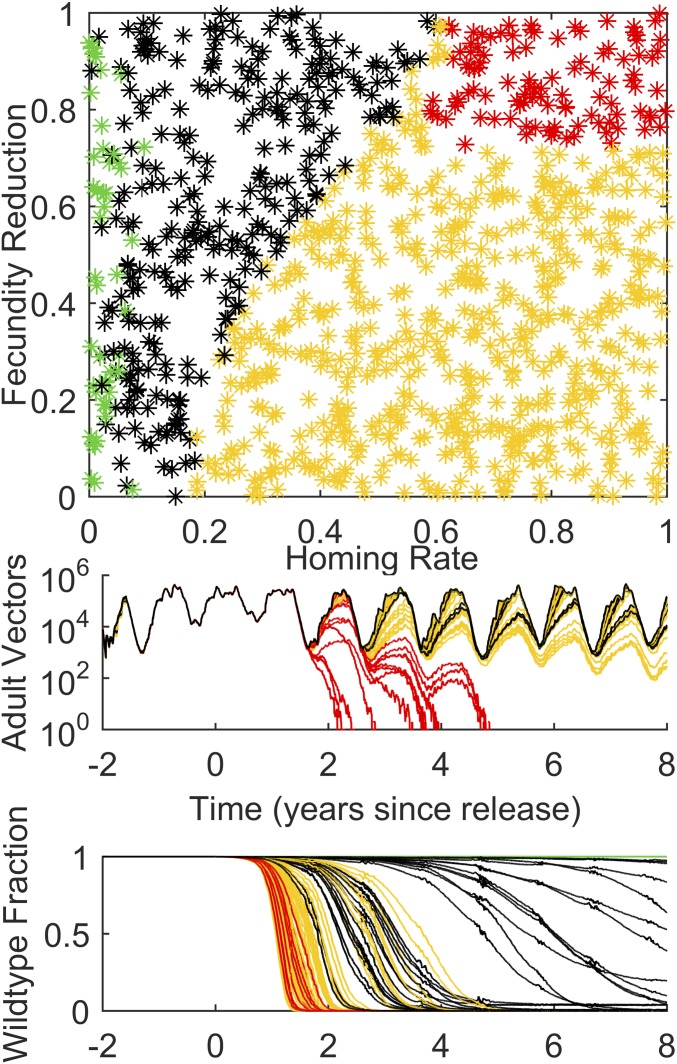
Fig. 1.
Fig. 1.
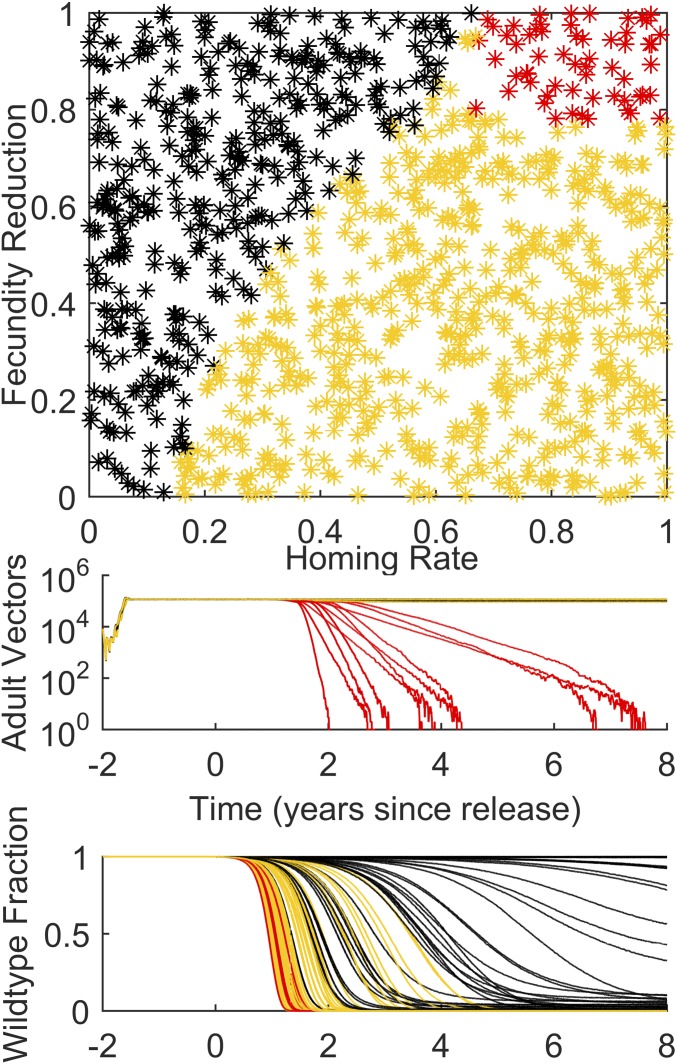
(Top) Introduction of a dual-germline homing gene drive construct as simulated for Namawala, Tanzania, in the 1990s, varying homing rate versus fecundity reduction. Red indicates collapse of the vector population; yellow, the absence of wild-type mosquitoes but the persistence of the population for at least 8 y after release; green, the disappearance of the gene drive construct; and black, the copresence of both wild type and introduced construct after 8 y. (Middle) One hundred trajectories for adult vector population randomly selected from the 1,000 points in the top panel, with matching color scheme. (Bottom) Corresponding 100 trajectories for fraction of mosquitoes that are wild type for the adult vector population traces plotted above.
Fig. 2.
Fig. 2.
The simulations of Fig. 1 repeated for constant weather to show the effect of nonseasonal dynamics on the fate of the gene drive construct.
Fig. 3.
Fig. 3.
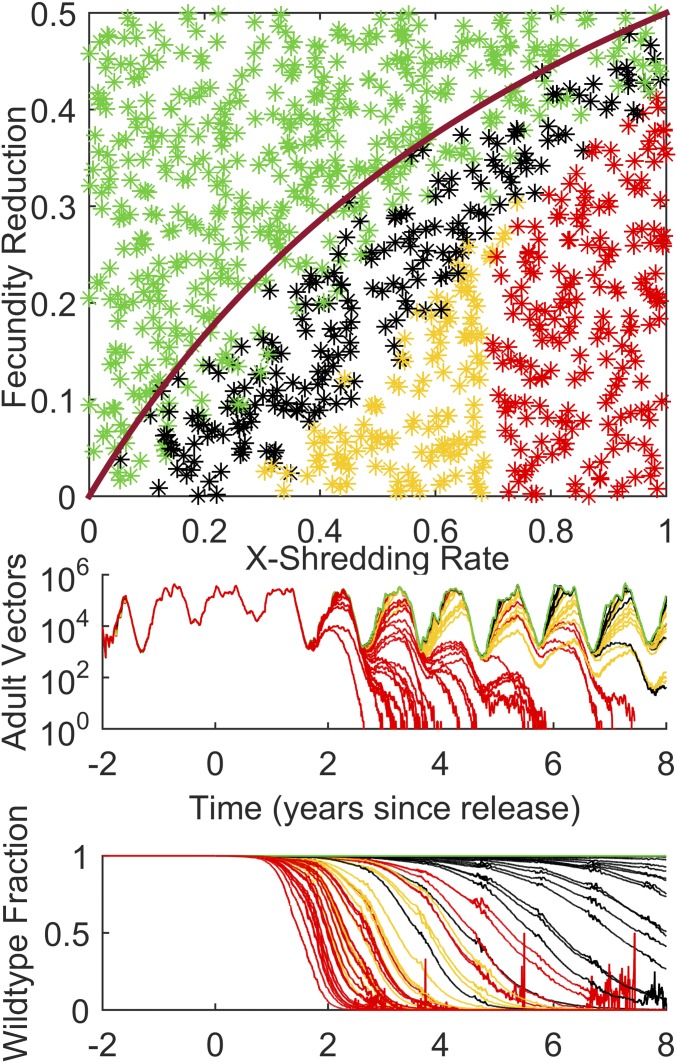
(Top) The fate of an introduced driving-Y chromosome and local vector population for Namawala, Tanzania, varying X-shredding rate versus fecundity reduction. Color scheme same as Fig. 1. (Middle) One hundred trajectories for adult vector population randomly selected from the 1,000 points in the top panel. (Bottom) Trajectories of fraction of mosquitoes that are wild type for the adult vector population traces above. The magenta curve represents the analytical limit for driving-Y success.
Fig. 4.
Fig. 4.
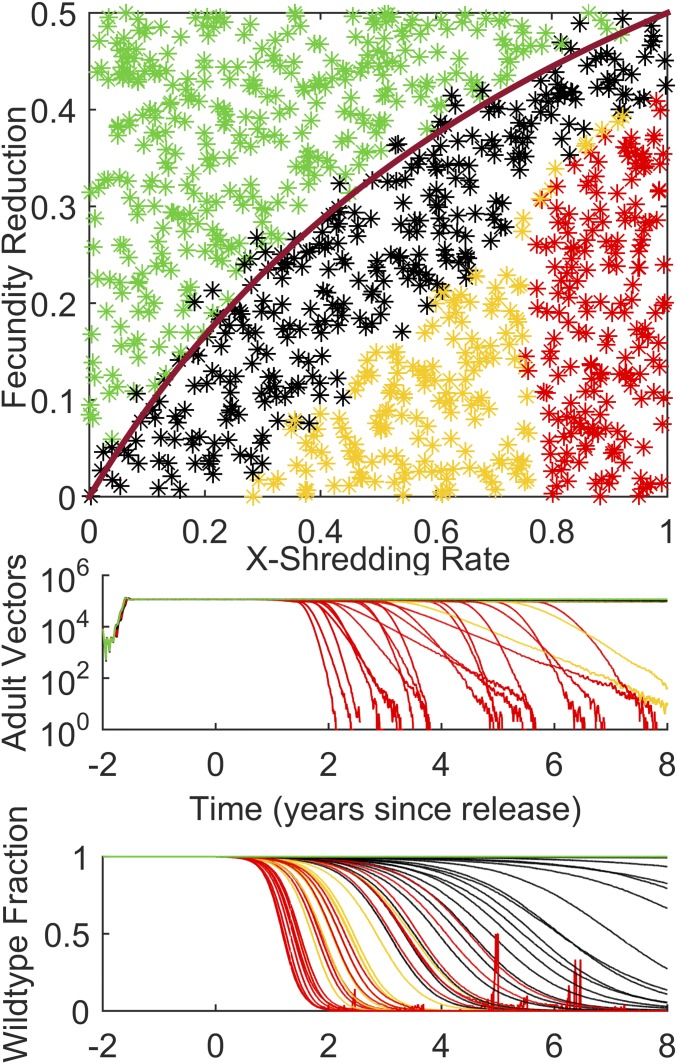
The simulations of Fig. 2 repeated for constant weather to show the effect of nonseasonal dynamics on the driving-Y construct and the local vector population.
Fig. 5.
Fig. 5.
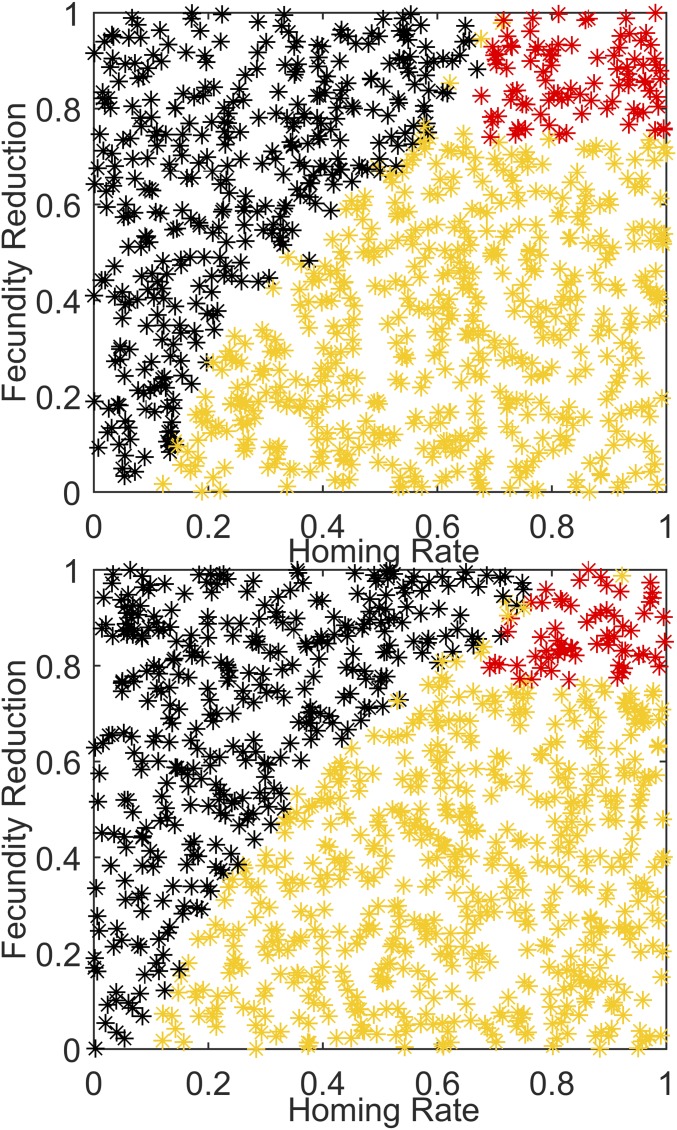
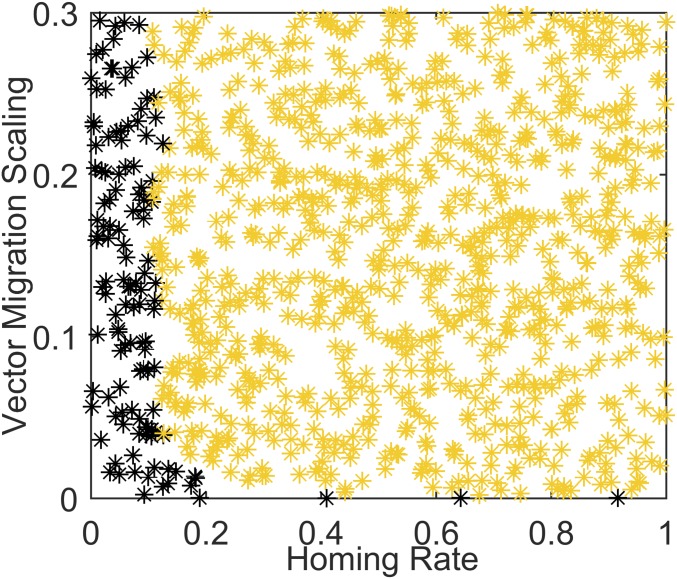
(Top) The fate of introduced dual-germline homing gene drive construct as simulated for the spatially explicit Garki District, Nigeria, with 1 × 1-km resolution, varying homing rate versus fecundity reduction, with a larval habitat scaling of 1, vector migration rate of 0.15, and constant habitat component of 0.5. Color scheme as before. (Bottom) The simulations of the top panel resimulated with nonseasonal dynamics.
Fig. 6.
Fig. 6.
Introducing a dual-germline gene drive construct with no fecundity reduction into the Garki District simulation with full seasonality to model population replacement approaches. Larval habitat scaling is set to 1.0, vector migration rate to 0.15, and constant habitat component of 0.5.
Fig. 7.
Fig. 7.
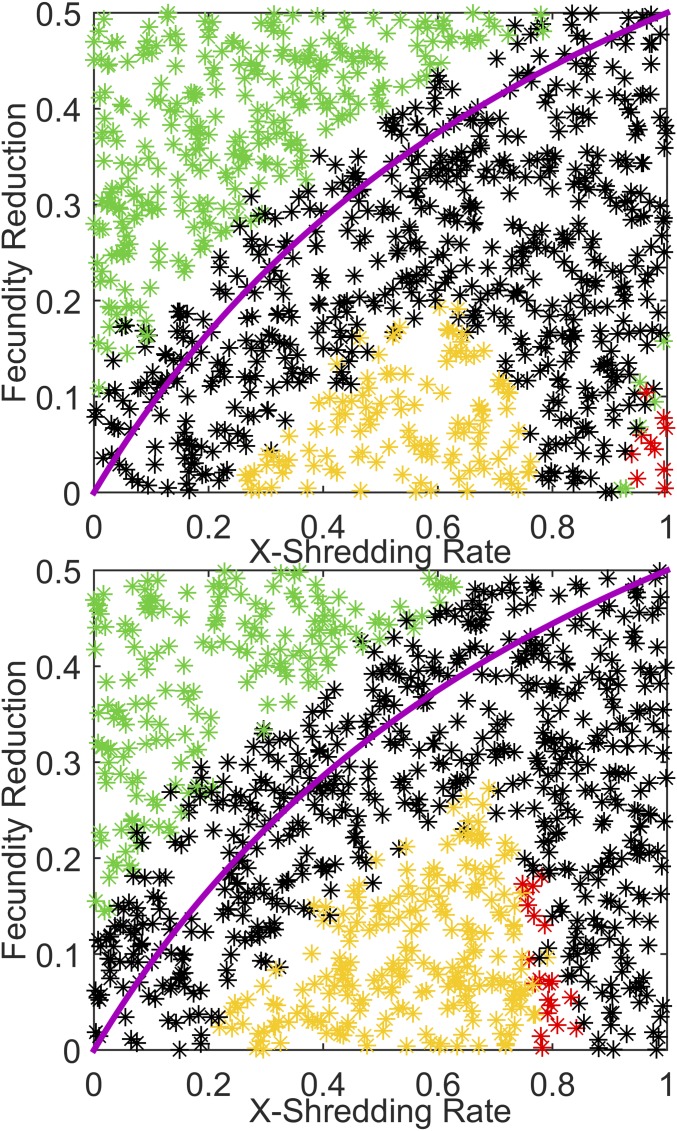
Driving-Y chromosome introduced into spatially explicit Garki District simulation, releasing 500 driving-Y male mosquitoes from each of 15 release sites every week for 1 y. (Top) Varying X-shredding rate versus fecundity reduction for a larval habitat scaling of 1.0, with full seasonality. (Bottom) Repeating the simulations of the top panel with constant weather.
Fig. 8.
Fig. 8.
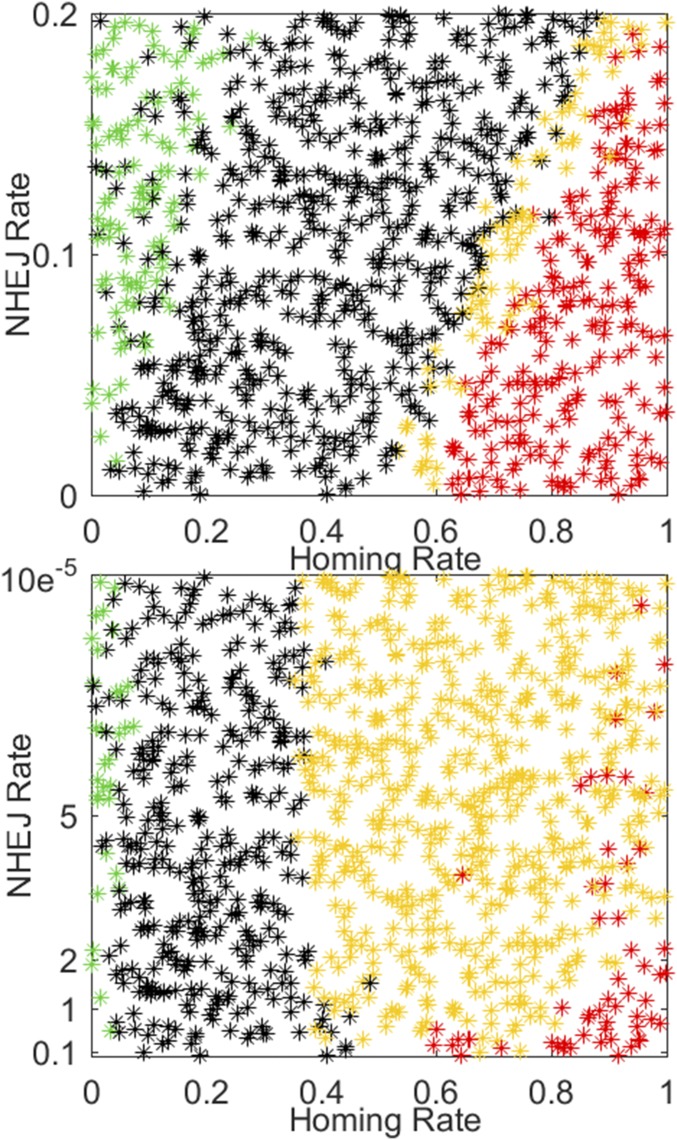
(Top) The experiments of Fig. 1 repeated with fecundity reduction of 0.8 but now allowing NHEJ for the case of the NHEJ allele having the same reduced fecundity as the gene drive construct. (Bottom) The pessimistic case of the NHEJ allele having wild-type fecundity.

References

    1. World Health Organization . World Malaria Report 2014. World Health Organization; Geneva: 2014.
    1. Bhatt S, et al. The effect of malaria control on Plasmodium falciparum in Africa between 2000 and 2015. Nature. 2015;526(7572):207–211. - PMC - PubMed
    1. Lengeler C. Insecticide-treated nets for malaria control: Real gains. Bull World Health Organ. 2004;82(2):84. - PMC - PubMed
    1. Moonen B, et al. Making the decision. In: Feachem RGA, et al., editors. Shrinking the Malaria Map: A Prospectus on Malaria Elimination. The Global Health Group: UCSF Global Health Sciences; San Francisco: 2009. pp. 1–18.
    1. Alphey L, et al. Malaria control with genetically manipulated insect vectors. Science. 2002;298(5591):119–121. - PubMed

Publication types