


The mangled extremity score and amputation: Time for a revision
- PMID: 28030489
- PMCID: PMC5321791
- DOI: 10.1097/TA.0000000000001339
The mangled extremity score and amputation: Time for a revision
Abstract
Background: The Mangled Extremity Severity Score (MESS) was developed 25 years ago in an attempt to use the extent of skeletal and soft tissue injury, limb ischemia, shock, and age to predict the need for amputation after extremity injury. Subsequently, there have been mixed reviews as to the use of this score. We hypothesized that the MESS, when applied to a data set collected prospectively in modern times, would not correlate with the need for amputation.
Methods: We applied the MESS to patient data collected in the American Association for the Surgery of Trauma PROspective Vascular Injury Treatment registry. This registry contains prospectively collected demographic, diagnostic, treatment, and outcome data.
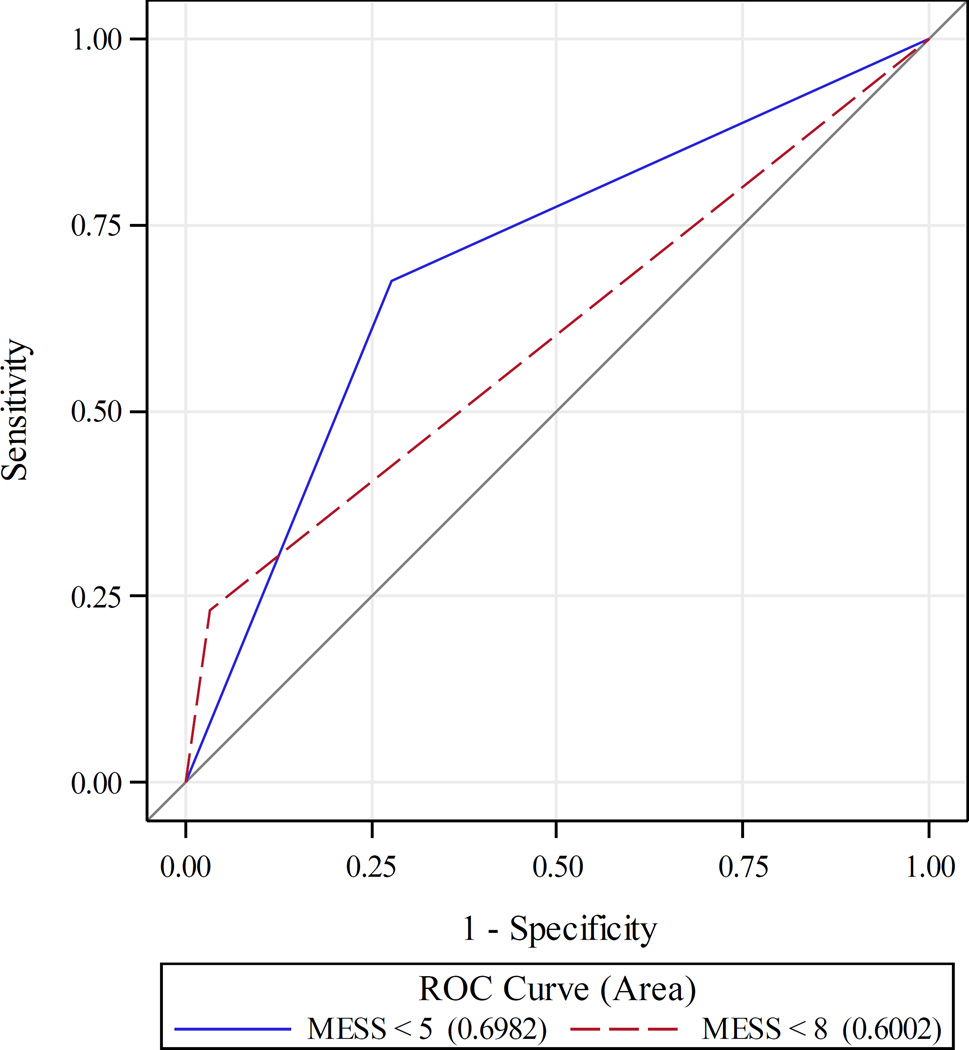
Results: Between 2013 and 2015, 230 patients with lower extremity arterial injuries were entered into the PROspective Vascular Injury Treatment registry. Most were male with a mean age of 34 years (range, 4-92 years) and a blunt mechanism of injury at a rate of 47.4%. A MESS of 8 or greater was associated with a longer stay in the hospital (median, 22.5 (15, 29) vs 12 (6, 21); p = 0.006) and intensive care unit (median, 6 (2, 13) vs 3 (1, 6); p = 0.03). Of the patients' limbs, 81.3% were ultimately salvaged (median MESS, 4 (3, 5)), and 18.7% required primary or secondary amputation (median MESS, 6 (4, 8); p < 0.001). However, after controlling for confounding variables including mechanism of injury, degree of arterial injury, injury severity score, arterial location, and concomitant injuries, the MESS between salvaged and amputated limbs was no longer significantly different. Importantly, a MESS of 8 predicted in-hospital amputation in only 43.2% of patients.
Conclusion: Therapeutic advances in the treatment of vascular, orthopedic, neurologic, and soft tissue injuries have reduced the diagnostic accuracy of the MESS in predicting the need for amputation. There remains a significant need to examine additional predictors of amputation following severe extremity injury.
Level of evidence: Prospective, prognostic study, level III.
Conflict of interest statement
Figures
References
-
- Scalea TM, DuBose J, Moore EE, West M, Moore FA, McIntyre R, Cocanour C, Davis J, Ochsner MG, Feliciano D. Western Trauma Association critical decisions in trauma: management of the mangled extremity. J Trauma Acute Care Surg. 2012;72(1):86–93. - PubMed
-
- Johansen K, Daines M, Howey T, Helfet D, Hansen ST., Jr. Objective criteria accurately predict amputation following lower extremity trauma. J Trauma. 1990;30(5):568–672. discussion 72-3. - PubMed
-
- DuBose JJ, Savage SA, Fabian TC, Menaker J, Scalea T, Holcomb JB, Skarupa D, Poulin N, Chourliaras K, Inaba K, et al. The American Association for the Surgery of Trauma PROspective Observational Vascular Injury Treatment (PROOVIT) registry: multicenter data on modern vascular injury diagnosis, management, and outcomes. J Trauma Acute Care Surg. 2015;78(2):215–222. discussion 22-3. - PubMed
-
- Aarabi S, Kavousi Y, Friedrich J, Singh N, Bulger E. Severe Lower Extremity Injury: MESS (Mangled Extremity Severity Score) Twenty-Five Years Later. J Trauma Acute Care Surg. 2016 in press.
-
- Howe HR, Jr, Poole GV, Jr, Hansen KJ, Clark T, Plonk GW, Koman LA, Pennell TC. Salvage of lower extremities following combined orthopedic and vascular trauma. A predictive salvage index. Am Surg. 1987;53(4):205–208. - PubMed
Publication types
MeSH terms
Grants and funding
LinkOut - more resources
Full Text Sources
Other Literature Sources
Medical
Research Materials
