


Comment
doi: 10.15252/embj.201696072.
Epub 2016 Dec 28.
Global snapshots of bacterial RNA networks
Affiliations
- PMID: 28031253
- PMCID: PMC5286387
- DOI: 10.15252/embj.201696072
Item in Clipboard
Comment
Global snapshots of bacterial RNA networks
EMBO J.
.
Abstract
While bacteria were long thought to rely primarily on transcriptional control, it is now well established that they also use numerous small
Figures
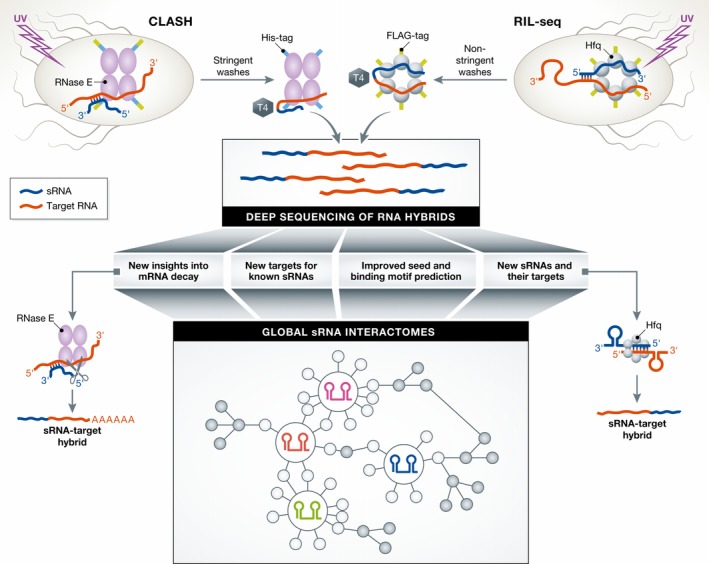
CLASH: Following in vivo cross‐linking, RNase E is pulled down using a FLAG‐tag, the bound RNA is trimmed, and the complex is purified under denaturing conditions using a His‐tag. Hybrid RNAs are created by ligation of the interacting RNAs with T4 ligase. RIL‐seq: In vivo cross‐linked Hfq is pulled down using a FLAG‐tag, followed by RNA trimming and ligation of the interacting RNAs with T4 ligase. Subsequently, the resulting hybrid RNAs of either protocol are sequenced, allowing in silico analysis of sRNA–target interactions. Bottom left: CLASH reveals new insights into mRNA decay. After binding 3′ of the sRNA–mRNA seed region, RNase E cleaves the mRNA, an oligo(A) stretch is added to the 3′ end, which finally allows decay by 3′ exonucleases. Bottom right: RIL‐seq reveals new sRNAs along with their targets. Bottom middle: Sequencing of RNA hybrids reveals global sRNA interactomes. sRNAs (colored) directly interact with targets (white nodes), which then interact with further targets (gray nodes).
Comment on
-
Global Mapping of Small RNA-Target Interactions in Bacteria.Mol Cell. 2016 Sep 1;63(5):884-97. doi: 10.1016/j.molcel.2016.07.026. Mol Cell. 2016. PMID: 27588604 Free PMC article.
-
Small RNA interactome of pathogenic E. coli revealed through crosslinking of RNase E.EMBO J. 2017 Feb 1;36(3):374-387. doi: 10.15252/embj.201694639. Epub 2016 Nov 11. EMBO J. 2017. PMID: 27836995 Free PMC article.
References
Publication types
MeSH terms
Substances
LinkOut - more resources
Full Text Sources
Other Literature Sources
