


Unexpected high prevalence of resistance-associated Rv0678 variants in MDR-TB patients without documented prior use of clofazimine or bedaquiline
- PMID: 28031270
- PMCID: PMC5400087
- DOI: 10.1093/jac/dkw502
Unexpected high prevalence of resistance-associated Rv0678 variants in MDR-TB patients without documented prior use of clofazimine or bedaquiline
Abstract
Objectives: Resistance-associated variants (RAVs) in Rv0678 , a regulator of the MmpS5-MmpL5 efflux pump, have been shown to lead to increased MICs of bedaquiline (2- to 8- fold) and clofazimine (2- to 4-fold). The prevalence of these Rv0678 RAVs in clinical isolates and their impact on treatment outcomes are important factors to take into account in bedaquiline treatment guidelines.
Methods: Baseline isolates from two bedaquiline MDR-TB clinical trials were sequenced for Rv0678 RAVs and corresponding bedaquiline MICs were determined on 7H11 agar. Rv0678 RAVs were also investigated in non-MDR-TB sequences of a population-based cohort.
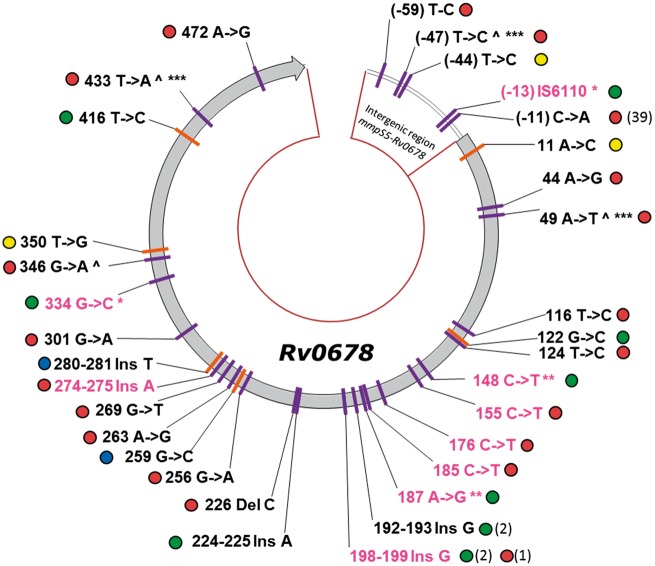
Results: Rv0678 RAVs were identified in 23/347 (6.3%) of MDR-TB baseline isolates. Surprisingly, bedaquiline MICs for these isolates were high (> 0.24 mg/L, n = 8), normal (0.03-0.24 mg/L, n = 11) or low (< 0.03 mg/L, n = 4). A variant at position -11 in the intergenic region mmpS5 - Rv0678 was identified in 39 isolates (11.3%) and appeared to increase the susceptibility to bedaquiline. In non-MDR-TB isolates, the frequency of Rv0678 RAVs was lower (6/852 or 0.7%). Competition experiments suggested that rifampicin was not the drug selecting for Rv0678 RAVs.
Conclusions: RAVs in Rv0678 occur more frequently in MDR-TB patients than previously anticipated, are not associated with prior use of bedaquiline or clofazimine, and in the majority of cases do not lead to bedaquiline MICs above the provisional breakpoint (0.24 mg/L). Their origin remains unknown. Given the variety of RAVs in Rv0678 and their variable effects on the MIC, only phenotypic drug-susceptibility methods can currently be used to assess bedaquiline susceptibility.
© The Author 2016. Published by Oxford University Press on behalf of the British Society for Antimicrobial Chemotherapy.
Figures
References
-
- Andries K, Verhasselt P, Guillemont J. et al. A diarylquinoline drug active on the ATP synthase of Mycobacterium tuberculosis. Science 2005; 307: 223–7. - PubMed
Publication types
MeSH terms
Substances
LinkOut - more resources
Full Text Sources
Other Literature Sources
Molecular Biology Databases
