Review
. 2015 Dec 23;2(1):FSO74.
doi: 10.4155/fso.15.74. eCollection 2016 Mar.

Opportunities in low-level radiocarbon microtracing: applications and new technology

Affiliations
Review

Opportunities in low-level radiocarbon microtracing: applications and new technology

Le Thuy Vuong et al. Future Sci OA. .

Abstract

14C-radiolabeled (radiocarbon) drug studies are central to defining the disposition of therapeutics in clinical development. Concerns over radiation, however, have dissuaded investigators from conducting these studies as often as their utility may merit. Accelerator mass spectrometry (AMS), originally designed for carbon dating and geochronology, has changed the outlook for in-human radiolabeled testing. The high sensitivity of AMS affords human clinical testing with vastly reduced radiative (microtracing) and chemical exposures (microdosing). Early iterations of AMS were unsuitable for routine biomedical use due to the instruments' large size and associated per sample costs. The situation is changing with advances in the core and peripheral instrumentation. We review the important milestones in applied AMS research and recent advances in the core technology platform. We also look ahead to an entirely new class of 14C detection systems that use lasers to measure carbon dioxide in small gas cells.

Keywords: AMS; accelerator mass spectrometry; cavity ring-down spectroscopy; microdosing; microtracing; pediatrics; radiocarbon.


Conflict of interest statement

Financial & competing interests disclosure The authors have no relevant affiliations or financial involvement with any organization or entity with a financial interest in or financial conflict with the subject matter or materials discussed in the manuscript. This includes employment, consultancies, honoraria, stock ownership or options, expert testimony, grants or patents received or pending, or royalties. No writing assistance was utilized in the production of this manuscript.

Figures
<b>Figure 1.</b>
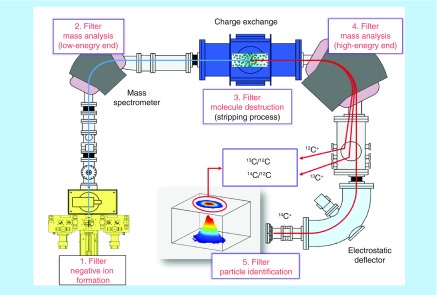
Figure 1.. A schematic of the 200 keV ‘MICADAS’ accelerator mass spectrometry developed at ETH Zürich (footprint: 2.5 × 3 m).
Core concepts of 14C-accelerator mass spectrometry are summarized: negative ion production to eliminate the atomic isobar, low-energy mass filtering, high-energy collisions to eliminate molecular isobars, high-energy dipole mass spectrometry resolution of carbon isotopes to 1 amu, particle identification of 14C after electrostatic sector filtering. Ion beams of 12C and 13C are measured in off-axes Faraday cups.
<b>Figure 2.</b>
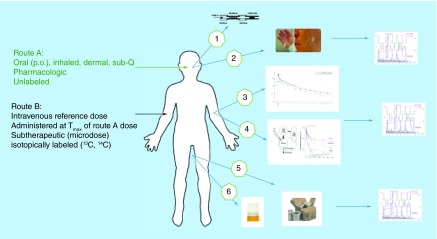
Figure 2.. Information-rich absolute bioavailability using an intravenous 14C-microdose.
The primary objective of conducting a microdose absolute bioavailability study is to obtain information on the absolute bioavailability and compound clearance. Other valuable information is available that can help complete the drug disposition picture. The total radioactivity in expired air, bile, plasma or whole blood, cell populations or small biopsies, feces and urine are all available for specific analyses without extensive, matrix-specific assay development. Small quantities of diluted or processed matrix can be profiled on chromatographic systems for metabolite profiling from any matrix. sub-Q: Subcutaneous.
<b>Figure 3.</b>
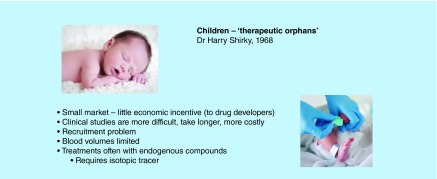
Figure 3.. Therapeutic orphans.
The pediatric community remains from several years to decades behind the adult population in terms of drug development. As a result, children are disproportionately treated with older, less modern drugs. Over 40 years ago, Shirkey recognized the dilemma of pediatric drug labeling, called therapeutic orphans, to capture its concept. There are many hurdles to overcome in conducting a pediatric versus an adult study. Available blood volumes for testing in particular are limiting. Accelerator mass spectrometry sensitivity allows accurate and precise determination of drug product in small microliter blood volumes [57].
<b>Figure 4.</b>
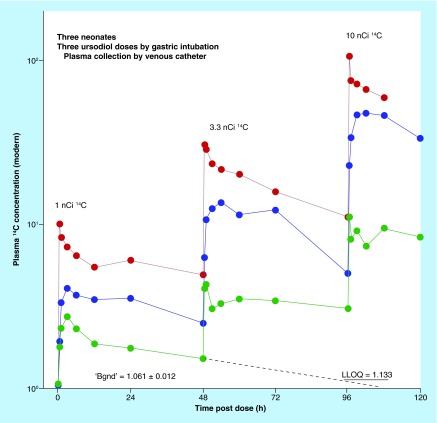
Figure 4.. Biokinetics of 14C-ursodiol microdoses in neonates.
The figure plots the 14C concentration in 25 μl samples of plasma from three neonates, each dosed at 1, 3.3 and 10 nanoCi of 14C-ursodiol with 48 h between doses. Background natural 14C was measured in an initial cohort of five subjects. The LLOQ was determined at six-times the standard deviation in the background measurement. This proof-of-concept study suggested that accelerator mass spectrometry techniques are applicable to the study of any medications prescribed to newborns.
<b>Figure 5.</b>
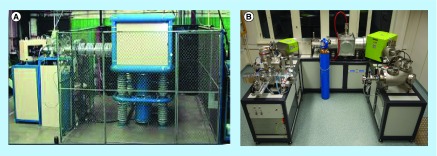
Figure 5.. Compact, low-maintenance accelerator mass spectrometry systems.
(A) The single stage open stack accelerator mass spectrometry (AMS) system unit from National Electrostatics Corporation is an air-insulated single stage accelerator that is simple in design. The instrument is robust and easy to maintain as it does not have any moving parts or pressurized insulating tank around the high-voltage section. The combination of simple design, excellent performance and reasonable price has resulted in 12 new National Electrostatics Corporation AMS installations as of 2013. (B) With dimensions of only 3.4 m × 2.6 m × 2 m, the pictured green MICADAS analyzing dating AMS system is the most compact commercially available 14C-AMS system. Fixed magnets are used in place of electromagnets, reducing the overall footprint and power consumption. In conjunction with the gas interface system, this AMS system performs fully automated gas measurements with an autosampler, an elemental analyzer or CO2 filled glass or quartz tubes (provided by ETH).
<b>Figure 6.</b>
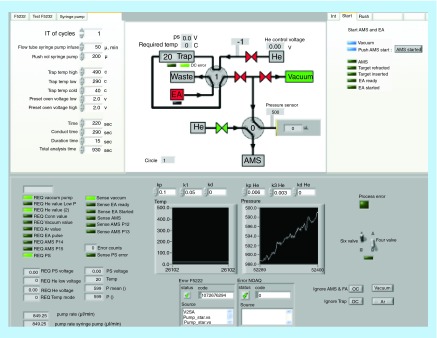
Figure 6.. Control module for the automated CO2 analyzing system.
The system omits sample preparation of total 14C determinations with self-directed analysis for up to 200 samples which is represented in the middle top panel. The hybrid ion source accepts both solid and gaseous samples. Small samples (<2 µl of plasma) are placed in tin foil cups, and the cups are placed in a carousel. The analyzer combusts the samples one by one and the generated oxidative gases are guided by the carrier gas (helium) to a trapping matrix (zeolite). The zeolite is desorbed using heating and passed to a syringe that precisely feeds the gas into the accelerator mass spectrometry ion source after mixing with helium gas to a precise ratio (courtesy of W Vaes).
<b>Figure 7.</b>
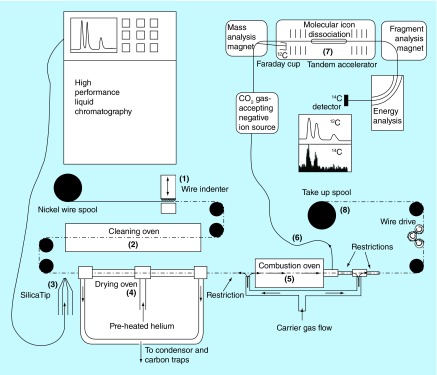
Figure 7.. Schematic layout of liquid chromatographic/accelerator mass spectrometry.
A wire indenter generates periodic indentations on the wire. Surface carbon is removed and the wire is oxidized at high temperature. A stream of effluent or a single droplet is placed on the wire. Solvent is evaporated at elevated temperature in an atmosphere of helium. Nonvolatile analyte is combusted at high temperature in a helium and oxygen atmosphere. The flow of gas through the combustion oven directs all combustion products to the gas-accepting ion source through a narrow i.d. fused silica capillary. Reused with permission from [78], © American Chemical Society (2015).
<b>Figure 8.</b>
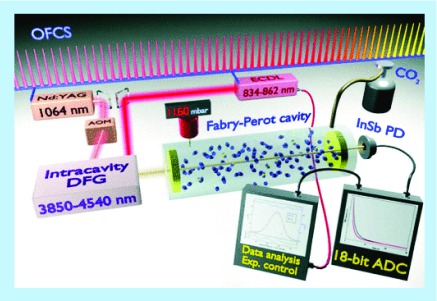
Figure 8.. Diagram of experimental setup of cavity ring-down system.
The basic components of a cavity ring-down spectroscopy system are a tunable laser source (infrared light region), a high-finesse optical cavity that bounces the light between highly reflective mirrors and a data acquisition system. 14C16O2 optical detection is based on molecular absorption spectroscopy saturated-absorption cavity ring-down (discussed above). An optical cavity filled with CO2 is illuminated with an intense laser tuned to excite the targeted rotovibrational transition of 14C16O2. When the laser is turned off, the radiant energy stored in the cavity ‘rings down’ or decreases over time. Within this ring down rate the absolute quantity of 14C16O2 is discerned. The prototype system has a footprint of 2 m2 and is expected to have a cost of less than a mass spectrometer. The currently described system requires large sample masses (68 mg carbon) and long acquisition times (hs) to achieve results similar to accelerator mass spectrometry. With further improvements, the infrared technique may well become the method of choice for measuring the isotope ratios of many common elements. ADC: ntibody–drug conjugate. Reproduced with permission from [81], © The American Physical Society.

References

    1. US FDA. Innovation/Stagnation: Challenge and Opportunity on the Critical Path to New Medical Product. US Department of Health and Human Services, Food and Drug Administration; MD, USA: 2004.
    1. Kamen M. Tracers. Sci. Am. 1949;180:40–40. - PubMed
    1. Vogel JS, Lohstroh P, Keck B, Dueker SR. Quantitative drug metabolism with accelerator mass spectrometry. In: Lee MS, Zhu M, editors. Mass Spectrometry in Drug Metabolism and Disposition. John Wiley & Sons, Inc; NJ, USA: 2011. pp. 525–566.
    1. Vogel JS, Turteltaub KW, Finkel R, Nelson DE. Accelerator mass spectrometry. Anal. Chem. 1995;67(11):A353–A359. - PubMed
    1. Lappin G, Garner RC. Big physics, small doses: the use of AMS and PET in human microdosing of development drugs. Nat. Rev. Drug Discov. 2003;2(3):233–240. - PubMed

LinkOut - more resources