


Prevalence of progressive supranuclear palsy in Yonago: change throughout a decade
- PMID: 28031995
- PMCID: PMC5166993
- DOI: 10.1002/brb3.557
Prevalence of progressive supranuclear palsy in Yonago: change throughout a decade
Abstract
Background: Progressive supranuclear palsy (PSP) is a neurodegenerative disorder that is sometimes confused with Parkinson's disease, multiple system atrophy, and other disorders. The typical clinical features are categorized as Richardson's syndrome (RS), but other clinical subtypes include PSP-parkinsonism (PSP-P) and PSP-pure akinesia with gait freezing (PSP-PAGF). In this study, we determined the prevalence of PSP in a Japanese rural area compared to our previous 1999 report.
Methods: We collected data in Yonago City from 2009 to 2014 using a service-based study of PSP. We collected case history data from PSP patients in the area from our hospital. The crude prevalence and 95% confidence interval (CI) were calculated using the population demographics on the prevalence day of 1 October 2010. Age- and sex-adjusted prevalence was calculated by direct standardization to the population demographics in Yonago City on the prevalence day of 1 April 1999.
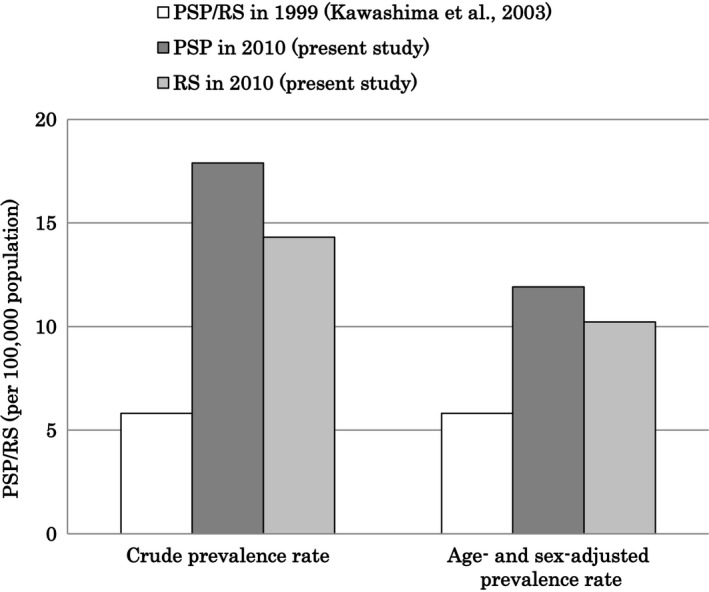
Material and results: We identified 25 patients: 16 with probable RS, 4 with possible RS, 3 with clinical PSP-P, and 2 with clinical PSP-PAGF. The prevalence per 100,000 was 17.90 (male = 18.05; female = 17.76). The prevalence of PSP in Yonago in 2010 increased compared to the measurements from 1999.
Conclusion: The prevalence of PSP in Japan increased from 1999 to 2010.
Keywords: PSP‐parkinsonism; PSP‐pure akinesia with gait freezing; Richardson's syndrome; epidemiology; tauopathy.
Figures
References
-
- dell'Aquila, C. , Zoccolella, S. , Cardinali, V. , de Mari, M. , Iliceto, G. , Tartaglione, B. , … Logroscino, G. (2013). Predictors of survival in a series of clinically diagnosed progressive supranuclear palsy patients. Parkinsonism & Related Disorders, 19, 980–985. - PubMed
-
- Braune, S. , Reinhardt, M. , Schnitzer, R. , Riedel, A. , & Lucking, C. H. (1999). Cardiac uptake of [123I]MIBG separates Parkinson's disease from multiple system atrophy. Neurology, 53, 1020–1025. - PubMed
-
- Burn, D. J. , & Lees, A. J. (2002). Progressive supranuclear palsy: Where are we now? The Lancet Neurology, 1, 359–369. - PubMed
-
- Chio, A. , Magnani, C. , & Schiffer, D. (1998). Prevalence of Parkinson's disease in Northwestern Italy: Comparison of tracer methodology and clinical ascertainment of cases. Movement Disorders, 13, 400–405. - PubMed
-
- Dickson, D. W. , Ahmed, Z. , Algom, A. A. , Tsuboi, Y. , & Josephs, K. A. (2010). Neuropathology of variants of progressive supranuclear palsy. Current Opinion in Neurology, 23, 394–400. - PubMed
Publication types
MeSH terms
LinkOut - more resources
Full Text Sources
Other Literature Sources
Medical
Miscellaneous
