


Determination of Pesticides Residues in Cucumbers Grown in Greenhouse and the Effect of Some Procedures on Their Residues
- PMID: 28032066
- PMCID: PMC5182257
Determination of Pesticides Residues in Cucumbers Grown in Greenhouse and the Effect of Some Procedures on Their Residues
Abstract
Background: The objective of this study was to determine the residual concentrations of ethion and imidacloprid in cucumbers grown in greenhouse. The effect of some simple processing procedures on both ethion and imidacloprid residues were also studied.
Methods: Ten active greenhouses that produce cucumber were randomly selected. Ethion and imidacloprid as the most widely used pesticides were measured in cucumber samples of studied greenhouses. Moreover, the effect of storing, washing, and peeling as simple processing procedures on both ethion and imidacloprid residues were investigated.
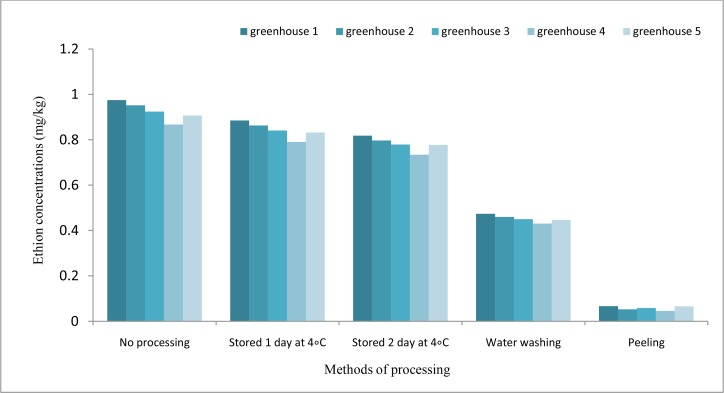
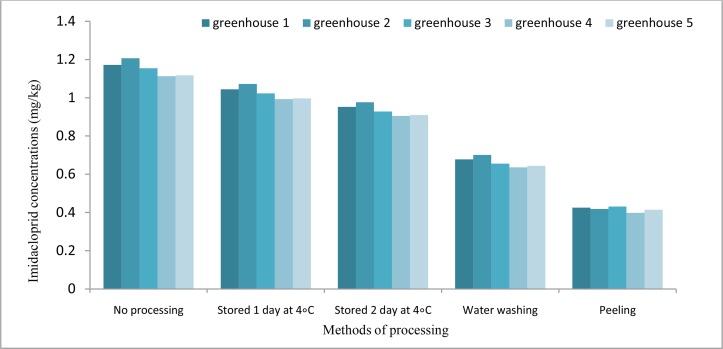
Results: One hour after pesticide application; the maximum residue levels (MRLs) of ethion and imidacloprid were higher than that of Codex standard level. One day after pesticide application, the levels of pesticides were decreased about 35 and 31% for ethion and imidacloprid, respectively, which still were higher than the MRL. Washing procedure led to about 51 and 42.5% loss in ethion and imidacloprid residues, respectively. Peeling procedure also led to highest loss of 93.4 and 63.7% in ethion and imidacloprid residues, respectively. The recovery for both target analytes was in the range between 88 and 102%.
Conclusion: The residue values in collected samples one hour after pesticides application were higher than standard value. The storing, washing, and peeling procedures lead to the decrease of pesticide residues in greenhouse cucumbers. Among them, the peeling procedure has the greatest impact on residual reduction. Therefore, these procedures can be used as simple and effective processing techniques for reducing and removing pesticides from greenhouse products before their consumption.
Keywords: Cucumber; Ethion; Greenhouse; Imidacloprid; Residuals.
Figures
References
-
- Shokrzadeh M, Saberyan M, Saeedi Saravi S. (2008). Assessment of lead (Pb) and cadmium (Cd) in 10 samples of Iranian and foreign consumed tea leaves and dissolved beverages. Toxicol Environ Chem, 90( 5): 879–83.
-
- Carvalho FP. (2006). Agriculture, pesticides, food security and food safety. Environ Sci Policy, 9( 7–8): 685–92.
-
- Katagi T. (2010). Bioconcentration, bioaccumulation, and metabolism of pesticides in aquatic organisms . Reviews of environmental contamination and toxicology: Springer; p. 1– 132. - PubMed
-
- Carriger JF, Rand GM. (2008). Aquatic risk assessment of pesticides in surface waters in and adjacent to the Everglades and Biscayne National Parks: II. Probabilistic analyses. Ecotoxicology, 17( 7): 680–96. - PubMed
-
- Karalliedde L, Senanayake N. (1989). Organophosphorus insecticide poisoning. Br J Anaesth, 63( 6): 736–50. - PubMed
LinkOut - more resources
Full Text Sources