


Late-onset moderate to severe acute respiratory distress syndrome is associated with shorter survival and higher mortality: a two-stage association study
- PMID: 28032130
- PMCID: PMC5554539
- DOI: 10.1007/s00134-016-4638-3
Late-onset moderate to severe acute respiratory distress syndrome is associated with shorter survival and higher mortality: a two-stage association study
Abstract
Purpose: To evaluate the association between acute respiratory distress syndrome (ARDS) onset time and prognosis.
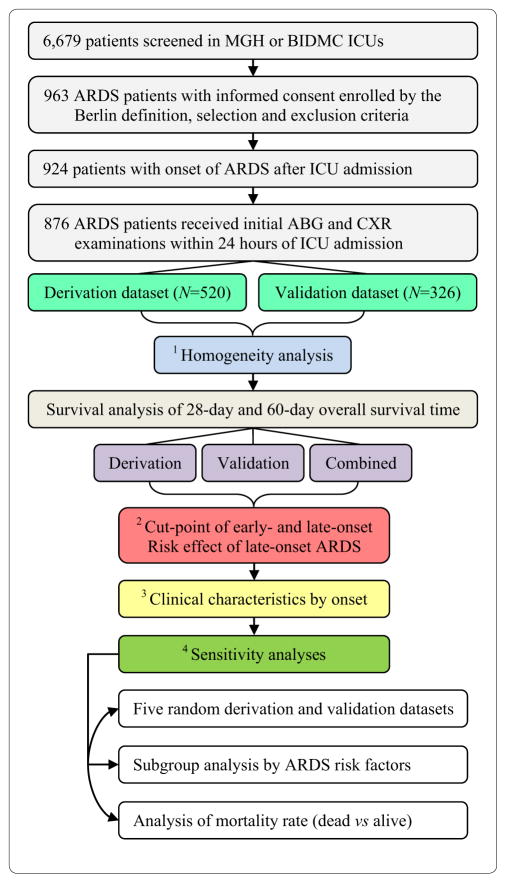
Methods: Patients with moderate to severe ARDS (N = 876) were randomly assigned into derivation (N = 520) and validation (N = 356) datasets. Both 28-day and 60-day survival times after ARDS onset were analyzed. A data-driven cutoff point between early- and late-onset ARDS was determined on the basis of mortality risk effects of onset times. We estimated the hazard ratio (HR) and odds ratio (OR) of late-onset ARDS using a multivariate Cox proportional hazards model of survival time and a multivariate logistic regression model of mortality rate, respectively.
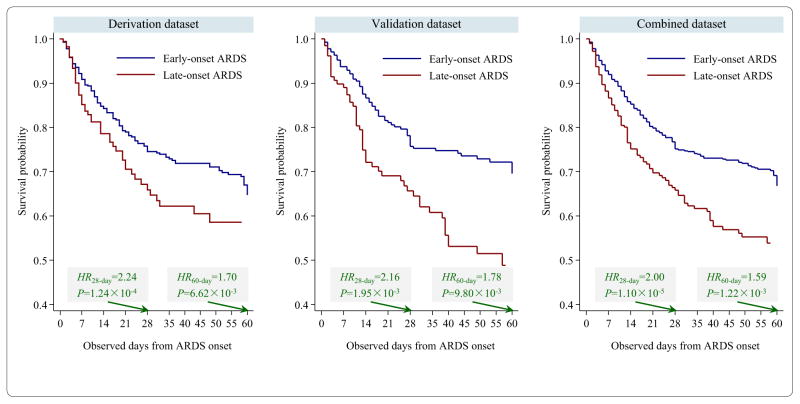
Results: Late-onset ARDS, defined as onset over 48 h after intensive care unit (ICU) admission (N = 273, 31%), was associated with shorter 28-day survival time: HR = 2.24, 95% CI 1.48-3.39, P = 1.24 × 10⁻⁴ (derivation); HR = 2.16, 95% CI 1.33-3.51, P = 1.95 × 10⁻³ (validation); and HR = 2.00, 95% CI 1.47-2.72, P = 1.10 × 10⁻⁵ (combined dataset). Late-onset ARDS was also associated with shorter 60-day survival time: HR = 1.70, 95% CI 1.16-2.48, P = 6.62 × 10⁻³ (derivation); HR = 1.78, 95% CI 1.15-2.75, P = 9.80 × 10⁻³ (validation); and HR = 1.59, 95% CI 1.20-2.10, P = 1.22 × 10⁻³ (combined dataset). Meanwhile, late-onset ARDS was associated with higher 28-day mortality rate (OR = 1.46, 95% CI 1.04-2.06, P = 0.0305) and 60-day mortality rate (OR = 1.44, 95% CI 1.03-2.02, P = 0.0313).
Conclusions: Late-onset moderate to severe ARDS patients had both shorter survival time and higher mortality rate in 28-day and 60-day observations.
Keywords: ARDS; Cox proportional hazards model; Early and late onset; Logistic regression model; Mortality rate; Overall survival time.
Conflict of interest statement
The authors declare that they have no conflict of interest.
Figures
Comment in
-
ARDS onset time and prognosis: is it a turtle and rabbit race?J Thorac Dis. 2017 Apr;9(4):973-975. doi: 10.21037/jtd.2017.03.147. J Thorac Dis. 2017. PMID: 28523151 Free PMC article. No abstract available.
References
-
- Gotts JE, Matthay MA. Treating ARDS: new hope for a tough problem. Lancet Respir Med. 2014;2:84–85. - PubMed
-
- Rubenfeld GD, Caldwell E, Peabody E, Weaver J, Martin DP, Neff M, Stern EJ, Hudson LD. Incidence and outcomes of acute lung injury. N Engl J Med. 2005;353:1685–1693. - PubMed
-
- Spragg RG, Lewis JF, Walmrath HD, Johannigman J, Bellingan G, Laterre PF, Witte MC, Richards GA, Rippin G, Rathgeb F, Hafner D, Taut FJ, Seeger W. Effect of recombinant surfactant protein C-based surfactant on the acute respiratory distress syndrome. N Engl J Med. 2004;351:884–892. - PubMed
-
- Steinberg KP, Hudson LD, Goodman RB, Hough CL, Lanken PN, Hyzy R, Thompson BT, Ancukiewicz M. Efficacy and safety of corticosteroids for persistent acute respiratory distress syndrome. N Engl J Med. 2006;354:1671–1684. - PubMed
-
- Papazian L, Forel J-M, Gacouin A, Penot-Ragon C, Perrin G, Loundou A, Jaber S, Arnal J-M, Perez D, Seghboyan J-M, Constantin J-M, Courant P, Lefrant J-Y, Guérin C, Prat G, Morange S, Roch A. Neuromuscular blockers in early acute respiratory distress syndrome. N Engl J Med. 2010;363:1107–1116. - PubMed
Publication types
MeSH terms
Grants and funding
LinkOut - more resources
Full Text Sources
Other Literature Sources
