. 2016 Nov 1;17(11):4929-4933.
doi: 10.22034/APJCP.2016.17.11.4929.

Nano-Micelle of Moringa Oleifera Seed Oil Triggers Mitochondrial Cancer Cell Apoptosis

Affiliations

Nano-Micelle of Moringa Oleifera Seed Oil Triggers Mitochondrial Cancer Cell Apoptosis

Ahmed A Abd-Rabou et al. Asian Pac J Cancer Prev. .

Abstract

Cancer, a worldwide epidemic disease with diverse origins, involves abnormal cell growth with the potential to invade other parts of the body. Globally, it is the main cause of mortality and morbidity. To overcome the drawbacks of the commercially available chemotherapies, natural products-loaded nano-composites are recommended to improve cancer targetability and decrease the harmful impact on normal cells. This study aimed at exploring the anti-cancer impacts of Moringa oleifera seed oil in its free- (MO) and nano-formulations (MOn) through studying whether it mechanistically promotes mitochondrial apoptosis-mediating cell death. Mitochondrial-based cytotoxicity and flow cytometric-based apoptosis analyses were performed on cancer HepG2, MCF7, HCT 116, and Caco-2 cell lines against normal kidney BHK-21 cell line. The present study resulted that MOn triggered colorectal cancer Caco-2 and HCT 116 cytotoxicity via mitochondrial dysfunction more powerful than its free counterpart (MO). On the other side, MOn and MO remarkably induces HCT 116 mitochondrial apoptosis, while sparing normal BHK-21 cells with minimal cytotoxic effect. The present results concluded that nano-micelle of Moringa oleifera seed oil (MOn) can provide a novel therapeutic approach for colorectal and breast cancers via mitochondrial-mediated apoptosis, while sparing normal and even liver cancer cells a bit healthy or with minimal harmful effect. Intriguingly, MOn induced breast cancer not hepatocellular carcinoma cell death.

Keywords: Moringa oleifera; seed oil; Nano-micelle; mitochondrial apoptosis; cancer.


Figures

Figure 1
Figure 1
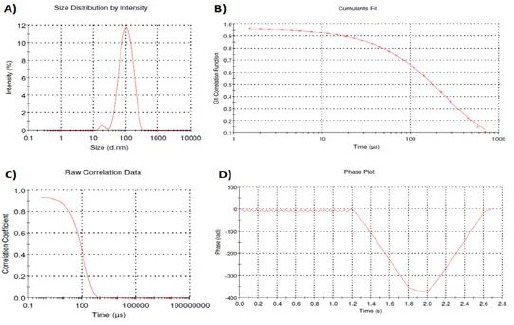
Characterization of Moringa Seed Oil Nano-Micelle (MOn). A) Size distribution of MOn in intensity was measured. Cumulants fit (B) is a simple method of analysing the autocorrelation function generated by a dynamic light scattering (DLS) experiment. The calculation is defined in ISO 13321 and ISO 22412 as it is a moment expansion that can produce a number of fitting values. Raw correlation curve (C) and phase plot (D) were also illustrated. The accuracy of the measured data in a DLS experiment is depdeing on the correlation curve which should be a smooth, single exponential decay function for a mono-size particle dispersion. Size= 85 nm and Polydispersity Index (PDI)= 0.1
Figure 2
Figure 2
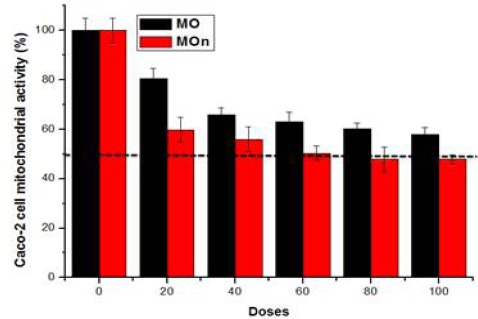
The Cytotoxic Effects of Moringa Seed Oil Nano-Micelle (MOn) and Its Free Counterpart on Caco-2 Colon Cancer Cell line. MOn significantly induces colon cancer Caco-2 cell death compared to Moringa seed oil itself. The results were presented as the mean of three independent experiments and the standard error (SE). There were statistically significant decreases when comparing MOn and MO concentrations with the control (P<0.05)
Figure 3
Figure 3
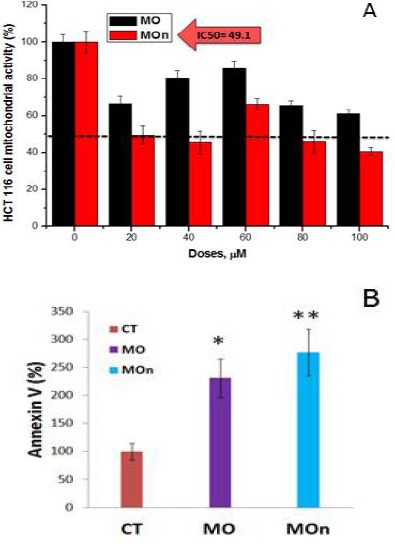
Moringa Seed Oil Nano-Micelle (MOn) Induces Mitochondrial-Mediated Apoptosis in HCT 116 Colon Cancer Cell Line. A) MOn and its free counterpart (MO) triggers mitochondrial dysfunction in HCT 116 cancer cells using MTT assay. B) Flow cytometric analyses for apoptosis measurement using Annexin V. To study the underlying mechanism of colon cancer HCT 116 cell death, MOn was tested upon those cells, showing a significant induction of apoptosis-mediated cell death compared to MO. The results were presented as the mean of three independent experiments and the standard error (SE). There were high statistically significant decreases when comparing MOn concentrations with the control (P<0.01) and statistically significant decreases when comparing MOn concentrations with the control (P<0.05)
Figure 4
Figure 4
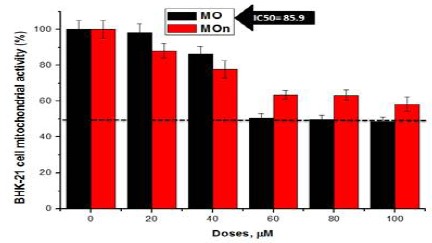
Nano-Formulation of MO (MOn) Significantly Lowers the Cytotoxic Effect by Enhancing the Mitochondrial Function of MO Itself when Applied up on Normal Kidney BHK-21 Cells. The results were presented as the mean of three independent experiments and the standard error (SE). There were statistically significant decreases when comparing MOn concentrations with the control (P<0.05)
Figure 5
Figure 5
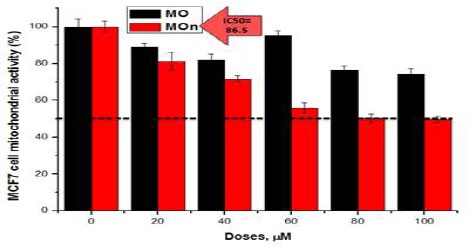
Moringa Seed Oil Nano-Micelle (MOn) Improves the Cytotoxic Effect of Its Free Counterpart on MCF7 Breast Cancer Cell Line. The results were presented as the mean of three independent experiments and the standard error (SE). There were statistically significant decreases when comparing MOn concentrations with the control (P<0.05)
Figure 6
Figure 6
Moringa Seed Oil Nano-Micelle (MOn) and MO Itself Have the Same Slight Cytotoxic Effects Upon Liver Cancer HepG2 Cell Line. The results were presented as the mean of three independent experiments and the standard error (SE). There were statistically significant decreases when comparing MOn and MO concentrations with the control (P<0.05)
Figure 7
Figure 7
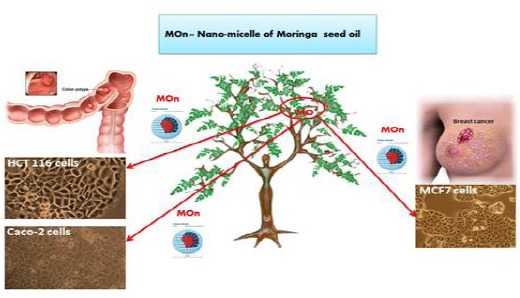
Schematic Diagram of the Impact of Moringa Seed Oil Nano-Micelle (MOn) on Different Cancer Cells. This diagram shows that MOn effectively kills MCF7, HCT 116, and Caco-2 not HepG2 cell lines compared to its free MO counterpart. While in the case of normal BHK-21 cells, the nano-form does not induce the MO cytotoxic effect and activates the mitochondrial activity

References

    1. Abd-Rabou AA, Zoheir K, Ahmed HH. Potential impact of curcumin and taurine on human hepatoma cells using huh-7 cell line. Clin Biochem. 2012;45:1519–21. - PubMed
    1. Abd-Rabou AA. Calcium, a cell cycle commander, drives colon cancer cell diffpoptosis. Ind J Clin Biochem. 2016:1–10. - PMC - PubMed
    1. Abdulkarim SM, Lai OM, Muhammad SKS, Long K, Ghazali HM. Some physic-chemical properties of Moringa oleifera seed oil extracted using solvent and aqueous enzymatic methods. Food Chem. 2005;93:253–63.
    1. Ahmad MB, Rauf A, Osman MJ. Oil technologies’ Association of India. 1989;3:46–7.
    1. Ahmed HH, Abd-Rabou AA, Hassan AZ, Kotob SE. Phytochemical analysis and anti-cancer investigation of boswellia serrata bioactive constituents in vitro. Asian Pac J Cancer Prev. 2015;16:7179–88. - PubMed