Published Erratum
doi: 10.1371/journal.pbio.1002589.
eCollection 2016 Dec.
Correction: Associative Mechanisms Allow for Social Learning and Cultural Transmission of String Pulling in an Insect
- PMID: 28033324
- PMCID: PMC5198970
- DOI: 10.1371/journal.pbio.1002589
Item in Clipboard
Published Erratum
Correction: Associative Mechanisms Allow for Social Learning and Cultural Transmission of String Pulling in an Insect
PLoS Biol.
.
Abstract
[This corrects the article DOI: 10.1371/journal.pbio.1002564.].
Figures
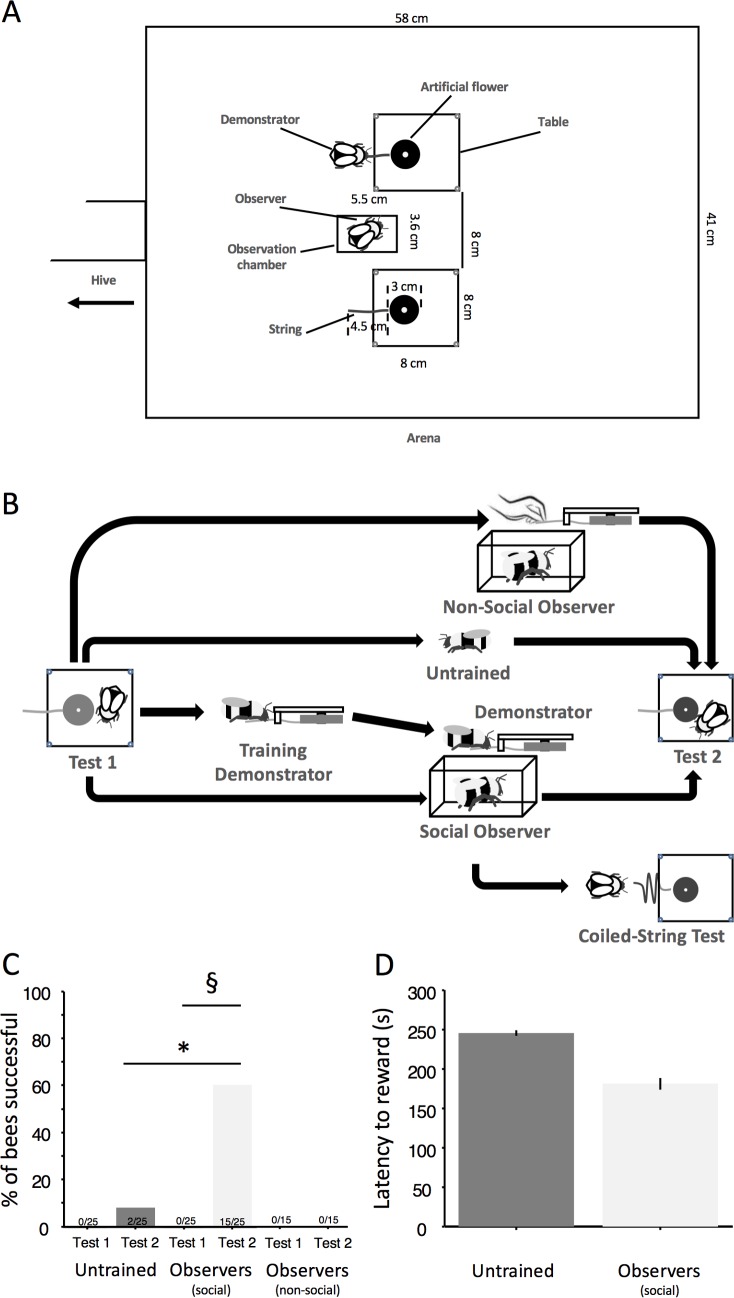
(A) Arena set up for the observation of string pulling. (B) The various testing procedures. Tests 1 and 2 were identical and consisted of giving 5 min to individual bees to solve the string pulling task. After having been trained to forage from blue artificial flowers, bees were tested a first time (Test 1). Then, demonstrators were trained (see Fig 1) and used to display string pulling (two instances, straight strings) during each of five foraging bouts to individual observers (n = 52) placed in a transparent Plexiglas cage. After the observation phase, 25 observers were tested again with the straight-string task (Test 2) and 27 with the coiled-string task. Fifteen different bees observed the flower moving without visible actor so that a forager could then obtain the sucrose solution (“Ghost control”) and, where tested, with the straight-string task subsequently. Untrained bees (n = 25) were also tested a second time with string pulling. (C) Percentage of successful untrained, social, and nonsocial observer bees in Tests 1 and 2. Asterisk: Fisher’s exact test, p ≤ 0.0001. Double S: McNemar test, χ21 = 13.067, p < 0.001. (D) Mean ± s.e. (s) latency in accessing the reward in untrained and observer bees. Observers’ latency was not different from that of the two “innovators” (Mann–Whitney U test, U15 = 6, p = 0.205), (see S1 Data).
Erratum for
-
Associative Mechanisms Allow for Social Learning and Cultural Transmission of String Pulling in an Insect.PLoS Biol. 2016 Oct 4;14(10):e1002564. doi: 10.1371/journal.pbio.1002564. eCollection 2016 Oct. PLoS Biol. 2016. PMID: 27701411 Free PMC article.
References
-
- Alem S, Perry CJ, Zhu X, Loukola OJ, Ingraham T, Søvik E, et al. (2016) Associative Mechanisms Allow for Social Learning and Cultural Transmission of String Pulling in an Insect. PLoS Biol 14(10): e1002564 doi:10.1371/journal.pbio.1002564 - DOI - PMC - PubMed
Publication types
LinkOut - more resources
Full Text Sources
Other Literature Sources