


Relapsed or Refractory Double-Expressor and Double-Hit Lymphomas Have Inferior Progression-Free Survival After Autologous Stem-Cell Transplantation
- PMID: 28034071
- PMCID: PMC5455688
- DOI: 10.1200/JCO.2016.68.2740
Relapsed or Refractory Double-Expressor and Double-Hit Lymphomas Have Inferior Progression-Free Survival After Autologous Stem-Cell Transplantation
Abstract
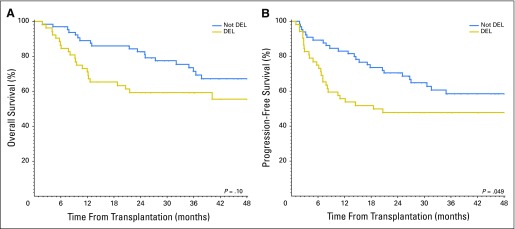
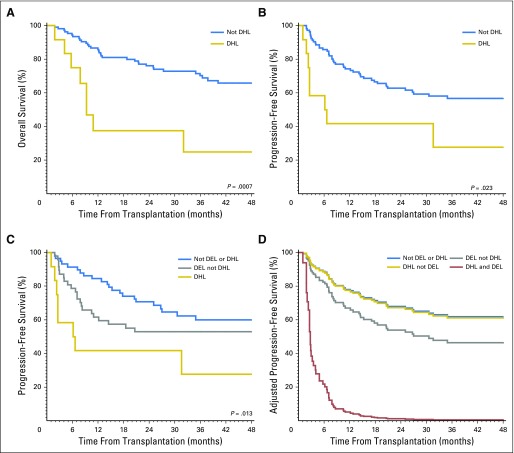
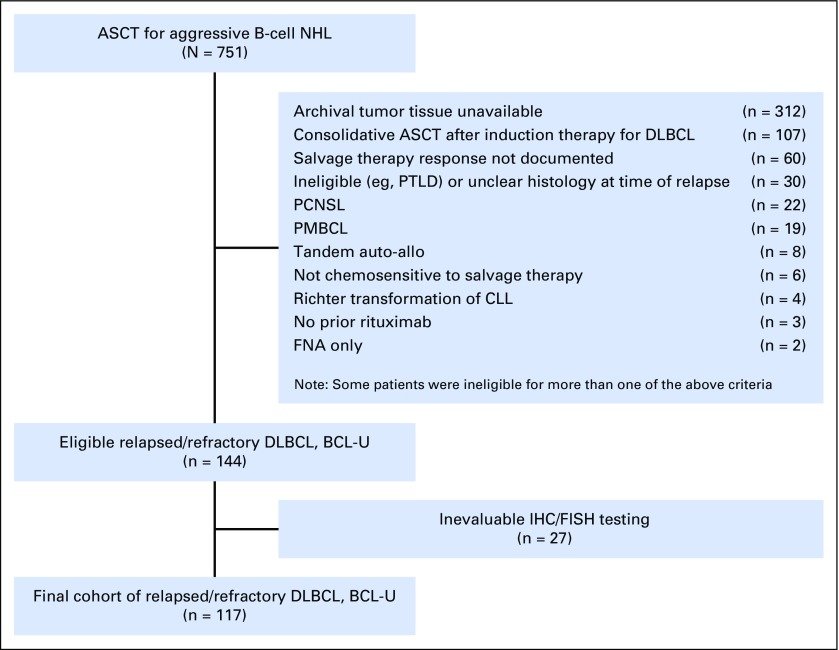
Purpose Double-hit lymphomas (DHLs) and double-expressor lymphomas (DELs) are subtypes of diffuse large B-cell lymphoma (DLBCL) associated with poor outcomes after standard chemoimmunotherapy. Data are limited regarding outcomes of patients with relapsed or refractory (rel/ref) DEL or DHL who undergo autologous stem-cell transplantation (ASCT). We retrospectively studied the prognostic impact of DEL and DHL status on ASCT outcomes in patients with rel/ref DLBCL. Methods Patients with chemotherapy-sensitive rel/ref DLBCL who underwent ASCT at two institutions and in whom archival tumor material was available were enrolled. Immunohistochemistry for MYC, BCL2, and BCL6 and fluorescence in situ hybridization (FISH) for MYC were performed. In cases with MYC rearrangement or copy gain, FISH for BCL2 and BCL6 was also performed. Results A total of 117 patients were included; 44% had DEL and 10% had DHL. DEL and DHL were associated with inferior progression-free survival (PFS), and DHL was associated with poorer overall survival (OS). The 4-year PFS in patients with DEL compared with those with non-DEL was 48% versus 59% ( P = .049), and the 4-year OS was 56% versus 67% ( P = .10); 4-year PFS in patients with DHL compared with those with non-DHL was 28% versus 57% ( P = .013), and 4-year OS was 25% versus 61% ( P = .002). The few patients with concurrent DEL and DHL had a poor outcome (4-year PFS, 0%). In multivariable models, DEL and DHL were independently associated with inferior PFS, whereas DHL and partial response ( v complete response) at transplant were associated with inferior OS. Conclusion DEL and DHL are both associated with inferior outcomes after ASCT in patients with rel/ref DLBCL. Although ASCT remains a potentially curative approach, these patients, particularly those with DHL, are a high-risk subset who should be targeted for investigational strategies other than standard ASCT.
Figures
Comment in
-
Impact of Double-Hit and Double-Expressor Phenotypes in Relapsed Aggressive B-Cell Lymphomas Treated With Autologous Hematopoietic Stem Cell Transplantation.J Clin Oncol. 2017 Jan;35(1):1-3. doi: 10.1200/JCO.2016.70.0625. Epub 2016 Oct 24. J Clin Oncol. 2017. PMID: 28034063 No abstract available.
References
-
- Philip T, Guglielmi C, Hagenbeek A, et al. Autologous bone marrow transplantation as compared with salvage chemotherapy in relapses of chemotherapy-sensitive non-Hodgkin’s lymphoma. N Engl J Med. 1995;333:1540–1545. - PubMed
-
- Alousi AM, Saliba RM, Okoroji GJ, et al. Disease staging with positron emission tomography or gallium scanning and use of rituximab predict outcome for patients with diffuse large B-cell lymphoma treated with autologous stem cell transplantation. Br J Haematol. 2008;142:786–792. - PubMed
-
- Armand P, Welch S, Kim HT, et al. Prognostic factors for patients with diffuse large B cell lymphoma and transformed indolent lymphoma undergoing autologous stem cell transplantation in the positron emission tomography era. Br J Haematol. 2013;160:608–617. - PubMed
-
- Derenzini E, Musuraca G, Fanti S, et al. Pretransplantation positron emission tomography scan is the main predictor of autologous stem cell transplantation outcome in aggressive B-cell non-Hodgkin lymphoma. Cancer. 2008;113:2496–2503. - PubMed
Publication types
MeSH terms
Substances
Grants and funding
LinkOut - more resources
Full Text Sources
Other Literature Sources
