


Psychosocial Influences on Exercise-Induced Hypoalgesia
- PMID: 28034985
- PMCID: PMC8491610
- DOI: 10.1093/pm/pnw275
Psychosocial Influences on Exercise-Induced Hypoalgesia
Abstract
Objective: The purpose of this study was to examine psychosocial influences on exercise-induced hypoalgesia (EIH).
Design: Randomized controlled trial.
Setting: Clinical research unit in a hospital.
Subjects: Fifty-eight healthy men and women (mean age = 21 ± 3 years) participated in this study.
Methods: Participants were first asked to complete a series of baseline demographic and psychological questionnaires including the Pain Catastrophizing Scale, the Fear of Pain Questionnaire, and the Family Environment Scale. Following this, they were familiarized with both temporal summation of heat pain and pressure pain testing protocols. During their next session, participants completed the Profile of Mood States, rated the intensity of heat pulses, and indicated their pressure pain thresholds and ratings before and after three minutes of submaximal, isometric exercise. Situational catastrophizing was assessed at the end of the experimental session.
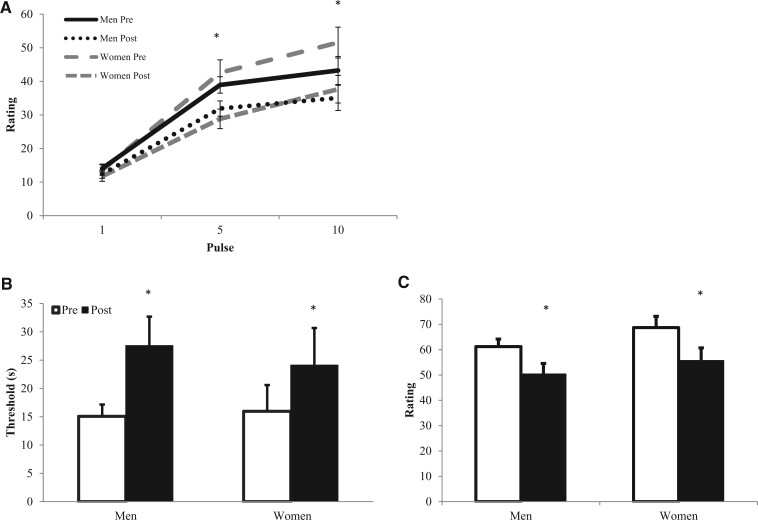
Results: Results indicated that experimental pain sensitivity was significantly reduced after exercise ( P < 0.05). Men and women did not differ on any of the measured psychosocial variables ( P > 0.05). Positive family environments predicted attenuated pain sensitivity and greater EIH, whereas negative and chronic pain-present family environments predicted worse pain and EIH outcomes. Situational catastrophizing and negative mood state also predicted worse pain and EIH outcomes and were additionally associated with increased ratings of perceived exertion and muscle pain during exercise.
Conclusions: This study provides preliminary evidence that psychosocial variables, such as the family environment and mood states, can affect both pain sensitivity and the ability to modulate pain through exercise-induced hypoalgesia.
Keywords: Catastrophizing; Exercise; Family; Modulation; Psychological; Sex.
© 2016 American Academy of Pain Medicine. All rights reserved. For permissions, please e-mail: journals.permissions@oup.com
Figures
References
-
- Goodin BR, McGuire L, Allshouse M, et al.. Associations between catastrophizing and endogenous pain-inhibitory processes: Sex differences. J Pain 2009;10(2):180–90. - PubMed
-
- George SZ, Dover GC, Fillingim RB. Fear of pain influences outcomes after exercise-induced delayed onset muscle soreness at the shoulder. Clin J Pain 2007;23(1):76–84. - PubMed
-
- Sullivan M, Thorn B, Haythornthwaite JA, et al.. Theoretical perspectives on the relation between catastrophizing and pain. Clin J Pain 2001;17(1):52–64. - PubMed
-
- Burke ALJ, Mathias JL, Denson LA. Psychological functioning of people living with chronic pain: A meta-analytic review. Br J Clin Psychol 2015;54(3):345–60. - PubMed
Publication types
MeSH terms
Substances
Grants and funding
LinkOut - more resources
Full Text Sources
Other Literature Sources
Medical
