Review
. 2017 May;26(5):666-674.
doi: 10.1158/1055-9965.EPI-16-0812. Epub 2016 Dec 29.

Approach for Classification and Severity Grading of Long-term and Late-Onset Health Events among Childhood Cancer Survivors in the St. Jude Lifetime Cohort

Affiliations
Review

Approach for Classification and Severity Grading of Long-term and Late-Onset Health Events among Childhood Cancer Survivors in the St. Jude Lifetime Cohort

Melissa M Hudson et al. Cancer Epidemiol Biomarkers Prev. 2017 May.

Abstract

Characterization of toxicity associated with cancer and its treatment is essential to quantify risk, inform optimization of therapeutic approaches for newly diagnosed patients, and guide health surveillance recommendations for long-term survivors. The NCI Common Terminology Criteria for Adverse Events (CTCAE) provides a common rubric for grading severity of adverse outcomes in cancer patients that is widely used in clinical trials. The CTCAE has also been used to assess late cancer treatment-related morbidity but is not fully representative of the spectrum of events experienced by pediatric and aging adult survivors of childhood cancer. Also, CTCAE characterization does not routinely integrate detailed patient-reported and medical outcomes data available from clinically assessed cohorts. To address these deficiencies, we standardized the severity grading of long-term and late-onset health events applicable to childhood cancer survivors across their lifespan by modifying the existing CTCAE v4.03 criteria and aligning grading rubrics from other sources for chronic conditions not included or optimally addressed in the CTCAE v4.03. This article describes the methods of late toxicity assessment used in the St. Jude Lifetime Cohort Study, a clinically assessed cohort in which data from multiple diagnostic modalities and patient-reported outcomes are ascertained. Cancer Epidemiol Biomarkers Prev; 26(5); 666-74. ©2016 AACR.


Conflict of interest statement

The authors declare no potential conflicts of interest.

Figures
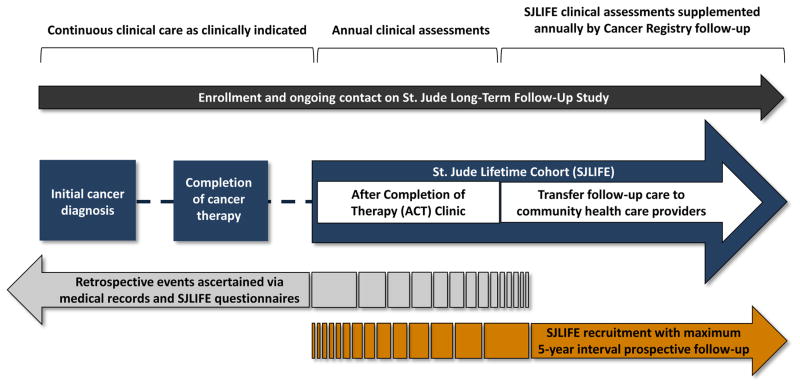
Figure 1
Figure 1
Sources of health outcomes data used in the St. Jude Lifetime Cohort (SJLIFE) Study where severity grading criteria of long-term and late-onset health events was applied. During and following treatment of pediatric cancer, cancer remission status and treatment-related toxicities are routinely monitored by the primary oncology team and/or the long-term follow-up (After Completion of Therapy) Clinic until the survivor is 10 years from diagnosis and at least 18 years of age. Participants in the SJLIFE cohort are invited to return to SJCRH at least once every five years for follow-up using protocol-based medical evaluations and assessments of patient-reported outcomes, neurocognitive function, and physical performance status. In addition to longitudinal evaluations undertaken as part of SJLIFE, all oncology patients transitioned from SJCRH long-term follow-up care to community providers are followed by the institutional review board-approved St. Jude Long-Term Follow-Up Study (SJLTFU) study. All SJCRH patients are invited to participate in SJLTFU study at diagnosis. Health and vital status of SJLTFU participants are monitored by the St. Jude Cancer Registry and supplemented by periodic National Death Index searches.
Figure 2
Figure 2
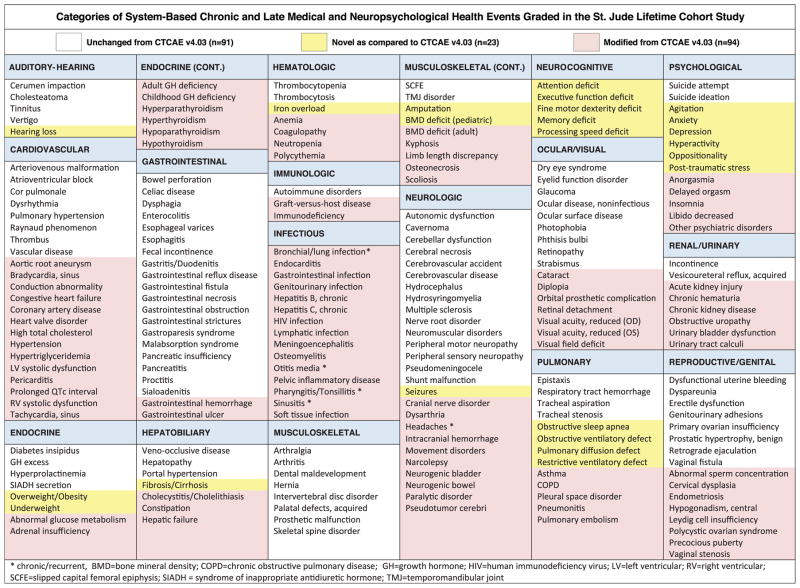
Categories of system-based chronic and late medical and neuropsychological health events graded in the St. Jude Lifetime Cohort Study. Among 208 chronic and late-onset medical and neuropsychological conditions, the severity grading was assessed by unmodified categories published in CTCAEv4.03 (n=91, white), modified CTCAEv4.03 categories (n=94, pink) or newly developed grading criteria (n=23, yellow).

References

    1. Phillips SM, Padgett LS, Leisenring WM, Stratton KK, Bishop K, Krull KR, et al. Survivors of childhood cancer in the United States: prevalence and burden of morbidity. Cancer Epidemiol Biomarkers Prev. 2015;24:653–63. - PMC - PubMed
    1. Robison LL, Hudson MM. Survivors of childhood and adolescent cancer: life-long risks and responsibilities. Nat Rev Cancer. 2014;14:61–70. - PMC - PubMed
    1. Armstrong GT, Chen Y, Yasui Y, Leisenring W, Gibson TM, Mertens AC, et al. Reduction in Late Mortality among 5-Year Survivors of Childhood Cancer. N Engl J Med. 2016;374:833–42. - PMC - PubMed
    1. Armstrong GT, Kawashima T, Leisenring W, Stratton K, Stovall M, Hudson MM, et al. Aging and risk of severe, disabling, life-threatening, and fatal events in the childhood cancer survivor study. J Clin Oncol. 2014;32:1218–27. - PMC - PubMed
    1. Bhakta N, Liu Q, Yeo F, Baassiri M, Ehrhardt MJ, Srivastava DK, et al. Cumulative burden of cardiovascular morbidity in paediatric, adolescent, and young adult survivors of Hodgkin’s lymphoma: an analysis from the St Jude Lifetime Cohort Study. Lancet Oncol. 2016;17:1325–34. - PMC - PubMed

Publication types

Substances