Review
. 2016 Dec 27;18(1):37.
doi: 10.3390/ijms18010037.

Neuroblastoma, a Paradigm for Big Data Science in Pediatric Oncology

Affiliations
Review

Neuroblastoma, a Paradigm for Big Data Science in Pediatric Oncology

Brittany M Salazar et al. Int J Mol Sci. .

Abstract

Pediatric cancers rarely exhibit recurrent mutational events when compared to most adult cancers. This poses a challenge in understanding how cancers initiate, progress, and metastasize in early childhood. Also, due to limited detected driver mutations, it is difficult to benchmark key genes for drug development. In this review, we use neuroblastoma, a pediatric solid tumor of neural crest origin, as a paradigm for exploring "big data" applications in pediatric oncology. Computational strategies derived from big data science-network- and machine learning-based modeling and drug repositioning-hold the promise of shedding new light on the molecular mechanisms driving neuroblastoma pathogenesis and identifying potential therapeutics to combat this devastating disease. These strategies integrate robust data input, from genomic and transcriptomic studies, clinical data, and in vivo and in vitro experimental models specific to neuroblastoma and other types of cancers that closely mimic its biological characteristics. We discuss contexts in which "big data" and computational approaches, especially network-based modeling, may advance neuroblastoma research, describe currently available data and resources, and propose future models of strategic data collection and analyses for neuroblastoma and other related diseases.

Keywords: big data; computational modeling; drug repositioning; metastasis; networks; neuroblastoma; spontaneous regression.


Conflict of interest statement

The authors declare no conflict of interest.

Figures
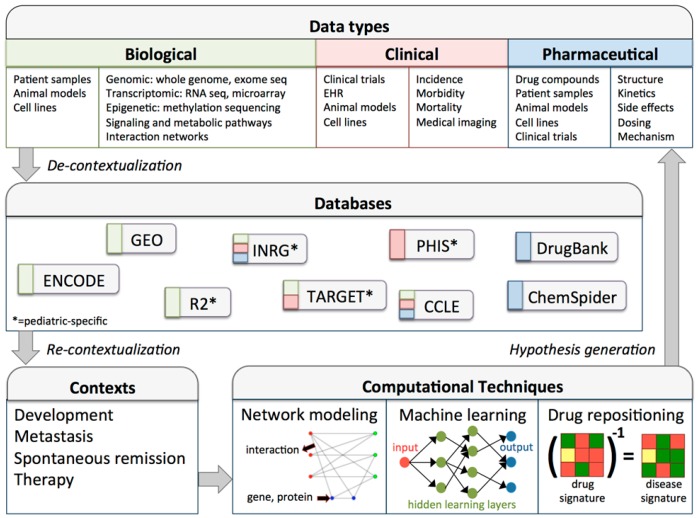
Figure 1
Figure 1
Data-driven research workflow for neuroblastoma or other pediatric cancers. The data types panel enumerates data sources (e.g., animal models) and types (e.g., RNA sequencing) for three categories of biological data. Following collection, data may be de-contextualized for inclusion in databases. De-contextualization involves properly formatting and annotating datasets, so that they are standardized, accessible, and useful for re-contextualization into new research contexts. Note that this workflow is iterative, and can therefore benefit from continued improvement of data infrastructure and data collections, development of more accurate and comprehensive data analysis tools, and advances in basic and translational research and therapeutic applications [35,118,119,120,121,122,123,124]. CCLE, cancer cell line encyclopedia; ENCODE, encyclopedia of DNA elements; GEO, gene expression omnibus; EHR: electronic health record; INRG, international neuroblastoma risk group; PHIS, pediatric health information system; R2, genomics analysis and visualization platform; TARGET, therapeutically applicable research to generate effective treatments.

References

    1. Adamson P.C., Houghton P.J., Perilongo G., Pritchard-Jones K. Drug discovery in paediatric oncology: Roadblocks to progress. Nat. Rev. Clin. Oncol. 2014;11:732–739. doi: 10.1038/nrclinonc.2014.149. - DOI - PMC - PubMed
    1. Lawrence M.S., Stojanov P., Polak P., Kryukov G.V., Cibulskis K., Sivachenko A., Carter S.L., Stewart C., Mermel C.H., Roberts S.A., et al. Mutational heterogeneity in cancer and the search for new cancer-associated genes. Nature. 2013;499:214–218. doi: 10.1038/nature12213. - DOI - PMC - PubMed
    1. Bosse K.R., Maris J.M. Advances in the translational genomics of neuroblastoma: From improving risk stratification and revealing novel biology to identifying actionable genomic alterations. Cancer. 2016;122:20–33. doi: 10.1002/cncr.29706. - DOI - PMC - PubMed
    1. Barone G., Anderson J., Pearson A.D., Petrie K., Chesler L. New strategies in neuroblastoma: Therapeutic targeting of MYCN and ALK. Clin. Cancer Res. 2013;19:5814–5821. doi: 10.1158/1078-0432.CCR-13-0680. - DOI - PMC - PubMed
    1. Park J.R., Bagatell R., London W.B., Maris J.M., Cohn S.L., Mattay K.K., Hogarty M., Committee C.O.G.N. Children’s Oncology Group’s 2013 blueprint for research: Neuroblastoma. Pediatr. Blood Cancer. 2013;60:985–993. doi: 10.1002/pbc.24433. - DOI - PubMed

LinkOut - more resources
