Review
. 2016 Dec 29;10(1):4.
doi: 10.3390/ph10010004.

Drosophila Protein Kinase CK2: Genetics, Regulatory Complexity and Emerging Roles during Development

Affiliations
Review

Drosophila Protein Kinase CK2: Genetics, Regulatory Complexity and Emerging Roles during Development

Mohna Bandyopadhyay et al. Pharmaceuticals (Basel). .

Abstract

CK2 is a Ser/Thr protein kinase that is highly conserved amongst all eukaryotes. It is a well-known oncogenic kinase that regulates vital cell autonomous functions and animal development. Genetic studies in the fruit fly Drosophila are providing unique insights into the roles of CK2 in cell signaling, embryogenesis, organogenesis, neurogenesis, and the circadian clock, and are revealing hitherto unknown complexities in CK2 functions and regulation. Here, we review Drosophila CK2 with respect to its structure, subunit diversity, potential mechanisms of regulation, developmental abnormalities linked to mutations in the gene encoding CK2 subunits, and emerging roles in multiple aspects of eye development. We examine the Drosophila CK2 "interaction map" and the eye-specific "transcriptome" databases, which raise the prospect that this protein kinase has many additional targets in the developing eye. We discuss the possibility that CK2 functions during early retinal neurogenesis in Drosophila and mammals bear greater similarity than has been recognized, and that this conservation may extend to other developmental programs. Together, these studies underscore the immense power of the Drosophila model organism to provide new insights and avenues to further investigate developmentally relevant targets of this protein kinase.

Keywords: CK2; Drosophila; Notch; eye development; neurogenesis.


Conflict of interest statement

The authors declare no conflict of interest. The funding sponsors had no role in the design of the study; in the collection, analyses, or interpretation of data; in the writing of the manuscript, and in the decision to publish the results.

Figures
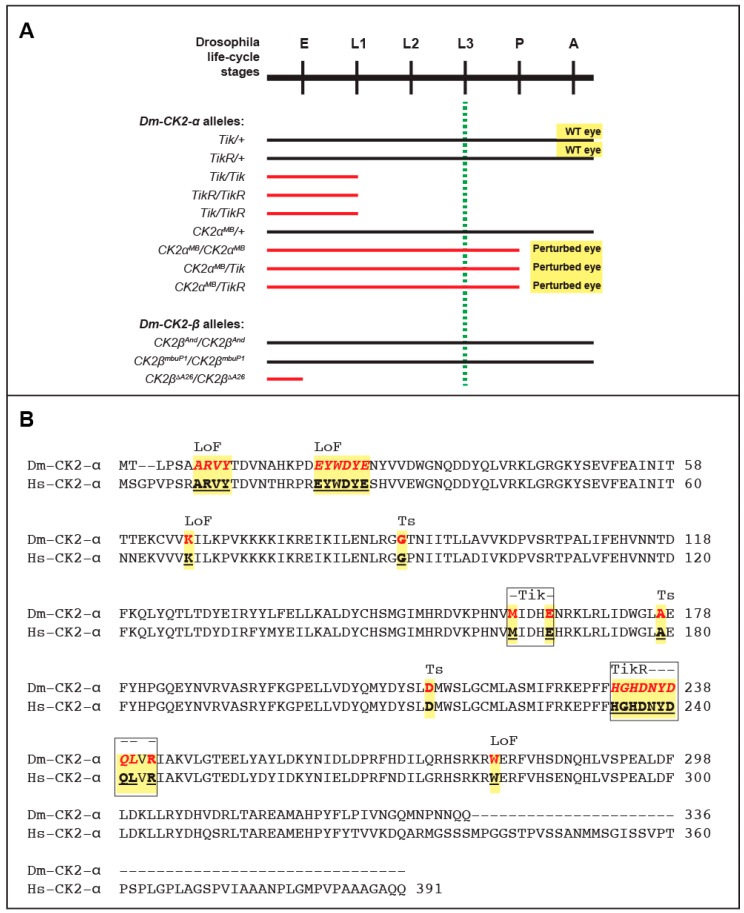
Figure 1
Figure 1
(A) Drosophila life cycle stages and effective lethal phase of CK2 mutants. Abbreviations are; E, Embryo; L1, 1st larval stage; L2, 2nd larval stage; L3, 3rd larval stage; P, pupal stage; A, adult. Note that Dm-CK2-α mutants Tik and TikR arrest at the L1 stage, whereas CK2αMB mutants die at the P-to-A transition. In contrast, CK2βAnd and CK2βmbuP1 are viable, whereas CK2β∆A26 die during embryogenesis. Dashed green line denotes stage of life cycle when eye development initiates; black lines denote normal development, whereas red lines denote effective lethal phases of indicated mutant combinations; (B) Alignment of CK2-α from D. melanogaster (Dm) and H. sapiens (Hs). LoF denotes loss-of-function, whereas Ts denotes Temperature-sensitive. The locations of the Tik and TikR mutations are boxed and yellow highlighting denotes conservation of residues between Dm and Hs CK2α subunits.
Figure 2
Figure 2
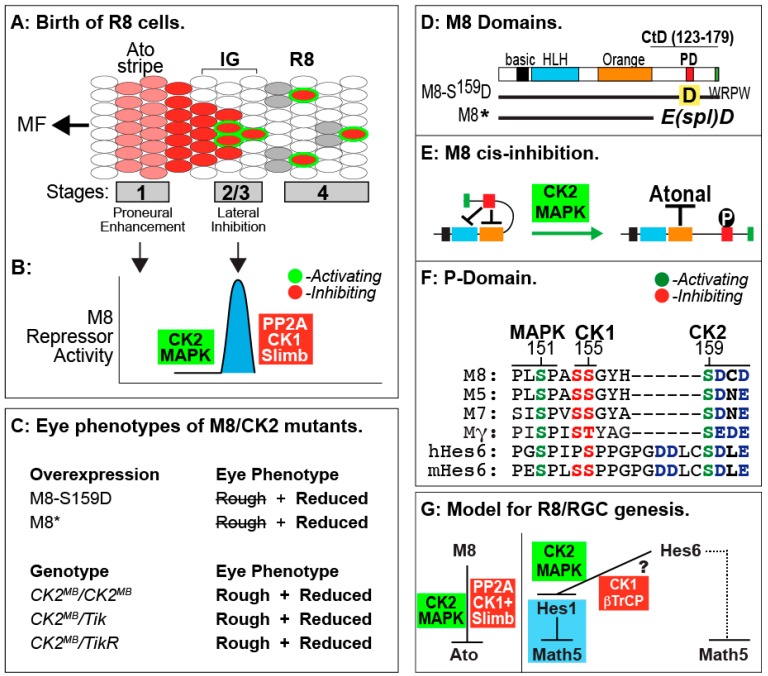
(A) R8 birth; Ato (pink/red), Sens (blue) and secondary R cells (grey); (B) CK2 and Mitogen Activated Protein Kinase (MAPK) activate M8 at stage-2/3 of the MF, and after R8 selection, PP2A and CK1 + Slimb mediate inactivation and/or destruction; (C) Eye phenotypes of CK2 and M8 mutants; (D) Functional domains in M8, and location of the phosphorylation domain (PD) in the C-terminal domain (CtD). The WRPW motif in M8 binds the essential co-repressor Groucho, and M8* (the product of the E(spl)D mutation) eliminates the CtD; (E) Regulation of cis-inhibited M8 by CK2 and MAPK. Note that in cis-inhibited M8, the PD blocks either HLH (blue) or Orange domains preventing interaction with Atonal; (F) Conservation of the PD in Drosophila M8/M5/M7/Mγ and human/mouse Hes6; (G) Model for CK2 regulation of Drosophila M8 and mammalian Hes6. Dotted line denotes non-canonical mode of Hes6 action.

References

    1. Burnett G., Kennedy E.P. The enzymatic phosphorylation of proteins. J. Biol. Chem. 1954;211:969–980. - PubMed
    1. Krebs E.G., Graves D.J., Fischer E.H. Factors affecting the activity of muscle phosphorylase b kinase. J. Biol. Chem. 1959;234:2867–2873. - PubMed
    1. Krebs E.G. Protein phosphorylation and cellular regulation I (Nobel Lecture) Angew. Chem. 1993;32:1122–1129. doi: 10.1002/anie.199311221. - DOI - PubMed
    1. Kennedy E.P. Sailing to Byzantium. Annu. Rev. Biochem. 1992;61:1–28. doi: 10.1146/annurev.bi.61.070192.000245. - DOI - PubMed
    1. Pinna L.A. Protein kinase CK2: A challenge to canons. J. Cell Sci. 2002;115:3873–3878. doi: 10.1242/jcs.00074. - DOI - PubMed

LinkOut - more resources