The prognosis analysis of different metastasis pattern in patients with different breast cancer subtypes: a SEER based study
- PMID: 28038448
- PMCID: PMC5432264
- DOI: 10.18632/oncotarget.14300
The prognosis analysis of different metastasis pattern in patients with different breast cancer subtypes: a SEER based study
Abstract
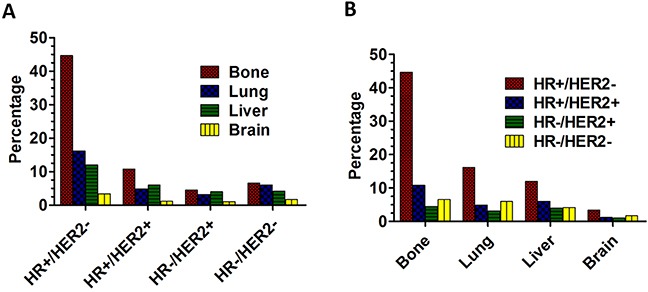
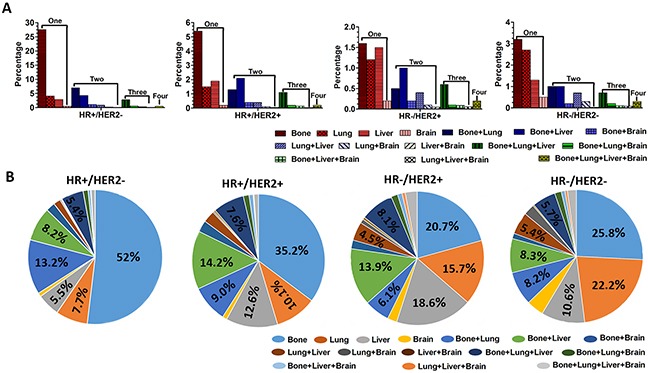
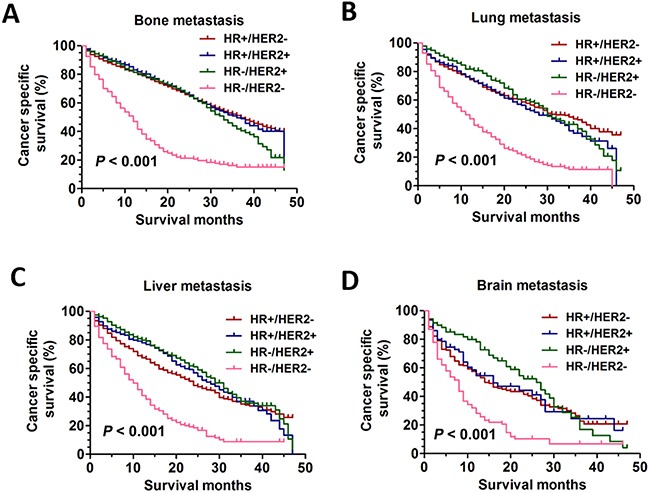
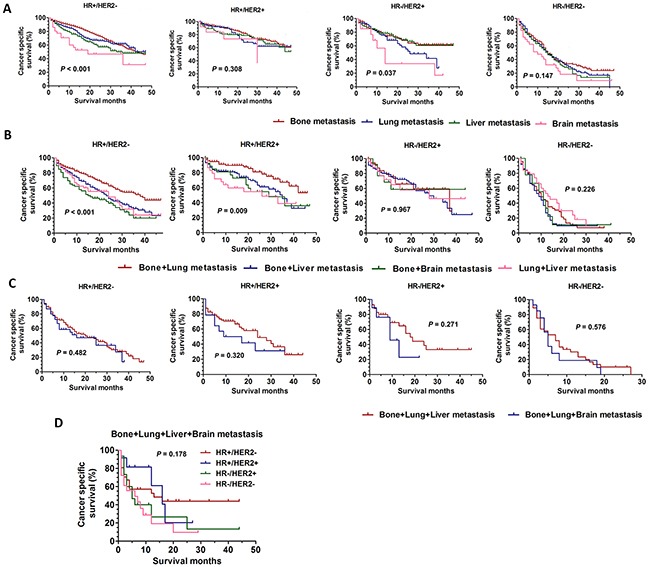
Studies on prognosis of different metastasis patterns in patients with different breast cancer subtypes (BCS) are limited. Therefore, we identified 7862 breast cancer patients with distant metastasis from 2010 to 2013 using Surveillance, Epidemiology, wand End Results (SEER) population-based data. The results showed that bone was the most common metastatic site and brain was the least common metastatic site, and the patients with HR+/HER2- occupied the highest metastasis proportion, the lowest metastasis proportion were found in HR-/HER2+ patients. Univariate and multivariate logistic regression analysis were used to analyze the association, and it was found that there were significant differences of distant metastasis patterns in patients with different BCS(different P value). Importantly, univariate and multivariate Cox regression analysis were used to analyze the prognosis. It was proven that only bone metastasis was not a prognostic factor in the HR+/HER2-, HR+/HER2+ and HR-/HER2+ subgroup (all, P > 0.05), and patients with brain metastasis had the worst cancer specific survival (CSS) in all the subgroups of BCS (all, P<0.01). Interestingly, for patients with two metastatic sites, those with bone and lung metastasis had best CSS in the HR+/HER2- (P<0.001) and HR+/HER2+ subgroups (P=0.009) However, for patients with three and four metastatic sites, there was no statistical difference in their CSS (all, P>0.05).
Keywords: SEER; breast cancer; breast cancer subtypes; metastasis pattern; prognosis.
Conflict of interest statement
All authors have reviewed the final version of the manuscript and approve it for publication. This manuscript has not been published in whole or in part nor is it being considered for publication elsewhere. The authors have no conflicts of interest to declare.
Figures
References
-
- Torre LA, Bray F, Siegel RL, Ferlay J, Lortet-Tieulent J, Jemal A. Global cancer statistics, 2012. CA Cancer J Clin. 2015;65:87–108. - PubMed
-
- Early Breast Cancer Trialists’ Collaborative Group. Effects of chemotherapy and hormonal therapy for early breast cancer on recurrence and 15-year survival: an overview of the randomised trials. Lancet. 2005;365:1687–1717. - PubMed
-
- Soni A, Ren Z, Hameed O, Chanda D, Morgan CJ, Siegal GP, Wei S. Breast cancer subtypes predispose the site of distant metastases. Am J Clin Pathol. 2015;143:471–478. - PubMed
-
- Kennecke H, Yerushalmi R, Woods R, Cheang MC, Voduc D, Speers CH, Nielsen TO, Gelmon K. Metastatic behavior of breast cancer subtypes. J Clin Oncol. 2010;28:3271–3277. - PubMed
MeSH terms
Substances
LinkOut - more resources
Full Text Sources
Other Literature Sources
Medical
Research Materials
Miscellaneous