


Variations in Strategies to Prevent Ventriculostomy-Related Infections: A Practice Survey
- PMID: 28042365
- PMCID: PMC5167094
- DOI: 10.1177/1941874416663281
Variations in Strategies to Prevent Ventriculostomy-Related Infections: A Practice Survey
Abstract
Background and purpose: The ideal strategy to prevent infections in patients with external ventricular drains (EVDs) is unclear.
Methods: We conducted a cross-sectional survey of members of the Neurocritical Care Society on infection prevention practices for patients with EVDs between April and July 2015.
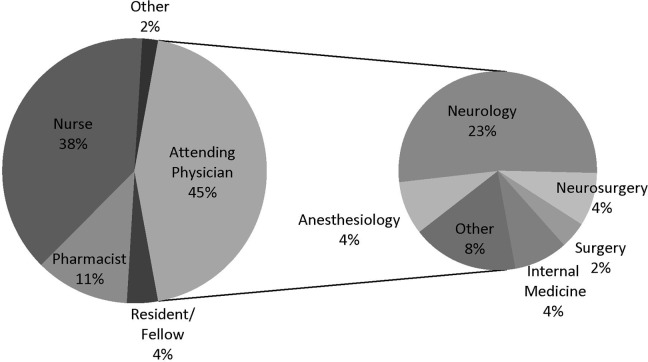
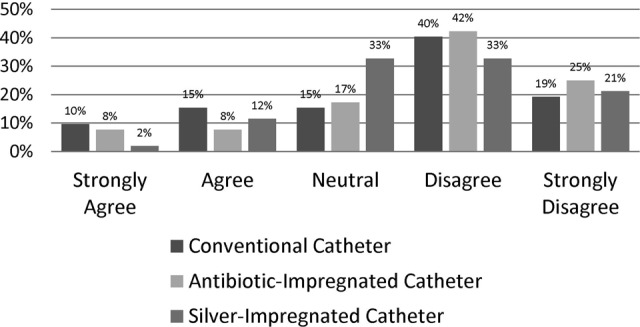
Results: The survey was completed by 52 individuals (5% response rate). Catheter selection, use of prolonged prophylactic systemic antibiotics (PPSAs), cerebrospinal fluid (CSF) collection policies, location of EVD placement, and performance of routine EVD exchanges varied. Antibiotic-impregnated catheters (AICs) and conventional catheters (CCs) were used with similar frequency, but no respondents reported routine use of silver-impregnated catheters (SICs). The majority of respondents were either neutral or disagreed with the need for PPSA with all catheter types (CC: 75%, AIC: 85%, and SIC: 87%). Despite this, 55% of the respondents reported PPSAs were routinely administered to patients with EVDs at their institutions. The majority (80%) of the respondents reported CSF collection only on an as-needed basis. The EVD placement was restricted to the operating room at 27% of the respondents' institutions. Only 2 respondents (4%) reported that routine EVD exchanges were performed at their institution.
Conclusion: Practice patterns demonstrate that institutions use varying strategies to prevent ventriculostomy-related infections. Identification and further study of optimum care for these patients are essential to decrease the risk of complications and to aid development of practice standards.
Keywords: cerebrospinal fluid; external ventricular drain; ventriculitis; ventriculostomy-related infection.
Conflict of interest statement
The authors declared no potential conflicts of interest with respect to the research, authorship, and/or publication of this article.
Figures
References
-
- Srinivasan VM, O’Neill BR, Jho D, Whiting DM, Oh MY. The history of external ventricular drainage. J Neurosurg. 2014;120(1):228–236. - PubMed
-
- Bader MK, Littlejohns L, Palmer S. Ventriculostomy and intracranial pressure monitoring: in search of a 0% infection rate. Heart Lung. 1995;24(2):166–172. - PubMed
-
- Le Roux P, Menon DK, Citerio G, et al. Consensus summary statement of the International Multidisciplinary Consensus Conference on Multimodality Monitoring in Neurocritical Care: a statement for healthcare professionals from the Neurocritical Care Society and the European Society of Intensive Care Medicine. Neurocrit Care. 2014;21(suppl 2):S1–S26. - PMC - PubMed
-
- Babu MA, Patel R, Marsh WR, Wijdicks EFM. Strategies to decrease the risk of ventricular catheter infections: a review of the evidence. Neurocrit Care. 2012;16(1):194–202. - PubMed
Grants and funding
LinkOut - more resources
Full Text Sources
Other Literature Sources
Miscellaneous