


Effects on Balance and Walking with the CoDuSe Balance Exercise Program in People with Multiple Sclerosis: A Multicenter Randomized Controlled Trial
- PMID: 28042485
- PMCID: PMC5155099
- DOI: 10.1155/2016/7076265
Effects on Balance and Walking with the CoDuSe Balance Exercise Program in People with Multiple Sclerosis: A Multicenter Randomized Controlled Trial
Abstract
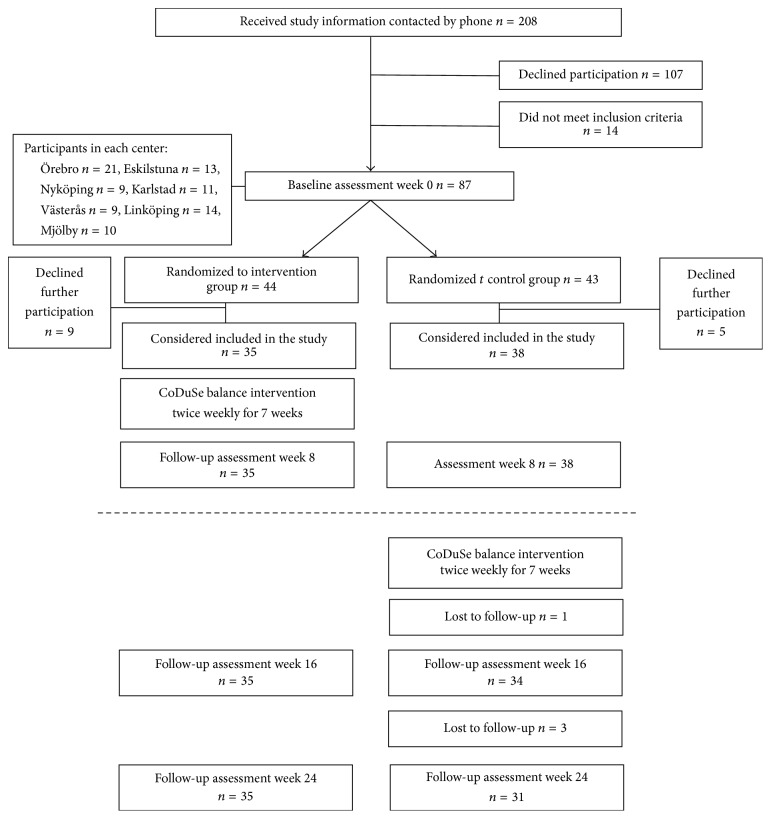
Background. Balance and walking impairments are frequent in people with multiple sclerosis (MS). Objective. The aim was to investigate the effects of a group-based balance exercise program targeting core stability, dual tasking, and sensory strategies (CoDuSe) on balance, postural sway, walking, perceived walking limitations, and balance confidence. Design. A single-blinded randomized multicenter trial. No intervention was given to controls. Participants. People with MS able to walk 100 meters but unable to maintain tandem stance ≥30 seconds. Eighty-seven participants were randomized to intervention or control. Intervention. The 60-minute CoDuSe group program, twice weekly for seven weeks, supervised by physical therapists. Measurements. Primary outcome was dynamic balance (Berg Balance Scale (BBS)). Secondary outcomes were postural sway, walking (Timed-Up and Go test; Functional Gait Assessment (FGA)), MS Walking Scale, and Activities-specific Balance Confidence (ABC) Scale. Assessments were performed before and after (week 8) the intervention. Results. 73 participants fulfilled the study. There were significant differences between the intervention and the control groups in change in the BBS and in the secondary measures: postural sway with eyes open, FGA, MS Walking Scale, and ABC scale in favor of the intervention. Conclusions. The seven-week CoDuSe program improved dynamic balance more than no intervention.
Conflict of interest statement
The authors are free to publish the data and declare that there is no conflict of interests.
Figures
References
LinkOut - more resources
Full Text Sources
Other Literature Sources
Miscellaneous
