


Relationship between Potential Sperm Factors Involved in Oocyte Activation and Sperm DNA Fragmentation with Intra-Cytoplasmic Sperm Injection Clinical Outcomes
- PMID: 28042543
- PMCID: PMC5086337
- DOI: 10.22074/cellj.2016.4725
Relationship between Potential Sperm Factors Involved in Oocyte Activation and Sperm DNA Fragmentation with Intra-Cytoplasmic Sperm Injection Clinical Outcomes
Abstract
Objective: The present study aimed to simultaneously evaluate the association between expression of three potential factors [post-acrosomal sheath WW domain-binding protein (PAWP), phospholipase Cζ (PLCζ), and truncated form of the kit receptor (TR-KIT)] as candidates of oocyte activation with fertilization rate and early embryonic development.
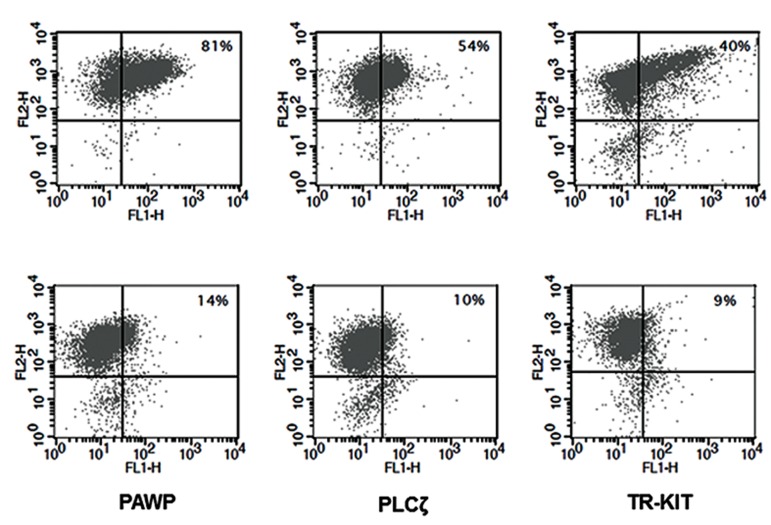
Materials and methods: In this experimental study, semen samples were collected from 35 intra-cytoplasmic sperm injection (ICSI) candidates and analyzed according to World Health Organization criteria (2010). Each sample was divided into two parts. The first part was processed for insemination by density-gradient centrifugation (DGC) and the second part was prepared for assessment of sperm morphology (Papanicolaou staining), DNA fragmentation [transferase dUTP nick end labeling (TUNEL)], and three Sperm-borne oocyte-activating factor (s) (SOAFs)-PLCζ, PAWP, and TR-KIT.
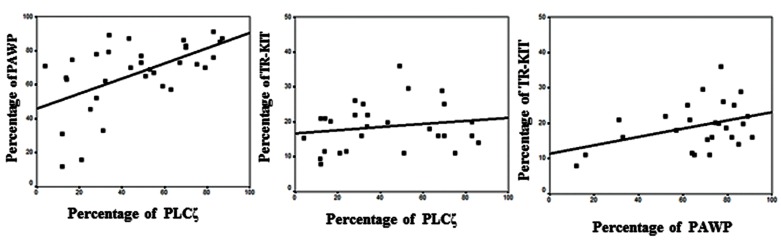
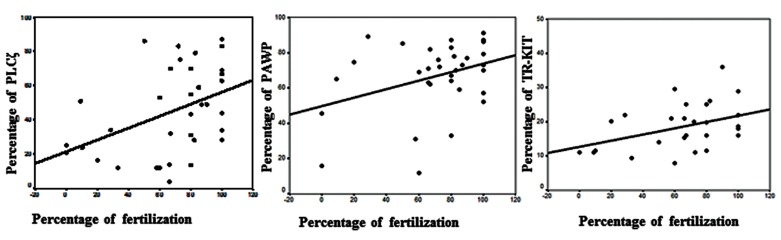
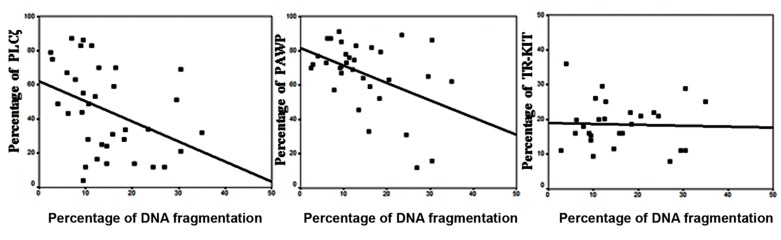
Results: Significant positive correlations existed between the percentages of PLCζ, PAWP, and TR-KIT with fertilization rate. In addition, significant negative correlations existed between the percentage of DNA fragmentation with the percentages of PLCζ and PAWP. We did not find a relationship between percentages of PLCζ, PAWP, and TR-KIT with embryo quality and pregnancy rate (P>0.05). There was a significant negative correlation between percentage of DNA fragmentation with fertilization and embryo quality.
Conclusion: Oocyte activation was associated with the studied sperm factors (PAWP, PLCζ, and TR-KIT). These factors might hold the potential to be considered as diagnostic factors in the assessment of semen samples to evaluate their potential to induce oocyte activation. In addition, we observed a significant association between DNA fragmentation with fertilization, as well as embryo quality and expression of PAWP and PLCζ, which indicated that men with high degrees of DNA fragmentation might require artificial oocyte activation. Whether such action should take place, and its cost and benefits should be evaluated in the future.
Keywords: DNA Fragmentation; Fertilization; Intra-Cytoplasmic Sperm Injection; Phospholipase Cζ.
Figures
References
-
- Alvarez Sedó C, Oko R, Sutovsky P, Chemes H, Rawe VY. Biogenesis of the sperm head perinuclear theca during human spermiogenesis. Fertil Steril. 2009;92(4):1472–1473. - PubMed
-
- Muciaccia B, Sette C, Paronetto MP, Barchi M, Pensini S, D'Agostino A, et al. Expression of a truncated form of KIT tyrosine kinase in human spermatozoa correlates with sperm DNA integrity. Hum Reprod. 2010;25(9):2188–2202. - PubMed
-
- Sette C, Bevilacqua A, Bianchini A, Mangia F, Geremia R, Rossi P. Parthenogenetic activation of mouse eggs by microinjection of a truncated c-kit tyrosine kinase present in spermatozoa. Development. 1997;124(11):2267–2274. - PubMed
-
- Aarabi M, Balakier H, Bashar S, Moskovtsev SI, Sutovsky P, Librach CL, et al. Sperm-derived WW domain-binding protein, PAWP, elicits calcium oscillations and oocyte activation in humans and mice. FASEB J. 2014;28(10):4434–4440. - PubMed
-
- Kashir J, Nomikos M, Swann K, Lai FA. PLCζ or PAWP: revisiting the putative mammalian sperm factor that triggers egg activation and embryogenesis. Mol Hum Reprod. 2015;21(5):383–388. - PubMed
LinkOut - more resources
Full Text Sources