


Eimeria species occurrence varies between geographic regions and poultry production systems and may influence parasite genetic diversity
- PMID: 28043390
- PMCID: PMC5239766
- DOI: 10.1016/j.vetpar.2016.12.003
Eimeria species occurrence varies between geographic regions and poultry production systems and may influence parasite genetic diversity
Abstract
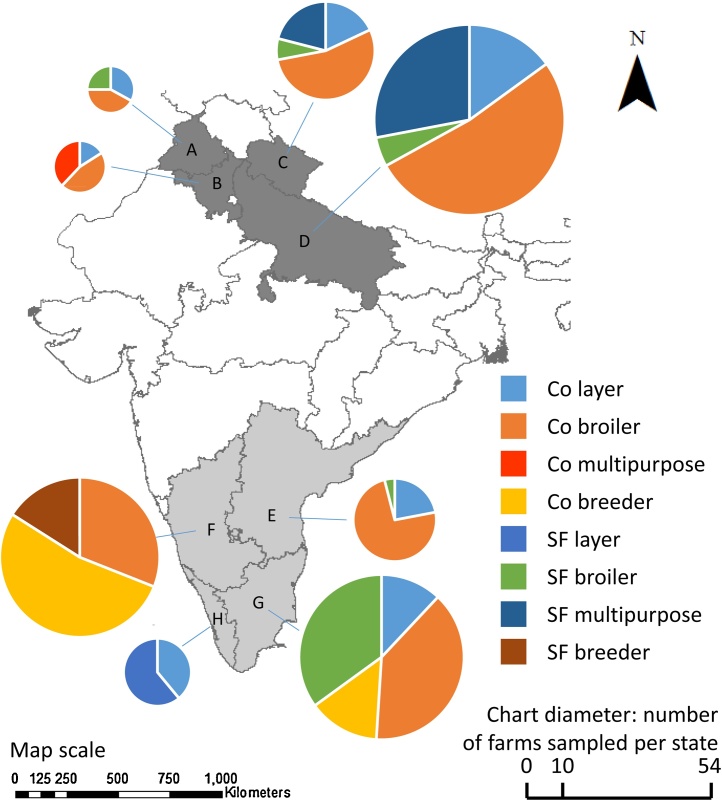
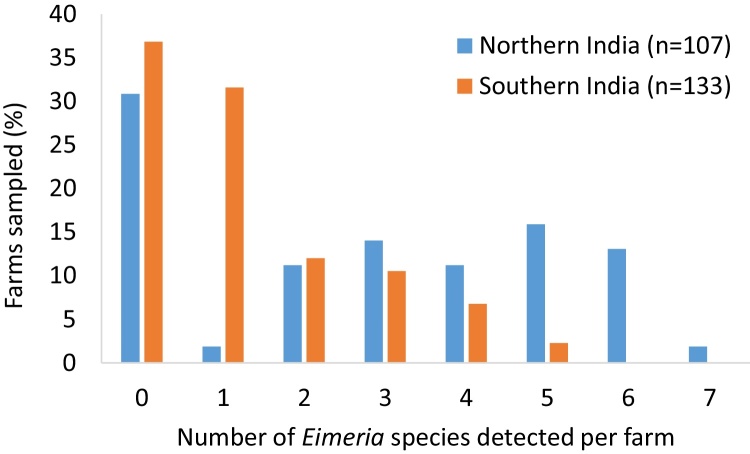
Coccidiosis is one of the biggest challenges faced by the global poultry industry. Recent studies have highlighted the ubiquitous distribution of all Eimeria species which can cause this disease in chickens, but intriguingly revealed a regional divide in genetic diversity and population structure for at least one species, Eimeria tenella. The drivers associated with such distinct geographic variation are unclear, but may impact on the occurrence and extent of resistance to anticoccidial drugs and future subunit vaccines. India is one of the largest poultry producers in the world and includes a transition between E. tenella populations defined by high and low genetic diversity. The aim of this study was to identify risk factors associated with the prevalence of Eimeria species defined by high and low pathogenicity in northern and southern states of India, and seek to understand factors which vary between the regions as possible drivers for differential genetic variation. Faecal samples and data relating to farm characteristics and management were collected from 107 farms from northern India and 133 farms from southern India. Faecal samples were analysed using microscopy and PCR to identify Eimeria occurrence. Multiple correspondence analysis was applied to transform correlated putative risk factors into a smaller number of synthetic uncorrelated factors. Hierarchical cluster analysis was used to identify poultry farm typologies, revealing three distinct clusters in the studied regions. The association between clusters and presence of Eimeria species was assessed by logistic regression. The study found that large-scale broiler farms in the north were at greatest risk of harbouring any Eimeria species and a larger proportion of such farms were positive for E. necatrix, the most pathogenic species. Comparison revealed a more even distribution for E. tenella across production systems in south India, but with a lower overall occurrence. Such a polarised region- and system-specific distribution may contribute to the different levels of genetic diversity observed previously in India and may influence parasite population structure across much of Asia and Africa. The findings of the study can be used to prioritise target farms to launch and optimise appropriate anticoccidial strategies for long-term control.
Keywords: Chickens; Eimeria; Epidemiology; Genetic diversity.
Copyright © 2016 The Author(s). Published by Elsevier B.V. All rights reserved.
Figures
References
-
- Aarthi S., Dhinakar Raj G., Raman M., Gomathinayagam S., Kumanan K. Molecular prevalence and preponderance of Eimeria spp. among chickens in Tamil Nadu, India. Parasitol. Res. 2010;107:1013–1017. - PubMed
-
- Al-Natour M.Q., Suleiman M.M., Abo-Shehada M.N. Flock-level prevalence of Eimeria species among broiler chicks in northern Jordan. Prev. Vet. Med. 2002;53:305–310. - PubMed
-
- Arora G., Mishra S.K., Nautiyal B., Pratap S.O., Gupta A., Beura C.K., Singh D.P. Genetics of hyperpigmentation associated with the Fibromelanosis gene (Fm) and analysis of growth and meat quality traits in crosses of native Indian Kadaknath chickens and non-indigenous breeds. Br. Poult. Sci. 2011;52:675–685. - PubMed
-
- Awais M.M., Akhtar M., Iqbal Z., Muhammad F., Anwar M.I. Seasonal prevalence of coccidiosis in industrial broiler chickens in Faisalabad Punjab, Pakistan. Trop. Anim. Health Prod. 2012;44:323–328. - PubMed
-
- Blake D.P., Tomley F.M. Securing poultry production from the ever-present Eimeria challenge. Trends Parasitol. 2014;30:12–19. - PubMed
MeSH terms
Substances
LinkOut - more resources
Full Text Sources
Other Literature Sources
