Review
. 2017 Jan 1;130(1):71-82.
doi: 10.1242/jcs.191742.

Tissue mechanics regulate brain development, homeostasis and disease

Affiliations
Review

Tissue mechanics regulate brain development, homeostasis and disease

J Matthew Barnes et al. J Cell Sci. .

Abstract

All cells sense and integrate mechanical and biochemical cues from their environment to orchestrate organismal development and maintain tissue homeostasis. Mechanotransduction is the evolutionarily conserved process whereby mechanical force is translated into biochemical signals that can influence cell differentiation, survival, proliferation and migration to change tissue behavior. Not surprisingly, disease develops if these mechanical cues are abnormal or are misinterpreted by the cells - for example, when interstitial pressure or compression force aberrantly increases, or the extracellular matrix (ECM) abnormally stiffens. Disease might also develop if the ability of cells to regulate their contractility becomes corrupted. Consistently, disease states, such as cardiovascular disease, fibrosis and cancer, are characterized by dramatic changes in cell and tissue mechanics, and dysregulation of forces at the cell and tissue level can activate mechanosignaling to compromise tissue integrity and function, and promote disease progression. In this Commentary, we discuss the impact of cell and tissue mechanics on tissue homeostasis and disease, focusing on their role in brain development, homeostasis and neural degeneration, as well as in brain cancer.

Keywords: Glioma; Mechanobiology; Mechanotransduction; Microenvironment; Neurodegeneration.


Conflict of interest statement

Competing interests

The authors declare no competing or financial interests.

Figures
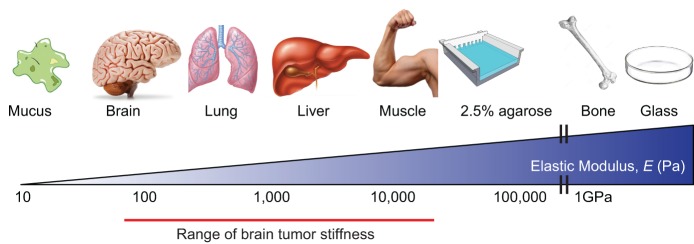
Fig. 1.
Fig. 1.
Mechanical properties of tissues. Young's, or elastic, modulus (E) describes the amount of force required to deform a substance, with units of force/area (N/m2) or Pascals. E of tissues and cells can be quantified, revealing their relative stiffness. All tissues have distinct intrinsic physical properties, which are important in their structure and function. The stiffest tissues of the body are tooth and bone (E≥109 Pa), muscle tissue is intermediate (E≥104 Pa), and among the softest are lung and brain (E≤4×10² Pa). For reference, a 2.5% agarose gel is approximately 35 kPa, whereas a tissue culture glass is off the scale, in the gigapascal range.
Fig. 2.
Fig. 2.
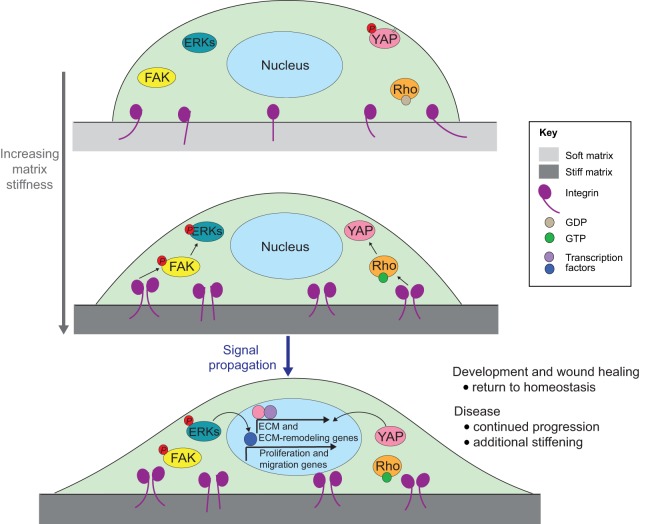
Example of mechanoreciprocity. In this example (there are many molecular sensors, amplifiers and effectors of mechanics), an adherent cell senses an increase in ECM stiffness through integrins. This leads to an increase in focal adhesion formation and activation of focal adhesion kinase (FAK), which propagates the signal to mitogen-activated kinases, such as extracellular signal-regulated kinase (ERK), and the small GTPase Rho. In response to Rho activation, actomyosin contractility is elevated, causing the cell to become more spread and tightly adhered to its matrix. Additionally, transcription factors such as Yes-associated protein (YAP) are mechanically activated through Rho (Dupont et al., 2011), which induce the expression of ECM and ECM-modifying genes. Signaling downstream of ERK also results in transcriptional activation of proliferation and migration genes. In a physiological context, such as gastrulation or wound healing, this process is eventually resolved. In disease states, such as cancer, this cascade remains active, driving a vicious cycle of matrix stiffening and mechanosignaling, thereby contributing to disease progression.
Fig. 3.
Fig. 3.
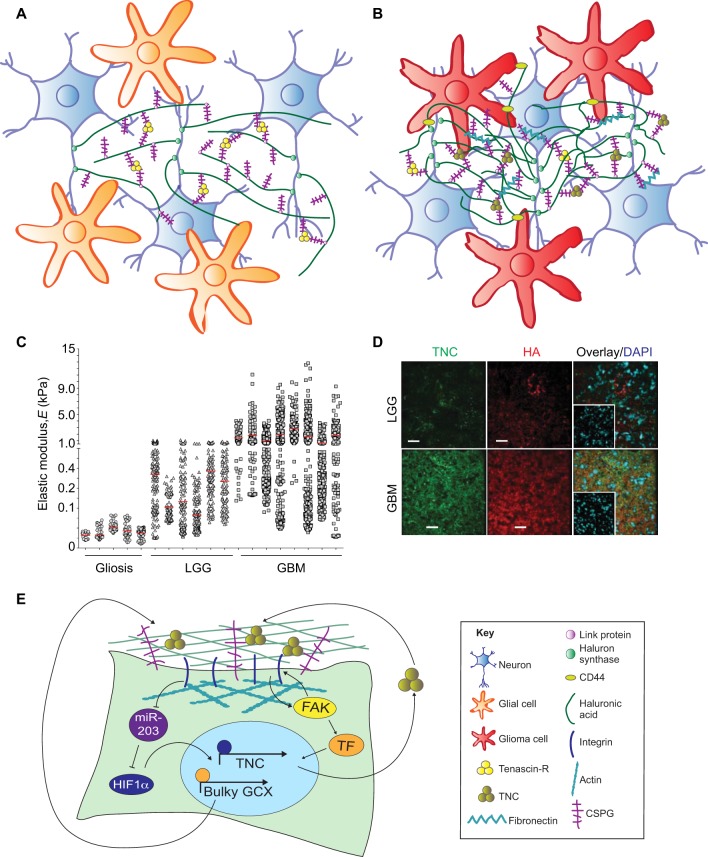
Tissue mechanics drive glioma aggression. (A) Diagram showing perineuronal nets of the normal brain and (B) the perturbed matrix in the context of glioma. (C) Human glioma samples have been mechanically analyzed by using AFM. Lower-grade gliomas (LGGs) and glioblastomas (GBMs) are progressively stiffer when compared to non-tumor gliotic brain tissue. The red vertical lines indicate the mean elastic modulus, ‘E’, for each sample. (D) Human LGG and GBM sections stained for tenascin C (TNC) and hyaluronic acid (HA) reveal that both factors are elevated in GBMs. Scale bars: 50 µm. Panels C and D are reproduced from Miroshnikova et al., 2016 with permission. (E) Diagram summarizing signaling pathways involved in translating extracellular mechanical and integrin-based signals into cellular responses in the context of glioma progression. FAK, focal adhesion kinase; GCX, glycocalyx genes; HIF1α, hypoxia-inducible factor-1α; TF, transcription factor; TNC, tenascin C.

References

    1. Abaskharoun M., Bellemare M., Lau E. and Margolis R. U. (2010a). Expression of hyaluronan and the hyaluronan-binding proteoglycans neurocan, aggrecan, and versican by neural stem cells and neural cells derived from embryonic stem cells. Brain Res. 1327, 6-15. 10.1016/j.brainres.2010.02.048 - DOI - PMC - PubMed
    1. Abaskharoun M., Bellemare M., Lau E. and Margolis R. U. (2010b). Glypican-1, phosphacan/receptor protein-tyrosine phosphatase-zeta/beta and its ligand, tenascin-C, are expressed by neural stem cells and neural cells derived from embryonic stem cells. Asn Neuro 2, e00039 10.1042/AN20100001 - DOI - PMC - PubMed
    1. Acerbi I., Cassereau L., Dean I., Shi Q., Au A., Park C., Chen Y. Y., Liphardt J., Hwang E. S. and Weaver V. M. (2015). Human breast cancer invasion and aggression correlates with ECM stiffening and immune cell infiltration. Integr. Biol. 7, 1120-1134. 10.1039/C5IB00040H - DOI - PMC - PubMed
    1. Alberti E., Hartmann A., Schutz H.-J. and Schreckenberger F. (1978). The effect of large doses of dexamethasone on the cerebrospinal fluid pressure in patients with supratentorial tumors. J. Neurol. 217, 173-181. 10.1007/BF00312958 - DOI - PubMed
    1. Alvarez-Buylla A. and Lim D. A. (2004). For the long run: maintaining germinal niches in the adult brain. Neuron 41, 683-686. 10.1016/S0896-6273(04)00111-4 - DOI - PubMed

Publication types