


Evaluation of Facebook and Twitter Monitoring to Detect Safety Signals for Medical Products: An Analysis of Recent FDA Safety Alerts
- PMID: 28044249
- PMCID: PMC5362648
- DOI: 10.1007/s40264-016-0491-0
Evaluation of Facebook and Twitter Monitoring to Detect Safety Signals for Medical Products: An Analysis of Recent FDA Safety Alerts
Abstract
Introduction: The rapid expansion of the Internet and computing power in recent years has opened up the possibility of using social media for pharmacovigilance. While this general concept has been proposed by many, central questions remain as to whether social media can provide earlier warnings for rare and serious events than traditional signal detection from spontaneous report data.
Objective: Our objective was to examine whether specific product-adverse event pairs were reported via social media before being reported to the US FDA Adverse Event Reporting System (FAERS).
Methods: A retrospective analysis of public Facebook and Twitter data was conducted for 10 recent FDA postmarketing safety signals at the drug-event pair level with six negative controls. Social media data corresponding to two years prior to signal detection of each product-event pair were compiled. Automated classifiers were used to identify each 'post with resemblance to an adverse event' (Proto-AE), among English language posts. A custom dictionary was used to translate Internet vernacular into Medical Dictionary for Regulatory Activities (MedDRA®) Preferred Terms. Drug safety physicians conducted a manual review to determine causality using World Health Organization-Uppsala Monitoring Centre (WHO-UMC) assessment criteria. Cases were also compared with those reported in FAERS.
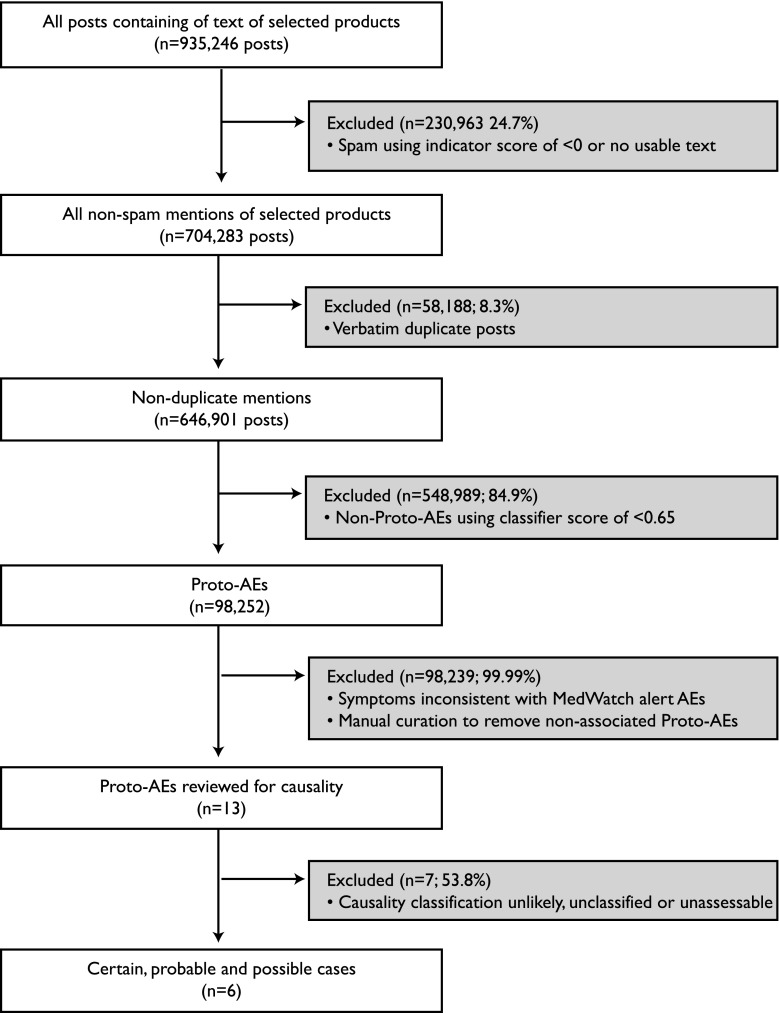
Findings: A total of 935,246 posts were harvested from Facebook and Twitter, from March 2009 through October 2014. The automated classifier identified 98,252 Proto-AEs. Of these, 13 posts were selected for causality assessment of product-event pairs. Clinical assessment revealed that posts had sufficient information to warrant further investigation for two possible product-event associations: dronedarone-vasculitis and Banana Boat Sunscreen--skin burns. No product-event associations were found among the negative controls. In one of the positive cases, the first report occurred in social media prior to signal detection from FAERS, whereas the other case occurred first in FAERS.
Conclusions: An efficient semi-automated approach to social media monitoring may provide earlier insights into certain adverse events. More work is needed to elaborate additional uses for social media data in pharmacovigilance and to determine how they can be applied by regulatory agencies.
Conflict of interest statement
Funding
All research presented here was conducted by the authors listed. Additional general development funds for the social listening platform were provided to Epidemico through a public–private partnership but were not used to directly support the specific content of this research. This collaborative effort is provided via the WEB-RADR project (
Conflict of interest
Carrie Pierce, Hoa Van Le, Harold Rodriguez, John Brownstein, Clark Freifeld, and Nabarun Dasgupta are employees of or contractors to Epidemico, a technology company intending to commercialize the software platform used in this research. Epidemico is a wholly owned subsidiary of Booz Allen Hamilton. I. Ralph Edwards has no conflicts of interest that are directly relevant to the content of this manuscript. Khaled Bouri, Carol Pamer, Scott Proestel, and Mark Walderhaug are employees of the United States Food and Drug Administration. Development of the social listening platform, research conducted, and manuscript development was funded by the US FDA (
US Government employee statement
The following authors are employees of the US Government: Khaled Bouri, Carol Pamer, Scott Proestel, and Mark Walderhaug. The opinions expressed in this manuscript are those of the authors and not intended to represent the opinions of the United States Food and Drug Administration.
Ethics statement
All human subject data used in this analysis were publicly available and used in a de-identified format whenever possible.
Figures
Comment in
-
Comment on: "Evaluation of Facebook and Twitter Monitoring to Detect Safety Signals for Medical Products: An Analysis of Recent FDA Safety Alerts".Drug Saf. 2017 Aug;40(8):755. doi: 10.1007/s40264-017-0537-y. Drug Saf. 2017. PMID: 28425072 No abstract available.
References
-
- Brown D. 52 Cool facts about social media--2012 edition dannybrown.me. 2012. http://dannybrown.me/2012/06/06/52-cool-facts-social-media-2012. Accessed 6 Oct 2015.
-
- Beevolve. An exhaustive study of Twitter users across the world--social media analytics. Beevolve. 2012. http://temp.beevolve.com/twitter-statistics/-cl. Accessed 6 Oct 2015.
Publication types
MeSH terms
LinkOut - more resources
Full Text Sources
Other Literature Sources
Medical
