


Public primary and secondary skin cancer prevention, perceptions and knowledge: an international cross-sectional survey
- PMID: 28045207
- PMCID: PMC6084324
- DOI: 10.1111/jdv.14104
Public primary and secondary skin cancer prevention, perceptions and knowledge: an international cross-sectional survey
Abstract
Background: The incidence of melanoma and non-melanoma skin cancer is continuing to increase worldwide, with sun exposure serving as the primary external aetiologic force in its development. Despite noticeable public health efforts, there continue to be gaps in public awareness and primary and secondary prevention mechanisms. This survey study sought to investigate preventative behaviours regarding sun exposure and skin cancer detection at an international scale.
Methods: A questionnaire was submitted, both online and by telephone, to a representative sample (based on official demographic statistics on gender, age and region) of people aged from 15 to 65 originating from 23 countries. Questions dealt with demographics, sun exposure and protection, risk knowledge, self-examination, medical advice seeking. Data were then gathered and analysed at different levels.
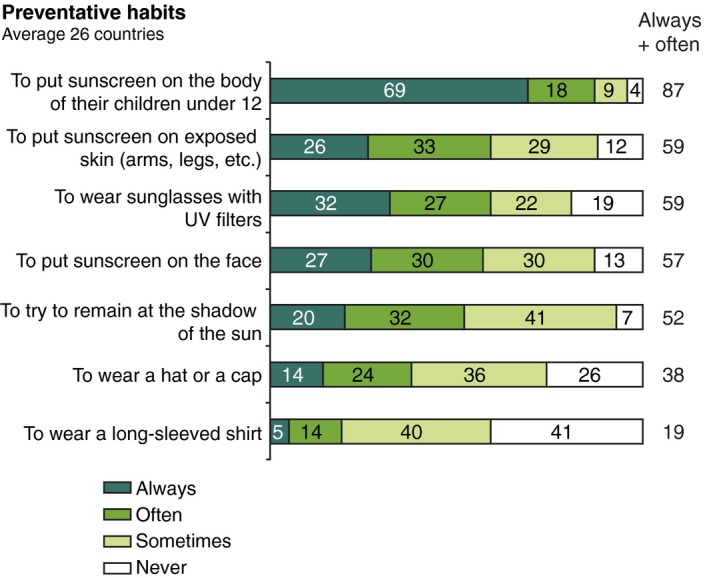
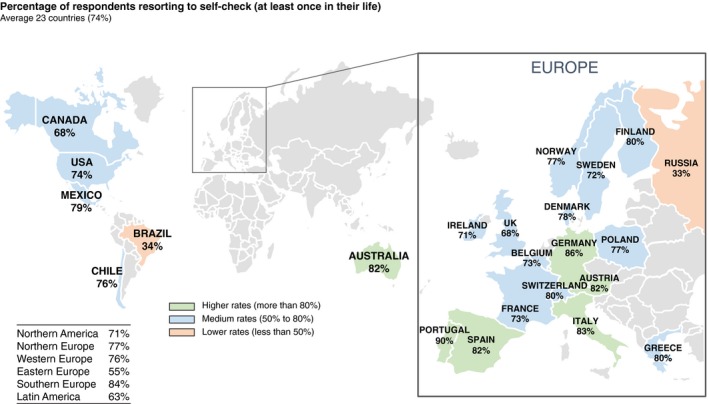
Results: A total of 19 569 respondents were recruited. Overall, sunscreen and sunglasses were the most used measures for sun protection. There were however difference between countries and geographical areas. Some high-risk countries in terms of sun exposure (according to their location to Equator) exhibited higher rates of primary preventative behaviours, in particular Australia, Chile and Greece. There were also discrepancies between countries regarding secondary prevention through self-examination and medical advice seeking. Young people, men, individuals belonging to a lower socio-economic class or having a lower education level were all least likely to know or follow primary and secondary preventive measures.
Conclusion: We found imperfections and geographical inequality both regarding primary and secondary prevention of skin cancer. Our study provides insights that could help to target populations more effectively through information campaigns embedded into the global needed endeavour aiming to reduce mid- and long-term development of skin cancer.
© 2017 European Academy of Dermatology and Venereology.
Figures
References
-
- American Cancer Society . Cancer facts and figures 2016. URL http://www.cancer.org/acs/groups/content/@research/documents/document/ac... (last accessed: 17 March 2016).
-
- Larkin J, Hodi FS, Wolchok JD. Combined nivolumab and ipilimumab or monotherapy in untreated melanoma. N Engl J Med 2015; 373: 1270–1271. - PubMed
-
- Erdmann F, Lortet‐Tieulent J, Schüz J et al International trends in the incidence of malignant melanoma 1953–2008‐are recent generations at higher or lower risk? Int J Cancer 2013; 132: 385–400. - PubMed
MeSH terms
Substances
LinkOut - more resources
Full Text Sources
Other Literature Sources
Medical
