Review
. 2017 Feb 28;11(2):1142-1164.
doi: 10.1021/acsnano.6b05737. Epub 2017 Feb 7.

Advancement of the Emerging Field of RNA Nanotechnology

Affiliations
Review

Advancement of the Emerging Field of RNA Nanotechnology

Daniel Jasinski et al. ACS Nano. .

Abstract

The field of RNA nanotechnology has advanced rapidly during the past decade. A variety of programmable RNA nanoparticles with defined shape, size, and stoichiometry have been developed for diverse applications in nanobiotechnology. The rising popularity of RNA nanoparticles is due to a number of factors: (1) removing the concern of RNA degradation in vitro and in vivo by introducing chemical modification into nucleotides without significant alteration of the RNA property in folding and self-assembly; (2) confirming the concept that RNA displays very high thermodynamic stability and is suitable for in vivo trafficking and other applications; (3) obtaining the knowledge to tune the immunogenic properties of synthetic RNA constructs for in vivo applications; (4) increased understanding of the 4D structure and intermolecular interaction of RNA molecules; (5) developing methods to control shape, size, and stoichiometry of RNA nanoparticles; (6) increasing knowledge of regulation and processing functions of RNA in cells; (7) decreasing cost of RNA production by biological and chemical synthesis; and (8) proving the concept that RNA is a safe and specific therapeutic modality for cancer and other diseases with little or no accumulation in vital organs. Other applications of RNA nanotechnology, such as adapting them to construct 2D, 3D, and 4D structures for use in tissue engineering, biosensing, resistive biomemory, and potential computer logic gate modules, have stimulated the interest of the scientific community. This review aims to outline the current state of the art of RNA nanoparticles as programmable smart complexes and offers perspectives on the promising avenues of research in this fast-growing field.

Keywords: RNA nanoparticles; nanobiotechnology; nanotechnology; pRNA 3WJ motif; siRNA.


Conflict of interest statement

The authors declare the following competing financial interest(s): P.G.'s Sylvan G. Frank Endowed Chair position in Pharmaceutics and Drug Delivery is funded by the CM Chen Foundation. P.G.'s inventions at the University of Kentucky have been licensed to Matt Holding LTD. The content is solely the responsibility of the authors and does not necessarily represent the official views of NIH. P.G. is the consultant of Oxford Nanopore Technologies and Nanobio Delivery Pharmaceutical Co. Ltd, as well as the cofounder of Shenzhen P&Z Bio-medical Co. Ltd and its subsidiary US P&Z Biological Technology LLC.

Figures
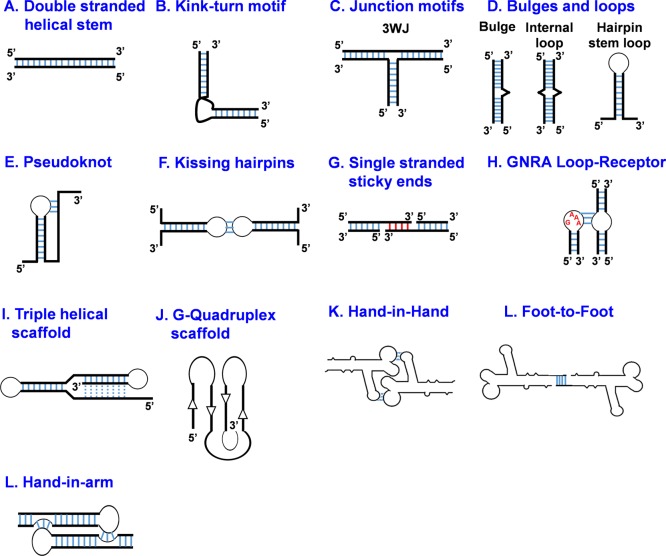
Figure 1
Figure 1
Motifs for constructing RNA nanoparticles. A multitude of RNA motifs are available for the construction of RNA nanoparticles. RNA motifs are extracted from biological RNAs and, after in-depth structural analysis, can be used to generate higher-order structures. The resulting RNA nanoparticles can be functionalized with targeting, imaging, and therapeutic modules for diverse applications in nanobiotechnology.
Figure 2
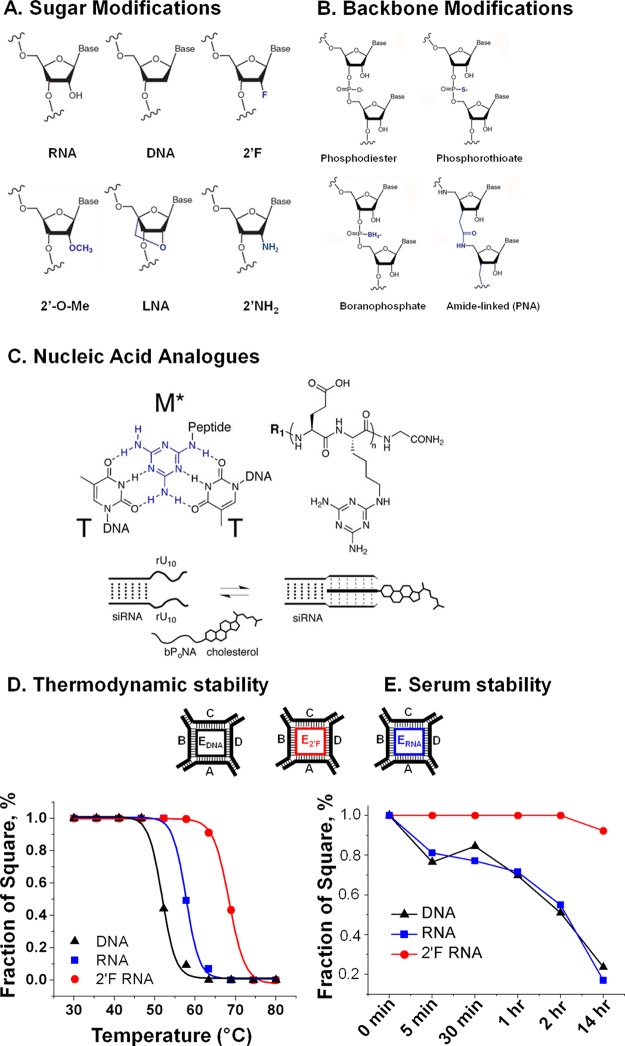
Figure 2
RNA modifications to impact the stability of RNA nanoparticles. (A) Modification to RNA’s sugar moiety. Reprinted with permission from ref (78). Copyright 2008 Elsevier. (B) Backbone modifications. Reprinted with permission from ref (78). Copyright 2008 Elsevier. (C) Synthetic RNA triplex to replace native duplex without compromising original function. Reprinted from ref (85). Copyright 2015 American Chemical Society. (D) Tm changes of RNA nanoparticles resulted from 2′ alteration. Reprinted from ref (22). Copyright 2014 American Chemical Society. (E) The 2′ alteration resulted in different levels of serum stability. Reprinted from ref (22). Copyright 2014 American Chemical Society.
Figure 3
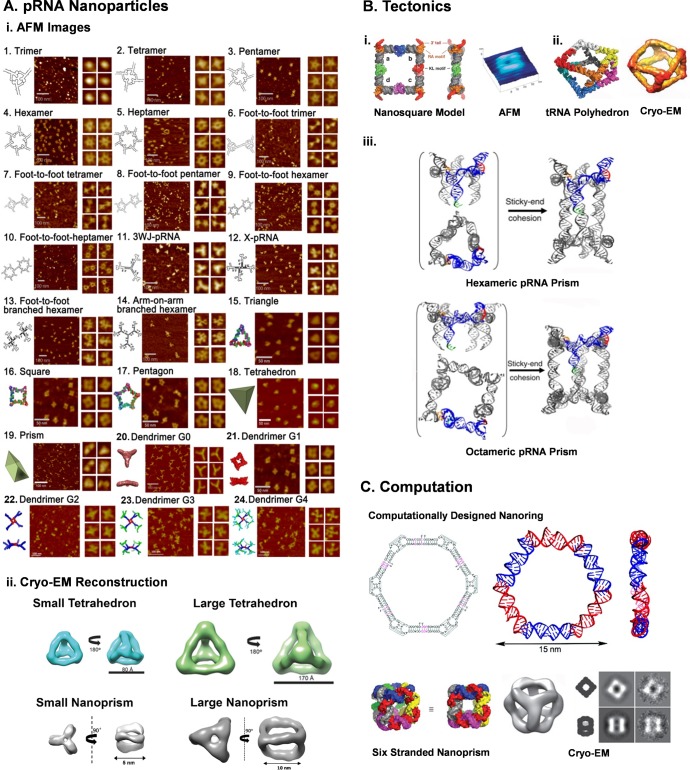
Figure 3
Methods for constructing RNA nanoparticles. (A-i) RNA nanoparticles constructed based on pRNA-3WJ from bacteriophage phi29. Adapted from ref (59). Reprinted with permission from ref (21) (copyright 2014 Oxford University Press) and ref (126) (copyright 2015 Elsevier). (A-ii) Cryo-EM reconstruction of RNA tetrahedron nanoparticles and RNA nanoprisms based on the pRNA-3WJ motif. Reprinted with permission from refs (18) and (125). Copyright 2016 Wiley Publishing. (B) Tectonics method to construct RNA nanosquares, polyhedron from tRNA, and nanoprisms from phi29 pRNA. Reprinted with permission from ref (103) (copyright 2009 American Chemical Society), ref (109) (copyright 2010 Nature Publishing Group), and ref (110) (copyright 2015 Nature Publishing Group). (C) Computational approaches to expedite RNA nanoparticle manufacture and optimization. Adapted from ref (116) and printed with permission from ref (117). Copyright 2010 Nature Publishing Group.
Figure 4
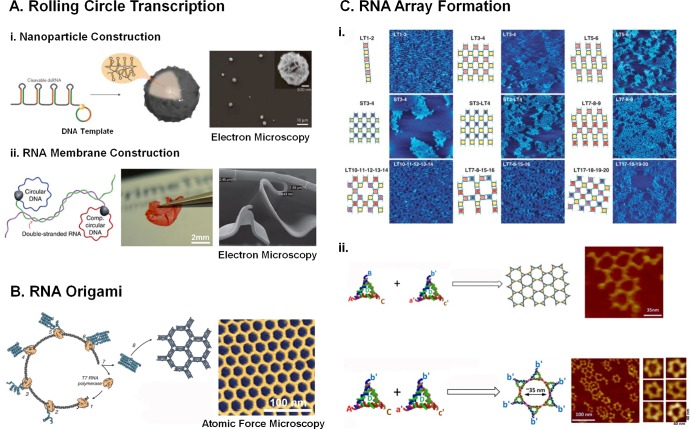
Figure 4
Methods for constructing RNA nanoparticles. (A) Rolling circle transcription to construct RNA architectures and membrane. Reprinted with permission from ref (5) (copyright 2012 Nature Publishing Group) and ref (132) (copyright 2014 Nature Publishing Group). (B) RNA origami utilizing co-transcriptional folding to produce large RNA nanostructures, such as hexameric arrays. Reprinted with permission from ref (127). Copyright 2014 AAAS. (C) RNA arrays. Reprinted with permission from (C-i) ref (32) (copyright 2004 AAAS) and (C-ii) ref (20) (copyright 2014 American Chemical Society).
Figure 5
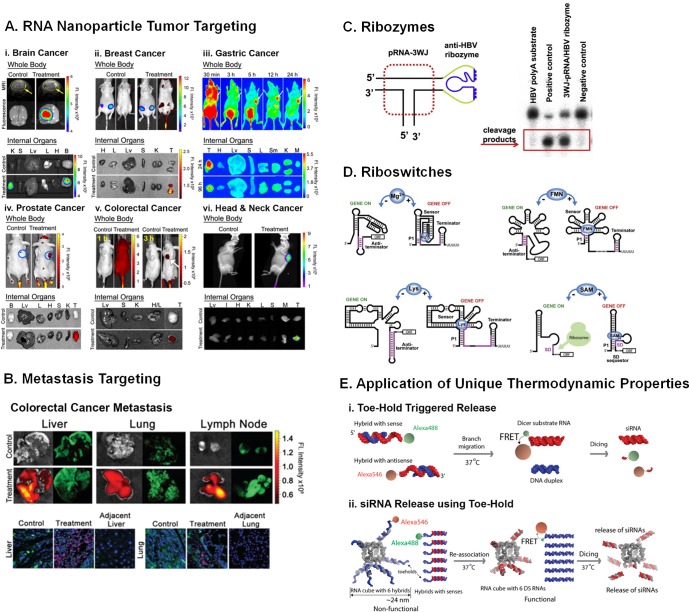
Figure 5
RNA nanoparticles for therapy. (A) RNA aptamers and chemical ligands are used to specifically target tumors in vivo without accumulation in healthy organs, targeting glioblastoma, breast cancer, gastric cancer, prostate cancer, colorectal cancer, and head and neck cancer. Adapted with permission from indicated references. (B) Targeting colorectal cancer metastasis utilizing RNA nanoparticles. Adapted from ref (62). Copyright 2015 American Chemical Society. (C) Ribozymes for cleaving specific RNA substrates similar to RNAi. Adapted with permission from ref (35). Copyright 2011 Nature Publishing Group. (D) Riboswitches to regulate gene expression. Reprinted with permission from ref (175). Copyright 2009 Elsevier. (E) Thermodynamic properties of nucleic acids used for activation and reagent release. Reprinted from (E-i) ref (181) (copyright 2013 Nature Publishing Group) and (E-ii) ref (180) (copyright 2014 American Chemical Society).
Figure 6
Figure 6
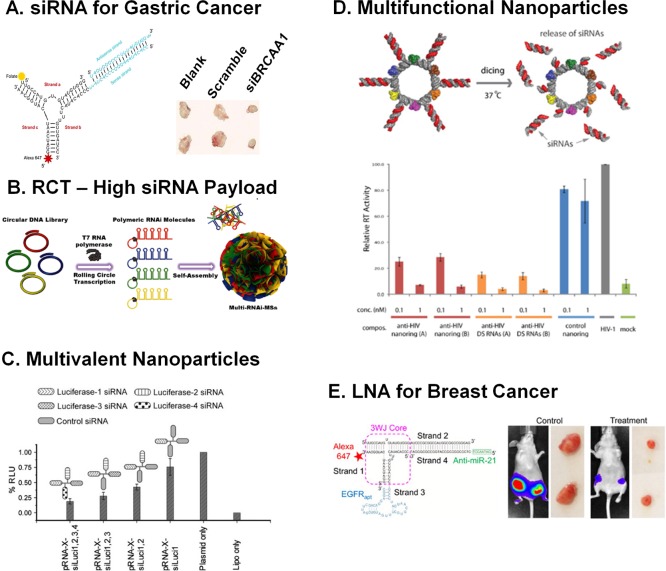
RNA nanoparticles for RNAi. (A) pRNA-3WJ to deliver BRCAA1 siRNA in vivo and inhibit the growth of gastric tumors. Adapted with permission from ref (61). Copyright 2015 Nature Publishing Group. (B) RCT used to generate kilobase concatemeric RNA oligomers for a high payload delivery of multiple siRNA. Adapted with permission from ref (186). Copyright 2016 Wiley Publishing Group. (C) Multivalency of siRNA showing a synergistic effect on gene knockdown. Increasing the copy number of luciferase siRNA shows drastic decrease in luminescence units. Reprinted with permission from ref (36). Copyright 2012 Elsevier. (D) RNA nanorings to carry six siRNAs for different targets in HIV for gene knockdown. Adapted from ref (188). Copyright 2014 American Chemical Society. (E) pRNA-3WJ to deliver anti-miRNA, LNA, to slow the growth of tumors in triple negative breast cancer. Adapted from ref (60). Copyright 2015 American Chemical Society.
Figure 7
Figure 7
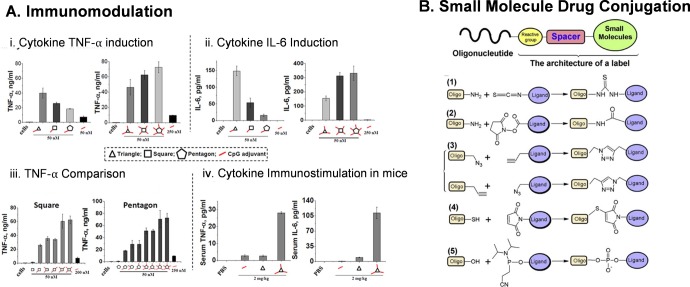
RNA nanoparticles for immunotherapy and chemotherapeutic delivery. (A) RNA nanoparticles display little to no immune response under normal conditions, but addition of immunostimulatory CpG sequences results in huge increases in the immune response for cytokine production. Reprinted with permission from ref (21). Copyright 2014 Oxford University Press. (B) Methods for conjugation of chemicals and drugs to RNA nanoparticles. Reprinted with permission from ref (119). Copyright 2014 Elsevier.
Figure 8
Figure 8
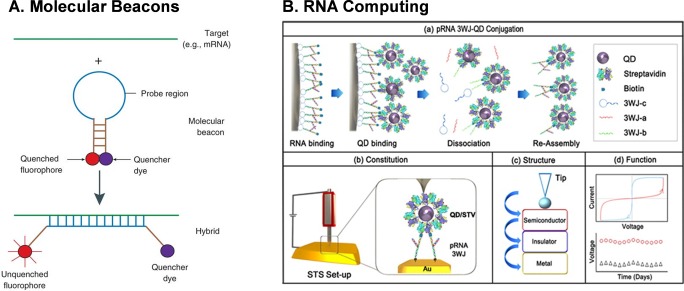
Application of RNA nanotechnology in beacons (A) and resistive biomemory (B). Panel A reprinted with permission from ref (207). Copyright 2006 Nature Publishing Group. Panel B reprinted from ref (220). Copyright 2015 American Chemical Society.

References

    1. Guo P. The Emerging Field of RNA Nanotechnology. Nat. Nanotechnol. 2010, 5, 833–842. 10.1038/nnano.2010.231. - DOI - PMC - PubMed
    1. Guo P.; Zhang C.; Chen C.; Trottier M.; Garver K. Inter-RNA Interaction of Phage Phi29 PRNA to Form a Hexameric Complex for Viral DNA Transportation. Mol. Cell 1998, 2, 149–155. 10.1016/S1097-2765(00)80124-0. - DOI - PubMed
    1. Guo S.; Tschammer N.; Mohammed S.; Guo P. Specific Delivery of Therapeutic RNAs to Cancer Cells Via the Dimerization Mechanism of Phi29 Motor PRNA. Hum. Gene Ther. 2005, 16, 1097–1109. 10.1089/hum.2005.16.1097. - DOI - PMC - PubMed
    1. Delebecque C. J.; Lindner A. B.; Silver P. A.; Aldaye F. A. Organization of Intracellular Reactions With Rationally Designed RNA Assemblies. Science 2011, 333, 470–474. 10.1126/science.1206938. - DOI - PubMed
    1. Lee J. B.; Hong J.; Bonner D. K.; Poon Z.; Hammond P. T. Self-Assembled RNA Interference Microsponges for Efficient SiRNA Delivery. Nat. Mater. 2012, 11, 316–322. 10.1038/nmat3253. - DOI - PMC - PubMed

Publication types