


Intensive Patient Education Improves Glycaemic Control in Diabetes Compared to Conventional Education: A Randomised Controlled Trial in a Nigerian Tertiary Care Hospital
- PMID: 28045979
- PMCID: PMC5207750
- DOI: 10.1371/journal.pone.0168835
Intensive Patient Education Improves Glycaemic Control in Diabetes Compared to Conventional Education: A Randomised Controlled Trial in a Nigerian Tertiary Care Hospital
Abstract
Background: Diabetes is now a global epidemic, but most cases are now in low- and middle-income countries. Diabetes self-management education (DSME) is key to enabling patients to manage their chronic condition and can reduce the occurrence of costly and devastating complications. However, there is limited evidence on the effectiveness of different DSME programmes in resource limited settings.
Methods: We conducted an unblinded, parallel-group, individually-randomised controlled trial at the University of Calabar Teaching Hospital (Nigeria) to evaluate whether an intensive and systematic DSME programme, using structured guidelines, improved glycaemic control compared to the existing ad hoc patient education (clinical practice was unchanged). Eligible patients (≥18 years, HbA1c > 8.5% and physically able to participate) were randomly allocated by permuted block randomisation to participate for six months in either an intensive or conventional education group. The primary outcome was HbA1c (%) at six-months.
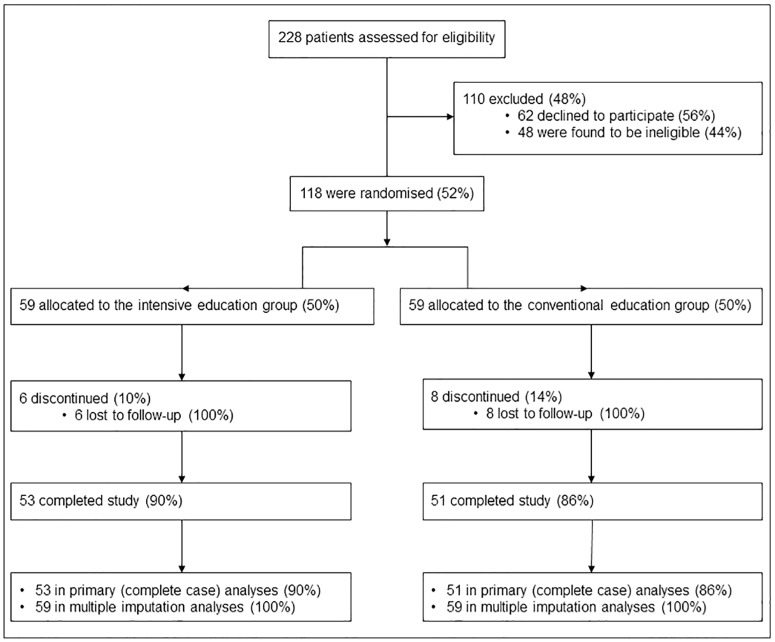
Results: We randomised 59 participants to each group and obtained six-month HbA1c outcomes from 53 and 51 participants in the intensive and conventional education groups, respectively. Intensive group participants had a mean six-month HbA1c (%) of 8.4 (95% CI: 8 to 8.9), while participants in the conventional education group had a mean six-month HbA1c (%) of 10.2 (95% CI: 9.8 to 10.7). The difference was statistically (P < 0.0001) and clinically significant, with intensive group participants having HbA1c outcomes on average -1.8 (95% CI: -2.4 to -1.2) percentage points lower than conventional group participants. Results were robust to adjustment for a range of covariates and multiple imputation of missing outcome data.
Conclusions: This study demonstrates the effectiveness of a structured, guideline-based DSME intervention in a LMIC setting versus a pragmatic comparator. The intervention is potentially replicable at other levels of the Nigerian healthcare system and in other LMICs, where nurses/diabetes educators can run the programme.
Trial registration: Pan African Clinical Trial Registry PACTR20130200047835.
Conflict of interest statement
This study received funding from Norvatis Pharmaceuticals and Biofem Pharmaceuticals provided the HbA1c analysers and cartridges. These were received by O Essien on behalf of the research group. However, the funders had no role in study design, data collection and analysis, decision to publish, or preparation of the manuscript. This does not alter our adherence to PLOS ONE policies on sharing data and materials.
Figures
References
-
- International Diabetes Federation. IDF Diabetes Atlas, 7 ed. 2015. http://www.diabetesatlas.org.
-
- World Health Organization. Global Report on Diabetes. 2016.
-
- Turner RC, Holman RR, Cull CA, Stratton IM, Matthews DR, Frighi V, et al. Intensive blood-glucose control with sulphonylureas or insulin compared with conventional treatment and risk of complications in patients with type 2 diabetes (UKPDS 33). Lancet. 1998;352(9131):837–53. - PubMed
Publication types
MeSH terms
Substances
LinkOut - more resources
Full Text Sources
Other Literature Sources
Medical
