


Indications for Emergency Intervention, Mode of Delivery, and the Childbirth Experience
- PMID: 28046019
- PMCID: PMC5207782
- DOI: 10.1371/journal.pone.0169132
Indications for Emergency Intervention, Mode of Delivery, and the Childbirth Experience
Abstract
Background: Although the impact of emergency procedures on the childbirth experience has been studied extensively, a possible association of childbirth experience with indications for emergency interventions has not been reported.
Objectives: To compare the impacts on childbirth experience of 'planned' delivery (elective cesarean section and vaginal delivery) versus 'unplanned' delivery (vacuum extraction or emergency cesarean section); the intervention itself (vacuum extraction versus emergency cesarean section); and indications for intervention (arrest of labor versus risk to the mother or fetus).
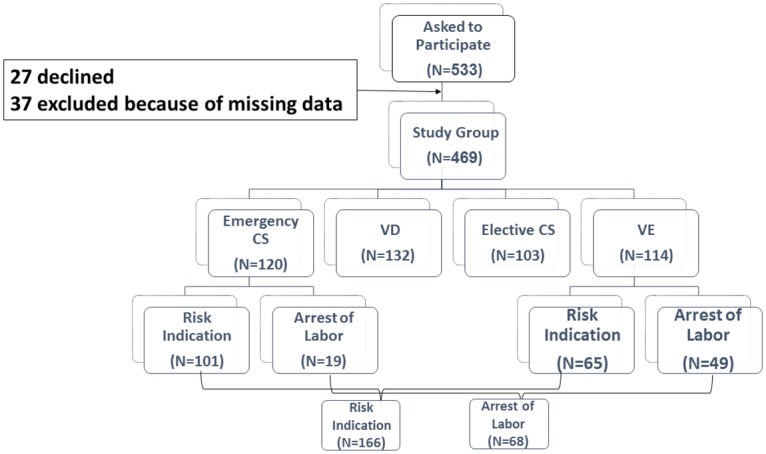
Study design: A total of 469 women, up to 72 hours post-partum, in the maternity ward of one tertiary health care institute completed the Subjective Childbirth Experience Questionnaire (score: 0-4, a higher score indicated a more negative experience) and a Personal Information Questionnaire. Intra-partum information was retrieved from the medical records. One-way analysis of variance and two-way analysis of variance, followed by analysis of covariance, to test the unique contribution of variables, were used to examine differences between groups in outcome. Tukey's Post-Hoc analysis was used when appropriate.
Results: Planned delivery, either vaginal or elective cesarean section, was associated with a more positive experience than unplanned delivery, either vacuum or emergency cesarean section (mean respective Subjective Childbirth Experience scores: 1.58 and 1.49 vs. 2.02 and 2.07, P <0.01). The difference in mean Subjective Childbirth Experience scores following elective cesarean section and vaginal delivery was not significant; nor was the difference following vacuum extraction and emergency cesarean section. Interventions due to immediate risk to mother or fetus resulted in a more positive birth experience than interventions due to arrest of labor (Subjective Childbirth Experience: 1.9 vs. 2.2, P <0.01).
Conclusions: Compared to planned interventions, unplanned interventions were shown to be associated with a more negative maternal childbirth experience. However, the indication for unplanned intervention appears to have a greater effect than the nature of the intervention on the birth experience. Women who underwent emergency interventions due to delay of birth (arrest of labor) perceived their birth experience more negatively than those who underwent interventions due to risk for the mother or fetus, regardless of the nature of the intervention (vacuum or emergency cesarean section). The results indicate the importance of follow-up after unexpected emergency interventions, especially following arrest of labor, as negative birth experience may have repercussions in a woman's psychosocial life and well-being.
Conflict of interest statement
The authors have declared that no competing interests exist.
References
-
- Callister LC. Making meaning: Women's birth narratives. J Obstet Gynecol Neonatal Nurs 2004;33:508–18. - PubMed
-
- Fenwick J, Gamble J, Mawson J. Women’s experiences of Caesarean section and vaginal birth after Caesarian: A Birthrites initiative. Int J Nurs Pract 2003;9:10–7. - PubMed
-
- Righetti-Veltema M, Conne-Perreard E, Bousquet A, Manzano J. Risk factors and predictive signs of postpartum depression. J Affect Disord 1998;49:167–80. - PubMed
-
- Soet JE, Brack GA, Dilorio C. Prevalence and predictors of women’s experience of psychological trauma during childbirth. Birth 2003;30:36–46. - PubMed
MeSH terms
LinkOut - more resources
Full Text Sources
Other Literature Sources
Medical
