


Invasive pneumococcal disease among adults in Japan, April 2013 to March 2015: disease characteristics and serotype distribution
- PMID: 28049447
- PMCID: PMC5209803
- DOI: 10.1186/s12879-016-2113-y
Invasive pneumococcal disease among adults in Japan, April 2013 to March 2015: disease characteristics and serotype distribution
Abstract
Background: In Japan, the clinical characteristics and recent serotype distribution among adult patients of invasive pneumococcal disease (IPD) have not been fully investigated since the introduction of the pneumococcal conjugate vaccine (PCV) in children. From November 2010, PCV7 was encouraged by an official program, funded by government, subsequently included in the routine schedule in April 2013, and replaced with a PCV13 in November 2013.
Methods: Between April 2013 and March 2015, patients with IPD older than 15 years were evaluated based on the enhanced national surveillance in ten prefectures of Japan. The serotype distribution of the isolates was analyzed in these patients.
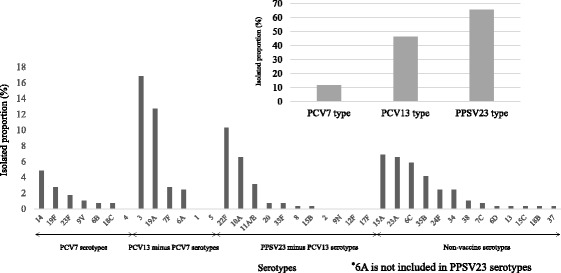
Results: The analysis included 291 patients: 107 patients (37%) were female and the median age was 70 years. Of 281 patients with available data, 202 (72%) had underlying diseases, including 107 patients (38%) with immunocompromised status. The case fatality proportion for all case was 20%. In subgroup analysis, the case fatality proportion (29%) in immunocompromised patients was much higher than that (0-16%) in each age group of nonimmunocompromised patients (15-39 years, 40-64 years, and ≥ 65 years). While the proportion of bacteremia without any focus (27%) was higher than that (8-10%) in nonimmunocompromised patients, the proportions of vaccine types (PCV13, 32%; PPSV23, 51%) of the causative isolates were lower than those in each age group of nonimmunocompromised patients. Among 291 isolates, the most frequent serotypes were 3 (17%), 19A (13%), and 22F (10%). Twelve percent of the isolates were PCV7 serotypes, 46% were PCV13 serotypes, and 66% were PPSV23 serotypes.
Conclusions: The majority of adult patients of IPD had underlying diseases, including immunocompromised conditions. A low proportion (12%) of PCV7-type IPD was observed in this population where PCV7 for children had been included in the routine immunization schedule.
Keywords: Indirect effect; Invasive pneumococcal disease; Streptococcus pneumoniae; Surveillance.
Figures
References
-
- Lynch JP, Zhanel GG. Streptococcus pneumoniae: epidemiology and risk factors, evolution of antimicrobial resistance and impact of vaccines. Curr Opin Pulm Med. 2010;16:217–225. - PubMed
MeSH terms
Substances
LinkOut - more resources
Full Text Sources
Other Literature Sources
Medical
Miscellaneous
