Review
. 2017 Jan;205(1):25-59.
doi: 10.1534/genetics.116.197160.

Cell Biology of the Caenorhabditis elegans Nucleus

Affiliations
Review

Cell Biology of the Caenorhabditis elegans Nucleus

Orna Cohen-Fix et al. Genetics. 2017 Jan.

Abstract

Studies on the Caenorhabditis elegans nucleus have provided fascinating insight to the organization and activities of eukaryotic cells. Being the organelle that holds the genetic blueprint of the cell, the nucleus is critical for basically every aspect of cell biology. The stereotypical development of C. elegans from a one cell-stage embryo to a fertile hermaphrodite with 959 somatic nuclei has allowed the identification of mutants with specific alterations in gene expression programs, nuclear morphology, or nuclear positioning. Moreover, the early C. elegans embryo is an excellent model to dissect the mitotic processes of nuclear disassembly and reformation with high spatiotemporal resolution. We review here several features of the C. elegans nucleus, including its composition, structure, and dynamics. We also discuss the spatial organization of chromatin and regulation of gene expression and how this depends on tight control of nucleocytoplasmic transport. Finally, the extensive connections of the nucleus with the cytoskeleton and their implications during development are described. Most processes of the C. elegans nucleus are evolutionarily conserved, highlighting the relevance of this powerful and versatile model organism to human biology.

Keywords: Caenorhabditis elegans; LEM-domain proteins; LINC; P granule; WormBook; chromatin; gene expression; lamin; nuclear envelope; nuclear pore complex; nucleocytoplasmic transport; nucleolus.


Figures

Figure 1
Figure 1
The transparency of C. elegans makes it very suitable for observation of nuclear processes in living animals. In this example, chromatin in a young adult hermaphrodite is visualized by expression of mCherry-tagged HIS-58/HisH2B from a MosSCI single-copy transgene (A; magenta in C and E), whereas GFP was inserted into the mel-28 locus by CRISPR to label NEs (B; green in C and E). The proteins are expressed in all tissues, but not at equal levels: MEL-28 is particularly abundant in germ line nuclei. Shown are maximal projections of seven confocal sections from hypodermal cells toward the body center (A–C and E) and DIC images (D–E). Strain from Gomez-Saldivar et al. (2016). Bar, 100 µm. mCh, mCherry.
Figure 2
Figure 2
Overview of the C. elegans NE. (A) The NE is an essential structure that regulates many nuclear processes. It is composed of an ONM and an INM, the nuclear lamina, and NPCs. The ONM is continuous with the ER and many macromolecules, including ribosomes, are associated with both membrane structures. In contrast, several NE transmembrane proteins (NETs) are found specifically in the INM, such as LEM-domain proteins EMR-1 and LEM-2, which both bind the chromatin factor BAF-1. Other proteins at the INM include CEC-4, HPL-1/2, and LEM-4 as well as SUN-domain proteins that interact with KASH-domain proteins in the lumen between the INM and the ONM to connect the nucleus to the cytoskeleton. See text for further details. (B) NPCs are composed of ∼30 nuclear pore proteins (NPPs, nups), each present in multiple copies, bringing the total number of proteins close to 1000. Many nups form stable NPC subcomplexes, such as the NPP-5/NUP107 and NPP-13/NUP93 complexes that form the outer (cytoplasmic and nucleoplasmic) and inner rings, respectively. Transmembrane nups are involved in anchoring of the NPC in the NE, whereas nups in the central channel and peripheral cytoplasmic and nucleoplasmic structures are responsible for translocation of substrates through the NPCs. The relative positions of C. elegans nups are predictions based on EM data from yeast and vertebrate cells.
Figure 3
Figure 3
Comparison of global chromosome patterning in humans and C. elegans. Centromeric histone variant (in blue) CENP-A is confined to a single region in the human chromosome, whereas the C. elegans ortholog HCP-3 is present throughout the chromosome, reflecting the monocentric and holocentric chromosome structures, respectively. Large domains enriched for either active chromatin marks (here represented by H3K36me3, in green) or repressive marks (H3K27me3 and H3K9me3, in red) are also more widespread on C. elegans autosomes, with a higher density of active marks in the center and repressive marks on the arms. Adapted from Ho et al. (2014).
Figure 4
Figure 4
Two (left), four (middle), and eight (right) cell-stage C. elegans embryos, visualized using an NPC protein, NPP-1, fused to GFP (top row). The bottom row shows a schematic view of the same embryos. Note that as the embryos progress through early development, their cells and nuclei become smaller. Adapted from Rahman et al. (2015). Bar, 10 µm.
Figure 5
Figure 5
Time-lapse images of two C. elegans embryos, starting at the two-cell stage, showing NE breakdown as it occurs during mitosis. The chromosomes are visualized using histone H2B fused to mCherry and the NE is visualized using (A) the NPC subunit NPP-1 fused to GFP or (B) LMN-1 fused to GFP. The images shown were taken 2 min apart. At the two-cell stage, the AB cell (situated at the bottom half of the embryos in these images) enters mitosis before the P1 cells (at the top half of these embryos). Note that both NPP-1 and LMN-1 are still visible in metaphase. The bright red spots at the bottom edge of the AB cell are the polar bodies. Adapted from Rahman et al. (2015). Bar, 10 µm.
Figure 6
Figure 6
Time-lapse images of early C. elegans embryonic divisions as seen by following the ER/NE. The ER/NE is visualized using (A) the NE protein LEM-2 fused to GFP or (B) the ER marker SP12 fused to GFP. Chromosomes in both panels are visualized using histone H2B fused to mCherry. The embryo in (A) is at the one-cell stage, and the time-lapse begins shortly after fertilization and pronuclear meeting (time −2 min). At time 0 the chromosomes are aligned at the metaphase plate and the two pronuclei have rotated such that the spindle (not shown) is aligned with the long embryo axis. Note that the NE/ER forms a “shell” around the region occupied by the chromosomes and spindle. This remnant NE/ER elongates during anaphase (2 and 4 min) and eventually collapses, as new NEs form around the segregated chromosomes (6 min). The two ER/NE circles indicated by arrows (time 0) surround the centrosomes. The membrane configuration and role of these membranous structures is not known. (B) Shows the ER/NE in a dividing two-cell embryo, where a similar behavior of the NE/ER is observed. The membranous structures around centrosomes are indicated by arrows. Adapted from Rahman et al. (2015). Bar, 10 µm.
Figure 7
Figure 7
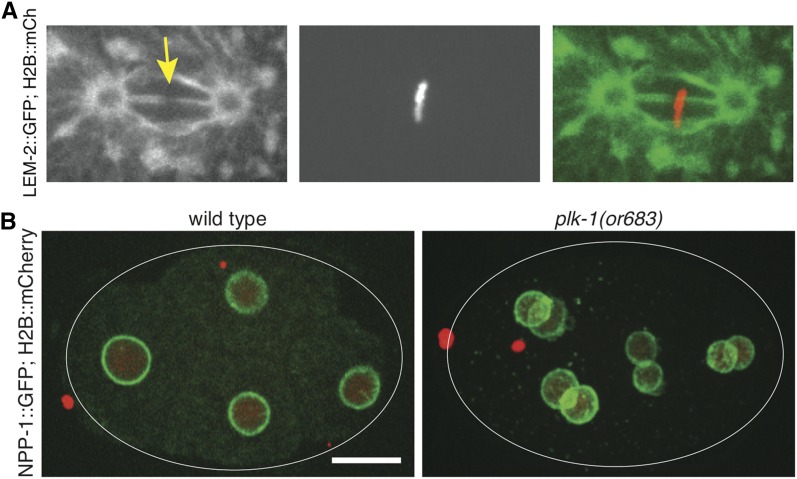
(A) The nuclear membranes between the two pronuclei in the one-cell C. elegans embryo are breached (arrow) only when chromosomes in both pronuclei are aligned on their respective metaphase plates, and the two metaphase plates are aligned relative to each other. The configuration of the membrane at this membrane gap, the mechanism of its formation, and the link between chromosome alignment and membrane gap formation are not known. In these images, the NE/ER and chromosomes are visualized using LEM-2 fused to GFP and histone H2B fused to mCherry, respectively. Adapted from Rahman et al. (2015). (B) Four-cell embryos from a wild type (left) and plk-1ts mutant, both growth at 23°C, the semipermissive temperature for this plk-1 temperature-sensitive allele. NE is detected with the nuclear pore subunit NPP-1 fused to GFP (in green) and the chromosomes are highlighted with histone H2B fused to mCherry (red). Bright red spots outside the nuclei are polar bodies. Adapted from Rahman et al. (2015). Bar, 10 µm.
Figure 8
Figure 8
Nuclear export and import of macromolecules are regulated by transport receptors and the RAN-1 GTPase cycle. Nuclear export (left) of substrates containing NESs involves the formation of a trimeric complex with an XPO transport receptor and RAN-1GTP. XPO mediates the translocation through the NPC via interactions with NPPs. When the export complex reaches the cytoplasm, RAN-2/RanGAP and RAN-5/RanBP1 stimulate the GTPase activity of RAN-1, which causes release of the NES cargo from XPO. Nuclear import (right) is also regulated by the RAN-1 GTPase cycle, but in this case IMB-like transport receptors associate either directly or via IMA adaptors with substrates harboring NLSs in the cytoplasm. After translocation through the NPC, RAN-1GTP binds IMB, which induces release of the NLS cargo and nuclear export of the RAN-1GTP-IMB complex. RAN-1 is reimported in its GDP-bound form by RAN-4/NTF2. Directionality of transport is determined by a high concentration of RAN-1GTP in the nucleus vs. a low concentration in the cytoplasm: The gradient of RAN-1GTP is established by the asymmetric distribution of RAN-2, RAN-5, and the guanine nucleotide exchange factor RAN-3/RCC1.
Figure 9
Figure 9
The LANS tag allows spatiotemporal control of nuclear accumulation by illumination. (A) In the dark, the LOV2 protein adopts a conformation that makes the NLS inaccessible, whereas the NES mediates active exclusion from the nucleus. Upon illumination, LOV2 changes conformation and the NLS is recognized by IMB, leading to nuclear accumulation. (B and C) Expression of the LANS tag fused to mCherry allows (B) visualization and (C) quantification of nuclear import and export dynamics. A small region of an early embryo was observed by live confocal scanning microscopy using a 561-nm laser. Nuclear import was induced by illumination with a 488-nm laser in the three indicated intervals (blue lightning bolts). Time in micrographs is indicated in seconds. For more information on the LANS tag, see Yumerefendi et al. (2015). Nuc, nucleus; cyt, cytoplasm.
Figure 10
Figure 10
P granules interact with and share characteristics with NPCs. (A) Transmission electron micrograph showing a P granule associated with a germ cell nucleus. Note that NPCs (indicated by arrows) cluster in the NE underneath the P granule. Nuc, nucleus; cyt, cytoplasm. (B) Many NPPs have cohesive FG dipeptide repeats (blue ○) that function to establish a permeability barrier of the NPC. FG repeats are also found in several P granule proteins, extending the exclusion barrier. (C) Small 10-kDa fluorescent dextran molecules (red) can diffuse freely across the NE and into P granules (visualized with GFP::PGL-1; green), whereas larger 155-kDa dextrans are excluded from nuclei and P granules. Bars, 10 μm (top) and 5 μm (bottom). (A) Courtesy of James Priess, whereas (B and C) are reproduced from Updike et al. (2011) with permission.
Figure 11
Figure 11
Chromosomes occupy separate territories and are organized in TADs. Chromosome territories are characterized by intrachromosomal contacts being much more frequent than interchromosomal contacts. Each territory consists of A and B compartments, which generally correlate with open and closed chromatin states. At the megabase scale, chromatin forms TADs consisting of closely spaced loops.
Figure 12
Figure 12
Spatial organization of C. elegans chromosomes. Examples of X chromosome (top) and chromosome I (bottom) are shown. Chromosome conformation capture (Hi-C) analysis was carried out on chromosomes from C. elegans embryos. The data from Hi-C analyses are typically depicted on a matrix where all chromosomal loci (in this case binned in 50-kb resolution) are on both the x- and y-axes, and the frequency of interaction (as reflected by the number of reads that span two loci) is color coded, with darker colors indicating a higher incidence of interaction (or more reads). Interactions will obviously be the greatest between two adjacent loci on the same chromosome, generating a very dark diagonal. The panels shown in this figure focus on a few megabases to each side of this diagonal. Diamond-shaped structures, such as the ones seen along the diagonal for the X chromosome, reflect TADs and indicate that there is a higher level of interaction between distant sites within the coordinates of the TAD than outside the TAD. This analysis revealed that C. elegans chromosomes are organized in megabase-sized TADs separated by boundaries (green lines; darker green indicates stronger boundary). The organization in TADs is more pronounced for the X chromosome than for autosomes (chromosome I shown as example). Figure courtesy of Barbara Meyer; data from Crane et al. (2015).
Figure 13
Figure 13
LMN-1 and EMR-1 associate with chromosome arms. Genome-wide chromatin association profiles for LMN-1 and EMR-1 in adult worms were obtained by DamID. Both NE proteins interact extensively with both chromosome arms of autosomes (chromosome V is shown as representative example) and the left arm of the X chromosome, whereas chromosome centers are largely devoid of contacts. From Gonzalez-Aguilera et al. (2014). MA2C, model-based analysis of two-color arrays.
Figure 14
Figure 14
The chromodomain protein CEC-4 is involved in perinuclear anchoring of heterochomatin. CEC-4 localizes to the NE where it is engaged in binding of nucleosomes containing methylated H3K9. Loss of CEC-4 leads to detachment of perinuclear heterochromatin.
Figure 15
Figure 15
LINC complexes formed by SUN-domain proteins (SUN-1, UNC-84) in the INM and KASH domain proteins (ANC-1, KDP-1, UNC-83, ZYG-12) in the ONM mediate extensive contacts to the cytoskeleton. ANC-1, a homolog of mammalian nesprin 2, associates with actin and microtubules; whereas dynein and kinesin mediate the connection of UNC-83 and ZYG-12 to microtubules. Examples of proteins functionally involved in these contacts are depicted. A ZYG-12 isoform without transmembrane domain localizes to centrosomes and interacts with ZYG-12 at the NE. In humans, LINC complexes involve trimeric SUN and KASH proteins (Sosa et al. 2012). LEM-2 is also involved in tethering of centrosomes to the NE, but the mechanism is unknown. Presumably, many of these interactions occur only in specific cell types. KDP-1 interacts with SUN-1 and perhaps also UNC-84 and regulates cell cycle progression. In addition to controlling nuclear positioning, the LINC complexes also mediate mechanosignaling to the genome via the nuclear lamina, and SUN-1 serves as anchoring point for chromosome PCs during meiosis and for telomeres. ZYG-12/SUN-1 complexes colocalize with PC at the NE, whereas KDP-1 and POT-1/telomeres are arbitrarily connected to the same SUN-1 molecules for simplicity.
Figure 16
Figure 16
The NE is critical for nuclear positioning. (A) During early embryonic cell divisions, centrosomes (arrows) are not properly anchored to the NE in lem-2 mutants. From Morales-Martinez et al. (2015). (B and C) ∼5 hr after fertilization, (B) cells of the intestinal E lineage are polarized and nuclei (asterisks) align at the midline in the interior of the embryo whereas (C) hypodermal cells in dorsal part of the embryos intercalate and nuclei migrate transversally (note relative position of nuclei labeled 3–5; nuclei 1–2 have not yet migrated). (D) As a consequence of abnormal nuclear migration in hypodermal cells during embryogenesis, nuclei are present in the dorsal side of unc-84 larvae (arrows). Bars, 10 µm.

References

    1. Adam S. A., 2009. The nuclear transport machinery in Caenorhabditis elegans: a central role in morphogenesis. Semin. Cell Dev. Biol. 20: 576–581. - PubMed
    1. Anderson D. J., Hetzer M. W., 2007. Nuclear envelope formation by chromatin-mediated reorganization of the endoplasmic reticulum. Nat. Cell Biol. 9: 1160–1166. - PubMed
    1. Asencio C., Davidson I. F., Santarella-Mellwig R., Ly-Hartig T. B., Mall M., et al. , 2012. Coordination of kinase and phosphatase activities by Lem4 enables nuclear envelope reassembly during mitosis. Cell 150: 122–135. - PubMed
    1. Askjaer P., Ercan S., Meister P., 2014a Modern techniques for the analysis of chromatin and nuclear organization in C. elegans (April 2, 2014), WormBook, ed. The C. elegans Research Community WormBook, 10.1895/wormbook.1.169.1, http://wormbook.org. - PMC - PubMed
    1. Askjaer P., Galy V., Meister P., 2014b Modern tools to study nuclear pore complexes and nucleocytoplasmic transport in Caenorhabditis elegans. Methods Cell Biol. 122: 277–310. - PubMed

Publication types

MeSH terms

Substances

LinkOut - more resources