. 2017 Feb;173(2):1197-1210.
doi: 10.1104/pp.16.01643. Epub 2017 Jan 3.

Outside-Xylem Vulnerability, Not Xylem Embolism, Controls Leaf Hydraulic Decline during Dehydration

Affiliations

Outside-Xylem Vulnerability, Not Xylem Embolism, Controls Leaf Hydraulic Decline during Dehydration

Christine Scoffoni et al. Plant Physiol. 2017 Feb.

Abstract

Leaf hydraulic supply is crucial to maintaining open stomata for CO2 capture and plant growth. During drought-induced dehydration, the leaf hydraulic conductance (Kleaf) declines, which contributes to stomatal closure and, eventually, to leaf death. Previous studies have tended to attribute the decline of Kleaf to embolism in the leaf vein xylem. We visualized at high resolution and quantified experimentally the hydraulic vulnerability of xylem and outside-xylem pathways and modeled their respective influences on plant water transport. Evidence from all approaches indicated that the decline of Kleaf during dehydration arose first and foremost due to the vulnerability of outside-xylem tissues. In vivo x-ray microcomputed tomography of dehydrating leaves of four diverse angiosperm species showed that, at the turgor loss point, only small fractions of leaf vein xylem conduits were embolized, and substantial xylem embolism arose only under severe dehydration. Experiments on an expanded set of eight angiosperm species showed that outside-xylem hydraulic vulnerability explained 75% to 100% of Kleaf decline across the range of dehydration from mild water stress to beyond turgor loss point. Spatially explicit modeling of leaf water transport pointed to a role for reduced membrane conductivity consistent with published data for cells and tissues. Plant-scale modeling suggested that outside-xylem hydraulic vulnerability can protect the xylem from tensions that would induce embolism and disruption of water transport under mild to moderate soil and atmospheric droughts. These findings pinpoint outside-xylem tissues as a central locus for the control of leaf and plant water transport during progressive drought.


Figures

Figure 1.
Figure 1.
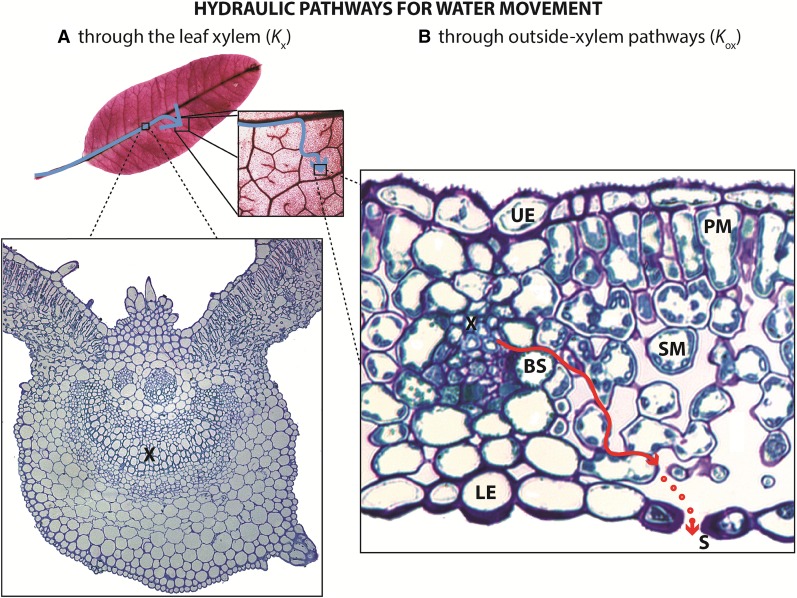
Kleaf characterizes the water-transport capacity of the whole leaf and is influenced by water movement through the leaf xylem (Kx; A) and through the mesophyll, or outside-xylem pathways (Kox; B), which includes vascular parenchyma, bundle sheath, and mesophyll cell pathways for liquid and/or vapor phase transport and diffusion through air spaces (red dots) through stomata. As the leaf dehydrates, observed declines in Kleaf have typically been attributed primarily to reduction of Kx due to the formation of embolism in xylem conduits, although recent studies suggested a possible role for changes in outside-xylem pathway properties via reduced membrane permeability and cell shrinkage. Symbols are as follows: xylem (X), bundle sheath cell (BS), spongy mesophyll cell (SM), palisade mesophyll cell (PM), upper epidermal cell (UE), lower epidermal cell (LE), and stomata (S).
Figure 2.
Figure 2.
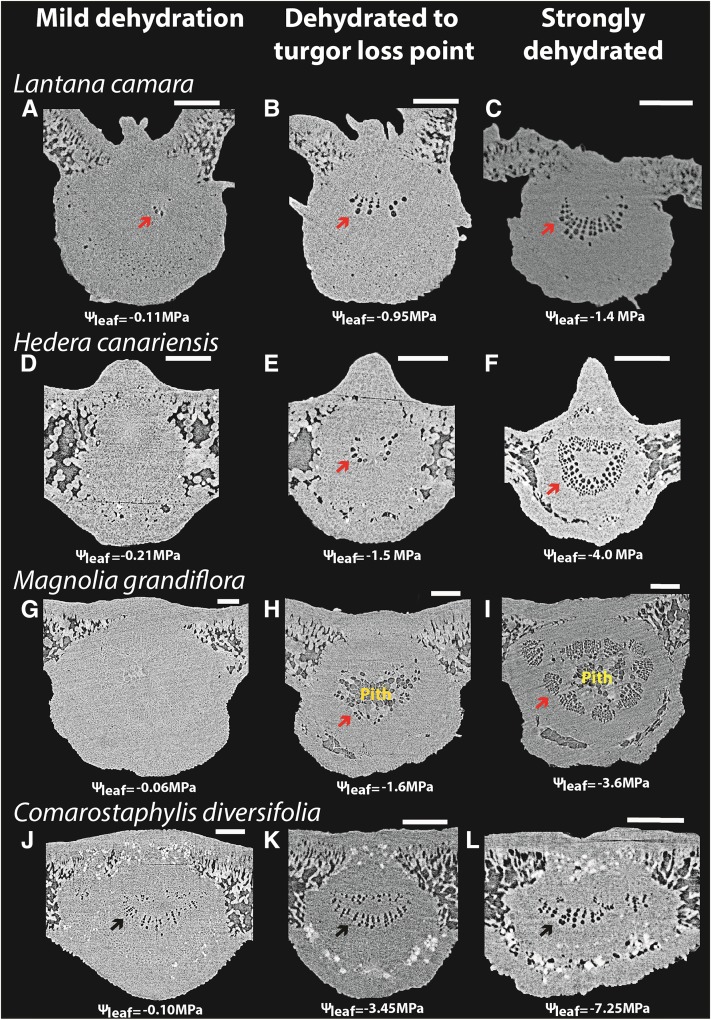
Low vulnerability of the leaf xylem to embolism before the turgor loss point as revealed by in vivo imaging of leaves of four diverse angiosperm species subjected to progressive dehydration (i.e. increasingly negative leaf water potential [Ψleaf]) using microCT. Scans show leaf midribs at mild dehydration, the turgor loss point, and extreme dehydration (an illustrative image for each range is shown from left to right), showing very few embolized midrib conduits above the turgor loss point. No emboli were observed in higher order veins above the turgor loss point, and few were observed even in extremely dehydrated leaves (data not shown). Note that C. diversifolia contains embolized protoxylem conduits, which are hydraulically nonfunctional, even for well-hydrated leaves, and these protoxylem conduits are included in the calculations of embolized conduits. Bars = 250 μm.
Figure 3.
Figure 3.
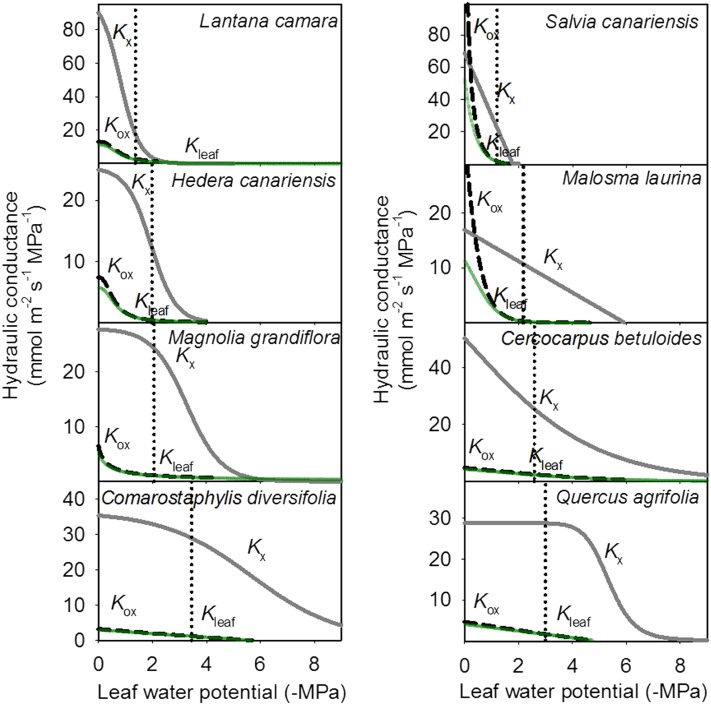
The vulnerability of Kleaf (green lines) to dehydration is determined mainly by the vulnerability of the outside-xylem pathways (Kox; dashed black lines) and not that of the xylem (Kx; light-gray lines) across the four species for which microCT was performed (left) and an additional expanded set of four diverse species (right). The maximum likelihood function is plotted for each vulnerability curve (see “Materials and Methods”). The turgor loss point for each species is represented by the vertical dotted black line.
Figure 4.
Figure 4.
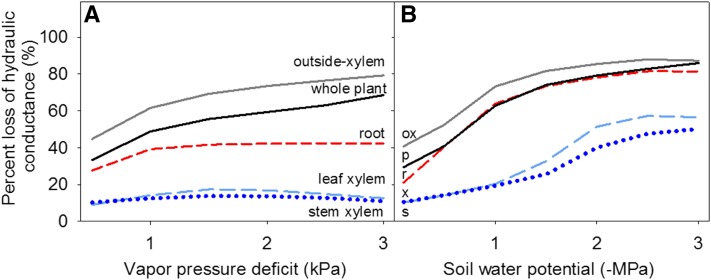
Model simulations of whole-plant hydraulic response to atmospheric drought (increasing vapor pressure deficit [VPD]; A) and dehydrating soil (B). Percentage loss of hydraulic conductance values plotted in both graphs are averages of simulations obtained for the four species tested (see “Materials and Methods”). The percentage loss of hydraulic conductance outside the xylem (ox; gray solid lines) is the main determinant of the decline of whole-plant hydraulic conductance (p; black solid lines) under both scenarios. Neither leaf xylem hydraulic conductance (x; dashed light blue lines) nor stem xylem hydraulic conductance (s; dotted dark blue lines) experiences strong declines with increasing soil drought or VPD. The root hydraulic conductance (dashed red lines) declines strongly under increasing soil drought and to a smaller extent under increasing VPD. Because the model simulates a transpiring plant, when the soil water potential is at zero on the x axis, the transpiring leaf water potential is still substantially negative, driving the decline of Kleaf from its maximum value (although not of Kx; for water potentials of each compartment, see Supplemental Table S2). Under the soil drought scenario, VPD was maintained at 0.5 kPa. Under the atmospheric drought scenario, soil water potential was maintained at −0.1 MPa.
Figure 5.
Figure 5.
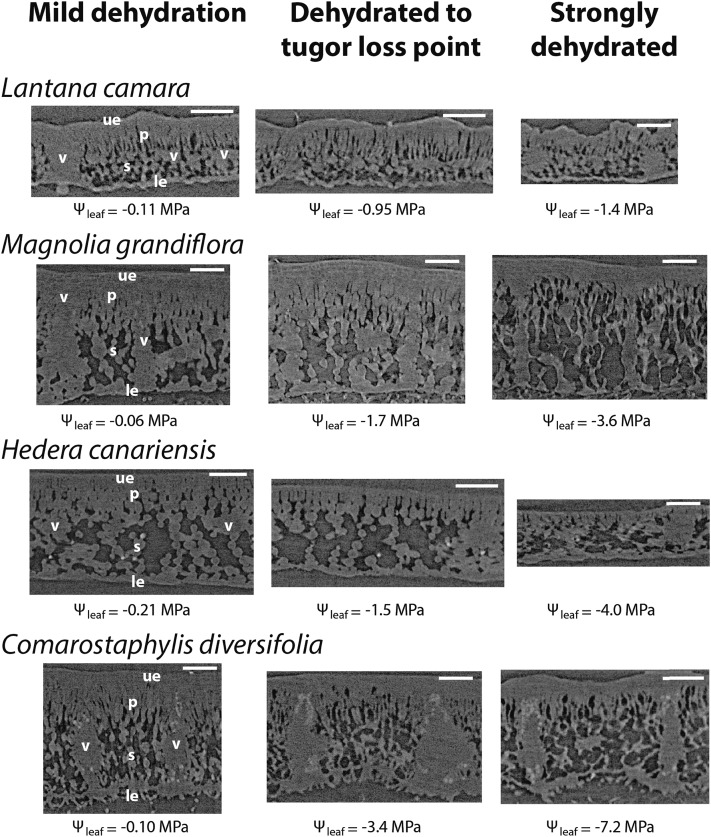
MicroCT scans of leaf laminas at three dehydration levels for four species. Symbols are as follows: leaf water potential (Ψleaf), vascular bundle (v), spongy mesophyll cell (s), palisade mesophyll cell (p), upper epidermal cell (ue), and lower epidermal cell (le). Bars = 250 μm.
Figure 6.
Figure 6.
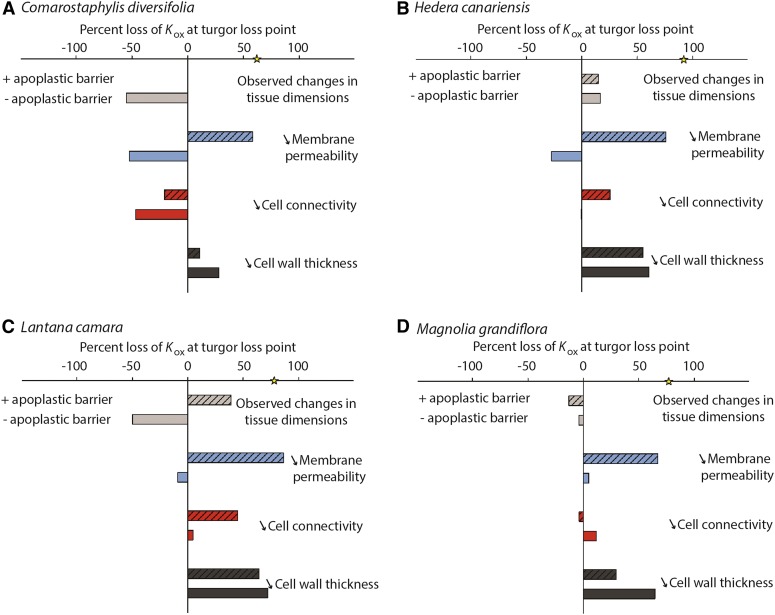
Testing hypotheses for the potential drivers of the decline in Kox in dehydrating leaves, using a spatially explicit model of leaf outside-xylem water transport (see “Materials and Methods”). Parameterizing the model for four species, we estimated the Kox based on the decline of observed cell size, porosity (air space), and leaf area at the turgor loss point (light gray bars). Because in some cases these changes in tissue dimensions resulted in an increase in Kox, we modeled Kox decline according to three scenarios (always including the observed changes in tissue dimension): an 80% decline at the turgor loss point in membrane permeability (blue bars), cell connectivity (red bars), and cell wall thickness (dark gray bars). All simulations were run with or without an apoplastic barrier at the bundle sheath cells (solid versus striped bars). The yellow star on the x axis represents the observed percentage Kox decline at the turgor loss point. Across all four species, only simulations of a strong decrease in membrane permeability in leaves with an apoplastic barrier could explain the observed declines in Kox.

References

    1. Anderegg WRL, Flint A, Huang C, Flint L, Berry JA, Davis FW, Sperry JS, Field CB (2015) Tree mortality predicted from drought-induced vascular damage. Nat Geosci 8: 367–371
    1. Bartlett MK, Klein T, Jansen S, Choat B, Sack L (2016) The correlations and sequence of plant stomatal, hydraulic, and wilting responses to drought. Proc Natl Acad Sci USA 113: 13098–13103 - PMC - PubMed
    1. Bartlett MK, Scoffoni C, Sack L (2012) The determinants of leaf turgor loss point and prediction of drought tolerance of species and biomes: a global meta-analysis. Ecol Lett 15: 393–405 - PubMed
    1. Blackman CJ, Brodribb TJ, Jordan GJ (2010) Leaf hydraulic vulnerability is related to conduit dimensions and drought resistance across a diverse range of woody angiosperms. New Phytol 188: 1113–1123 - PubMed
    1. Blackman CJ, Gleason SM, Chang Y, Cook AM, Laws C, Westoby M (2014) Leaf hydraulic vulnerability to drought is linked to site water availability across a broad range of species and climates. Ann Bot (Lond) 114: 435–440 - PMC - PubMed

Publication types

LinkOut - more resources