Comparison of fecal microbiota of three captive carnivore species inhabiting Korea
- PMID: 28049922
- PMCID: PMC5383174
- DOI: 10.1292/jvms.16-0472
Comparison of fecal microbiota of three captive carnivore species inhabiting Korea
Abstract
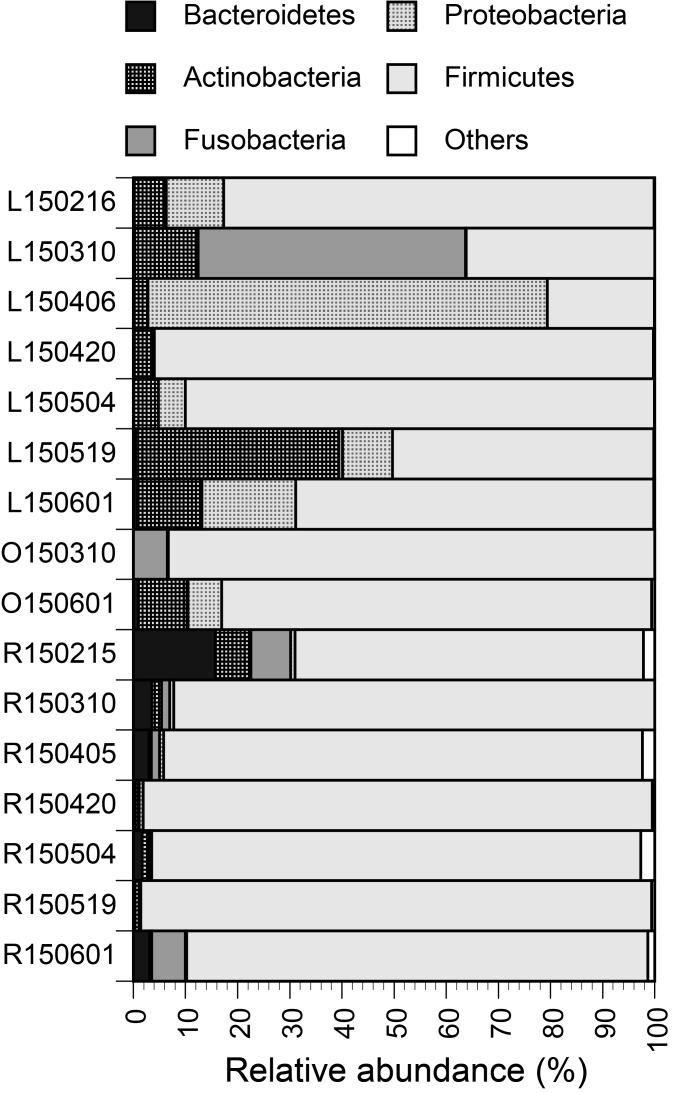
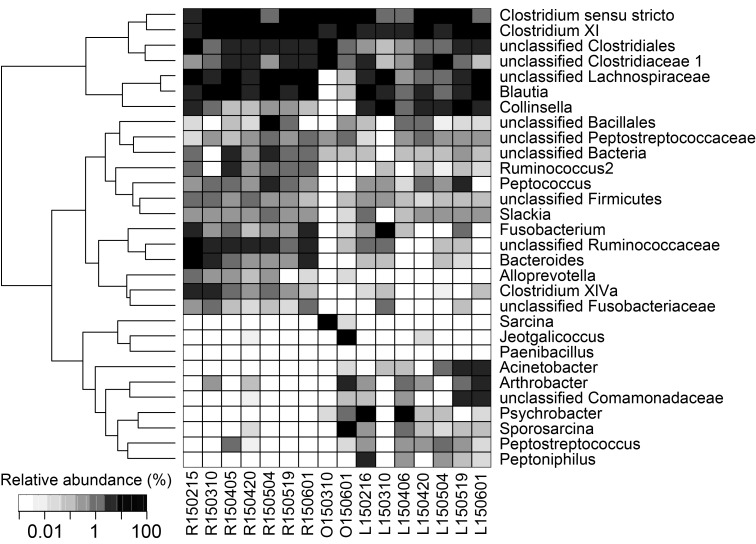
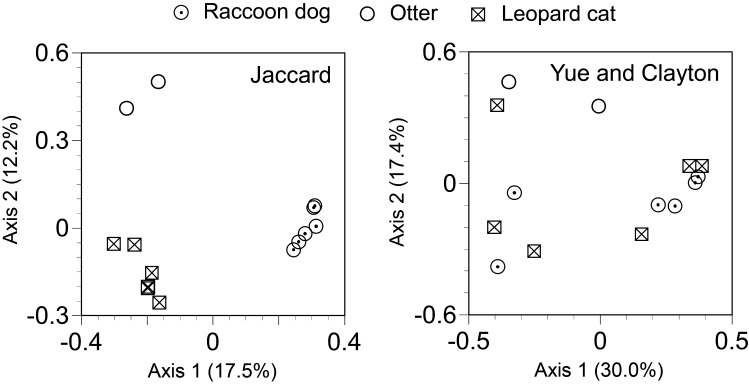
This study aimed at characterizing fecal microbiota of three captive carnivore species of leopard cats Prionailurus bengalensis, Eurasian otters Lutra lutra and raccoon dogs Nyctereutes procyonoides. We used DNA barcoding sequencing to analyze 16S rRNA genes of uncultured bacteria in the feces collected in the Seoul Zoo. The sequencing analyses revealed that: 1) Firmicutes was the most dominant phylum for all three animals; 2) bacterial genus-rank compositions were distinct across species of the animals; and 3) bacterial community memberships were different across species of the studied animals. We expect such baseline information is useful for better understanding of these endangered species and future management of their health in zoos.
Figures
References
-
- Arumugam M., Raes J., Pelletier E., Le Paslier D., Yamada T., Mende D. R., Fernandes G. R., Tap J., Bruls T., Batto J. M., Bertalan M., Borruel N., Casellas F., Fernandez L., Gautier L., Hansen T., Hattori M., Hayashi T., Kleerebezem M., Kurokawa K., Leclerc M., Levenez F., Manichanh C., Nielsen H. B., Nielsen T., Pons N., Poulain J., Qin J., Sicheritz-Ponten T., Tims S., Torrents D., Ugarte E., Zoetendal E. G., Wang J., Guarner F., Pedersen O., de Vos W. M., Brunak S., Doré J., Antolín M., Artiguenave F., Blottiere H. M., Almeida M., Brechot C., Cara C., Chervaux C., Cultrone A., Delorme C., Denariaz G., Dervyn R., Foerstner K. U., Friss C., van de Guchte M., Guedon E., Haimet F., Huber W., van Hylckama-Vlieg J., Jamet A., Juste C., Kaci G., Knol J., Lakhdari O., Layec S., Le Roux K., Maguin E., Mérieux A., Melo Minardi R., M’rini C., Muller J., Oozeer R., Parkhill J., Renault P., Rescigno M., Sanchez N., Sunagawa S., Torrejon A., Turner K., Vandemeulebrouck G., Varela E., Winogradsky Y., Zeller G., Weissenbach J., Ehrlich S. D., Bork P., MetaHIT Consortium. 2011. Enterotypes of the human gut microbiome. Nature 473: 174–180. doi: 10.1038/nature09944 - DOI - PMC - PubMed
-
- Bisgaard H., Li N., Bonnelykke K., Chawes B. L. K., Skov T., Paludan-Müller G., Stokholm J., Smith B., Krogfelt K. A.2011. Reduced diversity of the intestinal microbiota during infancy is associated with increased risk of allergic disease at school age. J. Allergy Clin. Immunol. 128: 646–52.e1, 5. doi: 10.1016/j.jaci.2011.04.060 - DOI - PubMed
-
- Daniels L., Budding A. E., de Korte N., Eck A., Bogaards J. A., Stockmann H. B., Consten E. C., Savelkoul P. H., Boermeester M. A.2014. Fecal microbiome analysis as a diagnostic test for diverticulitis. Eur. J. Clin. Microbiol. Infect. Dis. 33: 1927–1936. doi: 10.1007/s10096-014-2162-3 - DOI - PubMed
-
- Garcia-Mazcorro J. F., Lanerie D. J., Dowd S. E., Paddock C. G., Grützner N., Steiner J. M., Ivanek R., Suchodolski J. S.2011. Effect of a multi-species synbiotic formulation on fecal bacterial microbiota of healthy cats and dogs as evaluated by pyrosequencing. FEMS Microbiol. Ecol. 78: 542–554. doi: 10.1111/j.1574-6941.2011.01185.x - DOI - PubMed
MeSH terms
LinkOut - more resources
Full Text Sources
Other Literature Sources
Miscellaneous