


Medical futility and its challenges: a review study
- PMID: 28050241
- PMCID: PMC5203684
Medical futility and its challenges: a review study
Abstract
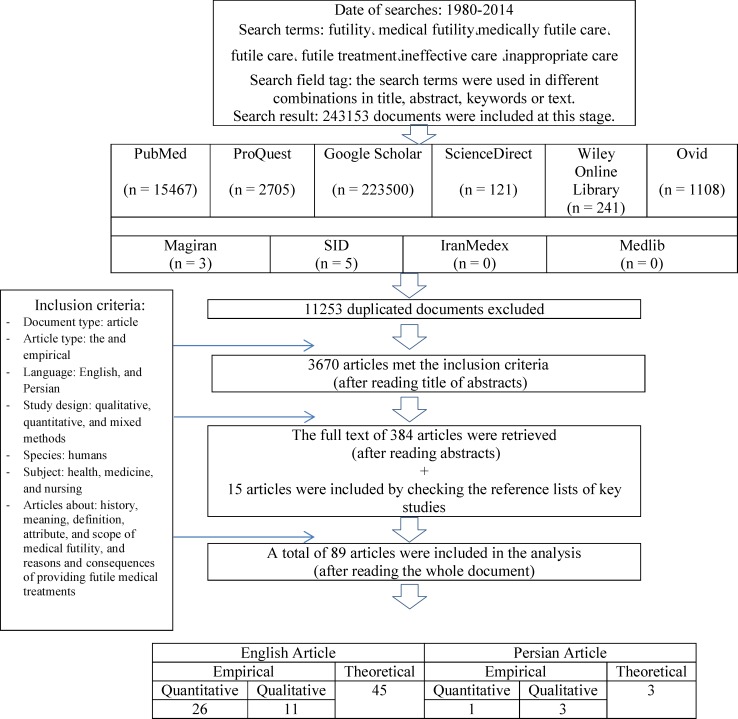
Concerns over limited medical equipment and resources, particularly in intensive care units (ICUs), have raised the issue of medical futility. Medical futility draws a contrast between physician's authority and patients' autonomy and it is one of the major issues of end-of-life ethical decision-making. The aim of this study was to review medical futility and its challenges. In this systematized review study, a comprehensive search of the existing literature was performed using an internet search with broad keywords to access related articles in both Persian and English databases. Finally, 89 articles were selected and surveyed. Medical futility is a complex, ambiguous, subjective, situation-specific, value-laden, and goal-dependent concept which is almost always surrounded by some degrees of uncertainty; hence, there is no objective and valid criterion for its determination. This concept is affected by many different factors such as physicians' and patients' value systems, medical goals, and sociocultural and religious context, and individuals' emotions and personal characteristics. It is difficult to achieve a clear consensus over the concept of medical futility; hence, it should be defined and determined at an individual level and based on the unique condition of each patient.
Keywords: Decision-making; Medical futility; Physiologic futility; Qualitative futility; Withholding of treatments.
Figures
References
-
- Aghabarari M, Dehghan Nayeri N. Futile Care: challenges of applying futility concept in caring domain. Hayat. 2015;21(1):1–5. [ in Persian]
-
- Niederman MS, Berger JT. The delivery of futile care is harmful to other patients. Crit Care Med. 2010;38(10 Suppl):S518–22. - PubMed
Publication types
LinkOut - more resources
Full Text Sources