


Gastrointestinal Dysfunctions in Parkinson's Disease: Symptoms and Treatments
- PMID: 28050310
- PMCID: PMC5168460
- DOI: 10.1155/2016/6762528
Gastrointestinal Dysfunctions in Parkinson's Disease: Symptoms and Treatments
Abstract
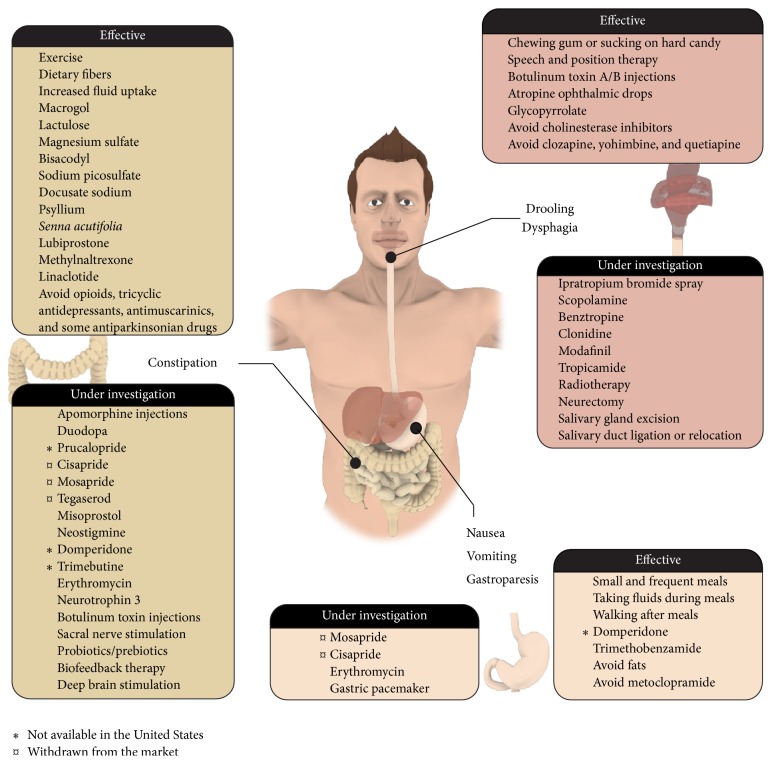
A diagnosis of Parkinson's disease is classically established after the manifestation of motor symptoms such as rigidity, bradykinesia, and tremor. However, a growing body of evidence supports the hypothesis that nonmotor symptoms, especially gastrointestinal dysfunctions, could be considered as early biomarkers since they are ubiquitously found among confirmed patients and occur much earlier than their motor manifestations. According to Braak's hypothesis, the disease is postulated to originate in the intestine and then spread to the brain via the vagus nerve, a phenomenon that would involve other neuronal types than the well-established dopaminergic population. It has therefore been proposed that peripheral nondopaminergic impairments might precede the alteration of dopaminergic neurons in the central nervous system and, ultimately, the emergence of motor symptoms. Considering the growing interest in the gut-brain axis in Parkinson's disease, this review aims at providing a comprehensive picture of the multiple gastrointestinal features of the disease, along with the therapeutic approaches used to reduce their burden. Moreover, we highlight the importance of gastrointestinal symptoms with respect to the patients' responses towards medical treatments and discuss the various possible adverse interactions that can potentially occur, which are still poorly understood.
Conflict of interest statement
The authors declare that there are no competing interests regarding the publication of this paper.
Figures
References
-
- Parkinson J. An essay on the shaking palsy. 1817. The Journal of Neuropsychiatry & Clinical Neurosciences. 2002;14(2):222–236. - PubMed
-
- Hayes M. W., Fung V. S., Kimber T. E., O'Sullivan J. D. Current concepts in the management of Parkinson disease. Medical Journal of Australia. 2010;192(3):144–149. - PubMed
Publication types
LinkOut - more resources
Full Text Sources
Other Literature Sources
