. 2017 Jan 4;17(1):9.
doi: 10.1186/s12885-016-3030-6.

A systematic search strategy identifies cubilin as independent prognostic marker for renal cell carcinoma

Affiliations

A systematic search strategy identifies cubilin as independent prognostic marker for renal cell carcinoma

Gabriela Gremel et al. BMC Cancer. .

Abstract

Background: There is an unmet clinical need for better prognostic and diagnostic tools for renal cell carcinoma (RCC).

Methods: Human Protein Atlas data resources, including the transcriptomes and proteomes of normal and malignant human tissues, were searched for RCC-specific proteins and cubilin (CUBN) identified as a candidate. Patient tissue representing various cancer types was constructed into a tissue microarray (n = 940) and immunohistochemistry used to investigate the specificity of CUBN expression in RCC as compared to other cancers. Two independent RCC cohorts (n = 181; n = 114) were analyzed to further establish the sensitivity of CUBN as RCC-specific marker and to explore if the fraction of RCCs lacking CUBN expression could predict differences in patient survival.

Results: CUBN was identified as highly RCC-specific protein with 58% of all primary RCCs staining positive for CUBN using immunohistochemistry. In venous tumor thrombi and metastatic lesions, the frequency of CUBN expression was increasingly lost. Clear cell RCC (ccRCC) patients with CUBN positive tumors had a significantly better prognosis compared to patients with CUBN negative tumors, independent of T-stage, Fuhrman grade and nodal status (HR 0.382, CI 0.203-0.719, P = 0.003).

Conclusions: CUBN expression is highly specific to RCC and loss of the protein is significantly and independently associated with poor prognosis. CUBN expression in ccRCC provides a promising positive prognostic indicator for patients with ccRCC. The high specificity of CUBN expression in RCC also suggests a role as a new diagnostic marker in clinical cancer differential diagnostics to confirm or rule out RCC.

Keywords: Cubilin; Immunohistochemistry; Independent prognostic biomarker; Renal cell carcinoma.


Figures
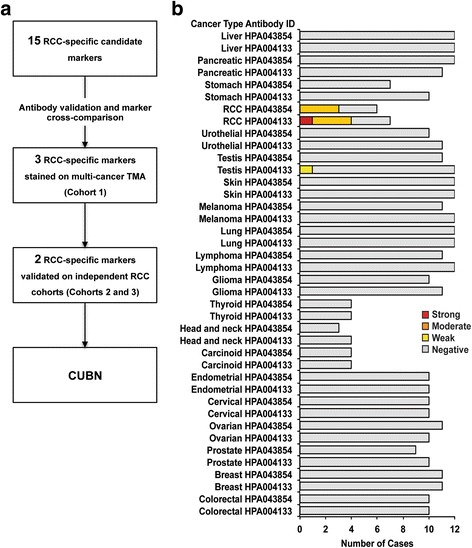
Fig. 1
Fig. 1
CUBN discovery pipeline and the standard Human Protein Atlas cancer test set. a The Human Protein Atlas database (www.proteinatlas.org and unpublished data) was systematically searched for cancer type-specific proteins using automated and manual searches. Staining patterns were reviewed and 15 proteins with RCC-enriched expression chosen for further antibody validation. Following extensive antibody validation and exclusion of antibodies with overlapping staining patterns, three antibodies were selected for validation of RCC-specific staining on multi-cancer TMA cohort 1. Two of these biomarkers were validated further on independent RCC-specific cohorts (cohort 2 and 3) and CUBN identified as highly RCC-specific protein. b CUBN staining on routine Human Protein Atlas cancer test set. Two antibodies, HPA004133 and HPA043854, targeting different epitopes on the same protein generated similar staining patterns. Red, orange and yellow coloring indicates cases with strong, moderate and weak staining, respectively. Grey corresponds to CUBN negative cases
Fig. 2
Fig. 2
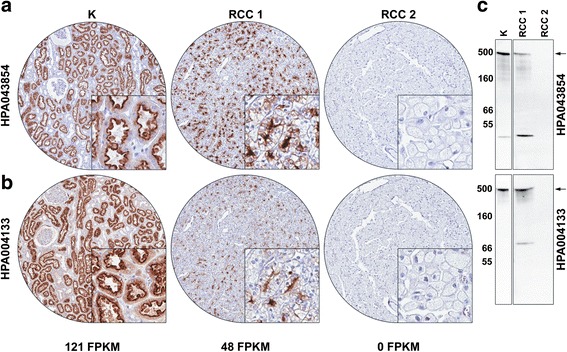
CUBN antibody validation. a Two antibodies targeting the CUBN protein at different epitopes (HPA043854 and HPA004133) were tested using immunohistochemistry on a range of normal and malignant tissue. Included in this figure are staining examples from normal human kidney (K) and two renal cell carcinoma cases (RCC1 and RCC2). As chromogen 3,3’-Diaminobenzidine (DAB) was used. b RNA-seq expression data from normal human kidney (K) and the renal cell carcinoma cases (RCC1 and RCC2). Expression levels are indicated as fragments per kilobase of exon model per million mapped reads (FPKM). c Western blot analysis of CUBN expression in protein extracts from normal human kidney and the renal cell carcinoma cases RCC1 and RCC2 using HPA043854 and HPA004133
Fig. 3
Fig. 3
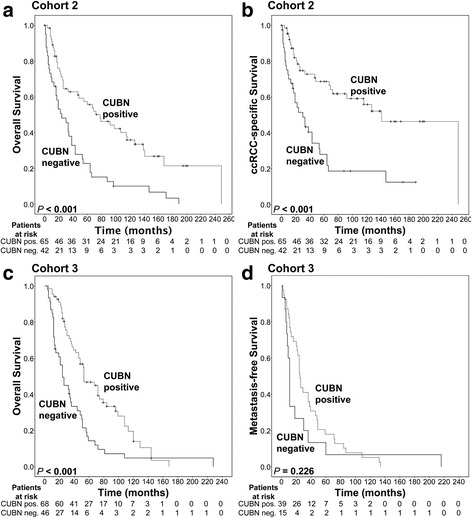
Kaplan-Meier survival analysis of ccRCC patients, stratified according to CUBN expression. a Overall survival and b ccRCC-specific survival of patients in cohort 2. c Overall survival and d metastasis-free survival of patients in cohort 3
Fig. 4
Fig. 4
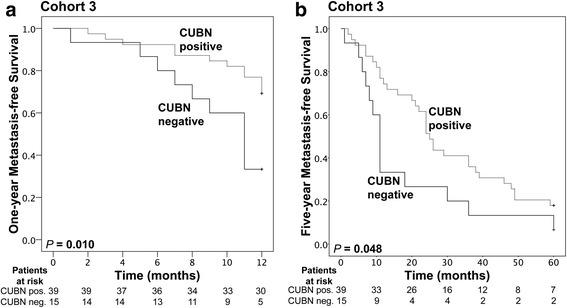
Kaplan-Meier survival analysis of ccRCC patients, stratified according to CUBN expression. a One-year metastasis-free survival and b five-year metastasis-free survival of patients in cohort 3

References

    1. Uhlen M, Fagerberg L, Hallstrom BM, Lindskog C, Oksvold P, Mardinoglu A, et al. Proteomics. Tissue-based map of the human proteome. Science. 2015;347(6220):1260419. doi: 10.1126/science.1260419. - DOI - PubMed
    1. Fagerberg L, Hallstrom BM, Oksvold P, Kampf C, Djureinovic D, Odeberg J, et al. Analysis of the human tissue-specific expression by genome-wide integration of transcriptomics and antibody-based proteomics. Mol Cell Proteomics. 2014;13(2):397–406. doi: 10.1074/mcp.M113.035600. - DOI - PMC - PubMed
    1. Habuka M, Fagerberg L, Hallstrom BM, Kampf C, Edlund K, Sivertsson A, et al. The kidney transcriptome and proteome defined by transcriptomics and antibody-based profiling. PLoS One. 2014;9(12):e116125. doi: 10.1371/journal.pone.0116125. - DOI - PMC - PubMed
    1. Uhlen M, Bjorling E, Agaton C, Szigyarto CA, Amini B, Andersen E, et al. A human protein atlas for normal and cancer tissues based on antibody proteomics. Mol Cell Proteomics. 2005;4(12):1920–32. doi: 10.1074/mcp.M500279-MCP200. - DOI - PubMed
    1. Leibovich BC, Lohse CM, Crispen PL, Boorjian SA, Thompson RH, Blute ML, et al. Histological subtype is an independent predictor of outcome for patients with renal cell carcinoma. J Urol. 2010;183(4):1309–15. doi: 10.1016/j.juro.2009.12.035. - DOI - PubMed

Publication types

MeSH terms

Substances