. 2017 Jan 4;37(1):184-193.
doi: 10.1523/JNEUROSCI.1104-16.2016.

Disruption of Glucagon-Like Peptide 1 Signaling in Sim1 Neurons Reduces Physiological and Behavioral Reactivity to Acute and Chronic Stress

Affiliations

Disruption of Glucagon-Like Peptide 1 Signaling in Sim1 Neurons Reduces Physiological and Behavioral Reactivity to Acute and Chronic Stress

Sriparna Ghosal et al. J Neurosci. .

Abstract

Organismal stress initiates a tightly orchestrated set of responses involving complex physiological and neurocognitive systems. Here, we present evidence for glucagon-like peptide 1 (GLP-1)-mediated paraventricular hypothalamic circuit coordinating the global stress response. The GLP-1 receptor (Glp1r) in mice was knocked down in neurons expressing single-minded 1, a transcription factor abundantly expressed in the paraventricular nucleus (PVN) of the hypothalamus. Mice with single-minded 1-mediated Glp1r knockdown had reduced hypothalamic-pituitary-adrenal axis responses to both acute and chronic stress and were protected against weight loss associated with chronic stress. In addition, regional Glp1r knockdown attenuated stress-induced cardiovascular responses accompanied by decreased sympathetic drive to the heart. Finally, Glp1r knockdown reduced anxiety-like behavior, implicating PVN GLP-1 signaling in behavioral stress reactivity. Collectively, these findings support a circuit whereby brainstem GLP-1 activates PVN signaling to mount an appropriate whole-organism response to stress. These results raise the possibility that dysfunction of this system may contribute to stress-related pathologies, and thereby provide a novel target for intervention.

Significance statement: Dysfunctional stress responses are linked to a number of somatic and psychiatric diseases, emphasizing the importance of precise neuronal control of effector pathways. Pharmacological evidence suggests a role for glucagon-like peptide-1 (GLP-1) in modulating stress responses. Using a targeted knockdown of the GLP-1 receptor in the single-minded 1 neurons, we show dependence of paraventricular nucleus GLP-1 signaling in the coordination of neuroendocrine, autonomic, and behavioral responses to acute and chronic stress. To our knowledge, this is the first direct demonstration of an obligate brainstem-to-hypothalamus circuit orchestrating general stress excitation across multiple effector systems. These findings provide novel information regarding signaling pathways coordinating central control of whole-body stress reactivity.

Keywords: HPA axis; acute stress; blood pressure; chronic stress; elevated plus maze; heart rate.


Figures

Figure 1.
Figure 1.
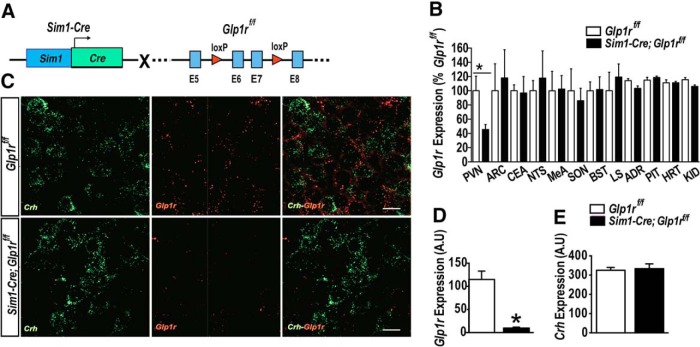
Sim1-Cre-induced KD of Glp1r within the PVN. A, Genetic strategy to delete Glp1r in neurons expressing Cre through the Sim1 promoter. Mice carrying two conditional Glp1r alleles were crossed to the Sim1-Cre line to excise the exons 6 and 7 of the Glp1r gene. B, Glp1r mRNA expression in various brain and peripheral tissues using primers specific for the amplicons spanning exons 6 and 7 in the Glp1r gene. The Sim1-Cre; Glp1rf/f mice showed ∼70% reduction in Glp1r mRNA expression within the PVN, but not in arcuate nucleus (ARC), central nucleus of amygdala (CEA), NTS, medial amygdala (MeA), SON, bed nucleus of stria terminalis (BST), lateral septum, pituitary (PIT), adrenal glands (ADR), heart (HRT), and kidney (KID). C, Representative images of RNAscope analysis of the Glp1r (red) and Crh (green) within the PVN Crh-enriched region of the Glp1rf/f (top) and Sim1-Cre; Glp1rf/f (bottom). D, The expression of Glp1r mRNA was significantly reduced within the PVN Crh-enriched region of the Sim1-Cre; Glp1rf/f mice compared with Glp1rf/f. E, The expression of Crh was similar in both genotypes. Data are mean ± SEM. Scale bar: C, 20 μm. *
Figure 2.
Figure 2.
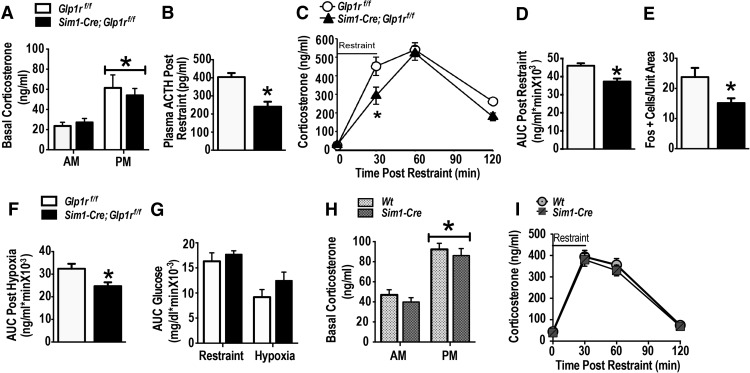
Sim1-Cre-induced KD of Glp1r attenuates HPA axis responses to acute stress. A, Basal circadian nadir and peak corticosterone concentrations in Sim1-Cre; Glp1rf/f and Glp1rf/f mice (n = 9 per group). Both genotypes exhibited intact circadian regulation of corticosterone secretion. B, Reduced peak ACTH response after a 20 min acute restraint stress in Sim1-Cre; Glp1rf/f mice. C, Decreased corticosterone (time course) response to a novel 30 min restraint challenge in Sim1-Cre; Glp1rf/f mice. D, Reduced integrated corticosterone response in Sim1-Cre; Glp1rf/f. E, Decreased Fos induction in the PVN of the Sim1-Cre; Glp1rf/f after a novel 30 min restraint challenge. F, Sim1-Cre; Glp1rf/f mice exhibited significantly reduced integrated corticosterone response after exposure to a novel 30 min hypoxia (systemic stress). G, Blood glucose levels measured over the stress time-points during both acute restraint and hypoxia showed no significant differences between the two genotypes (n = 9 per group). H, Basal nadir and peak corticosterone concentration in wild-type and Sim1-Cre mice showed no significant differences. There were significant differences between P.M. corticosterone level and A.M. corticosterone in both genotypes (p < 0.05), but no genotype-related differences (n = 7 per group). I, The time course of the corticosterone response to a 30 min restraint challenge did not differ between the two genotypes. Data are mean ± SEM. *p < 0.05 vs Glp1r f/f.
Figure 3.
Figure 3.
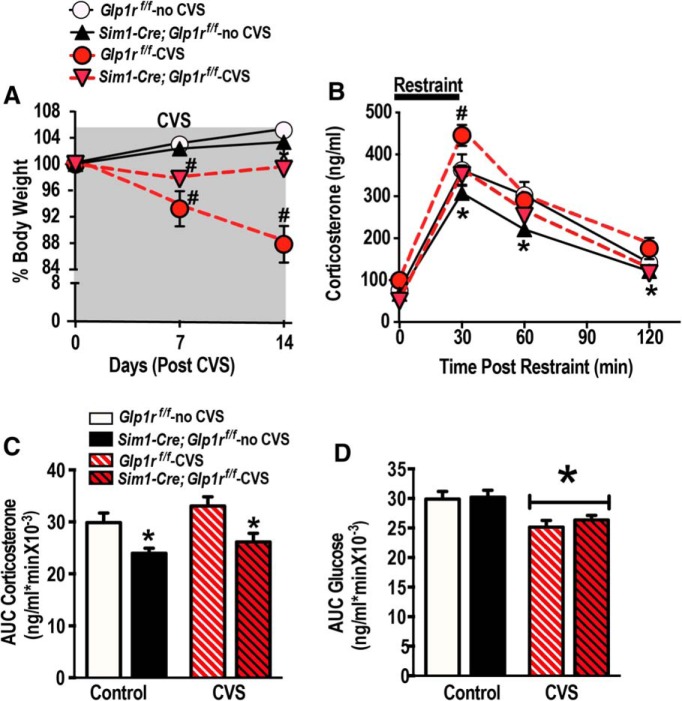
GLP-1 receptor KD diminishes chronic stress responses. A, CVS caused a significant reduction in percentage body weight in both Sim1-Cre; Glp1rf/f and Glp1rf/f during week 1. #p < 0.05 versus respective no CVS control. After week 1, Sim1-Cre; Glp1rf/f displayed significantly less body weight loss relative to Glp1rf/f CVS-exposed mice. #Significant difference from respective no CVS control. *Significant difference from Glp1rf/f-CVS exposed mice. B, C, Time course (B) and integrated corticosterone response (C) to a novel 30 min restraint challenge in Glp1rf/f and Sim1-Cre; Glp1rf/f mice. Statistical analysis revealed that CVS Glp1rf/f mice had significantly higher corticosterone response than no CVS Glp1rf/f. CVS Sim1-Cre; Glp1rf/f mice showed significantly decreased corticosterone at the 30 min time point compared with CVS Glp1rf/f mice. There were no significant differences between the CVS-exposed and no CVS Sim1-Cre; Glp1rf/f in the corticosterone response. Regardless of the CVS assignment, integrated stress response to restraint stress was significantly reduced in the Sim1-Cre; Glp1rf/f compared with Glp1rf/f. #Significant difference from respective no CVS control. *Significant difference from respective Glp1rf/f. D, Integrated glucose response to a novel 30 min restraint challenge in Glp1rf/f and Sim1-Cre; Glp1rf/f mice showed no effect of genotype. However, there was a main effect of stress, and area under the curve glucose was reduced in both genotypes following CVS exposure. *Significant difference from respective no CVS controls. Data are mean ± SEM.
Figure 4.
Figure 4.
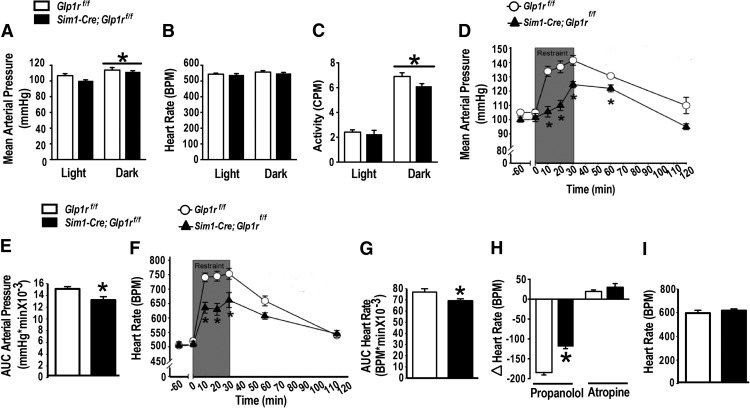
Sim1-Cre Glp1r KD attenuates cardiovascular responses to acute restraint. A–C, Baseline recordings of blood pressure (A), HR (B), and total activity (C) revealed no significant differences between the genotypes. There were main effects of time on blood pressure and activity, consistent with known circadian patterns. D–G, Exposure to acute restraint induced significant increases in blood pressure (MAP) and HR (BPM) that were attenuated in Sim1-Cre; Glp1rf/f mice. *Significant difference from Glp1rf/f (n = 7 or 8 per group). H, Sim1-Cre; Glp1rf/f mice showed less sympathetic cardiac tone following restraint, but there was no difference in the parasympathetic drive to the heart. I, HR response following total ganglionic blockade with hexamethonium did not differ between the genotypes. Data are mean ± SEM.
Figure 5.
Figure 5.
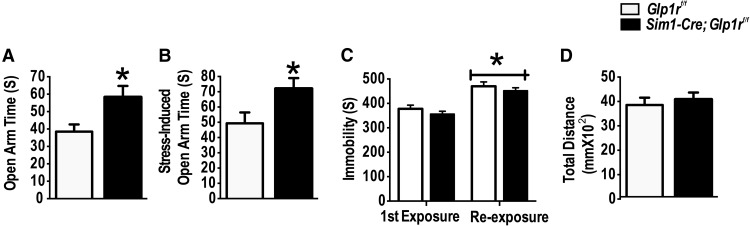
Decreased anxiety-like behavior following KD of Glp1r in Sim1 neurons. A, Sim1-Cre; Glp1rf/f mice exhibited more open arm time in the EPM than their littermates Glp1rf/f under basal conditions. B, Sim1-Cre; Glp1rf/f exhibited increased exploration into the open arm following prior stress exposure (10 min FST + 1 h rotation on a platform shaker on the day before testing). *Significant difference from Glp1rf/f. C, There was no significant effect of Glp1r KD on immobility in the FST. D, There was no genotype difference in locomotion in the EPM.
Figure 6.
Figure 6.
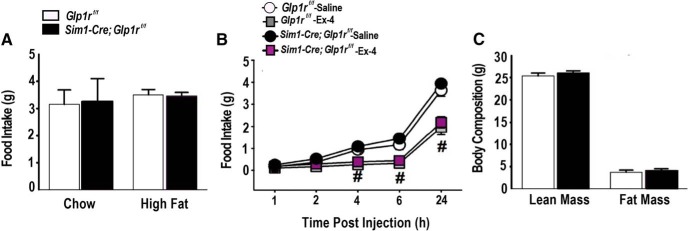
Sim1-Cre Glp1r KD does not alter food intake or body weight in the absence of stress. A, There were no significant genotype differences in food intake (under either normal chow or high-fat diet conditions). B, There were no genotype effects in response to the Glp1r agonist Ex-4. #Significant difference from respective saline control (n = 7 or 8 per group). C, Body composition showed no significant difference between the two genotypes (n = 7 or 8 per group).

References

    1. Alhadeff AL, Grill HJ. Hindbrain nucleus tractus solitarius glucagon-like peptide-1 receptor signaling reduces appetitive and motivational aspects of feeding. Am J Physiol. 2014;307:R465–R470. doi: 10.1152/ajpregu.00179.2014. - DOI - PMC - PubMed
    1. Balthasar N, Dalgaard LT, Lee CE, Yu J, Funahashi H, Williams T, Ferreira M, Tang V, McGovern RA, Kenny CD, Christiansen LM, Edelstein E, Choi B, Boss O, Aschkenasi C, Zhang CY, Mountjoy K, Kishi T, Elmquist JK, Lowell BB. Divergence of melanocortin pathways in the control of food intake and energy expenditure. Cell. 2005;123:493–505. doi: 10.1016/j.cell.2005.08.035. - DOI - PubMed
    1. Barrera JG, Jones KR, Herman JP, D'Alessio DA, Woods SC, Seeley RJ. Hyperphagia and increased fat accumulation in two models of chronic CNS glucagon-like peptide-1 loss of function. J Neurosci. 2011;31:3904–3913. doi: 10.1523/JNEUROSCI.2212-10.2011. - DOI - PMC - PubMed
    1. Bhatnagar S, Dallman M. Neuroanatomical basis for facilitation of hypothalamic-pituitary-adrenal responses to a novel stressor after chronic stress. Neuroscience. 1998;84:1025–1039. doi: 10.1016/S0306-4522(97)00577-0. - DOI - PubMed
    1. Buse JB, Rosenstock J, Sesti G, Schmidt WE, Montanya E, Brett JH, Zychma M, Blonde L. Liraglutide once a day versus exenatide twice a day for type 2 diabetes: a 26-week randomised, parallel-group, multinational, open-label trial (LEAD-6) Lancet. 2009;374:39–47. doi: 10.1016/S0140-6736(09)60659-0. - DOI - PubMed

Publication types

MeSH terms

LinkOut - more resources