Review
. 2017 Feb;149(2):181-197.
doi: 10.1085/jgp.201611637. Epub 2017 Jan 4.

Extraoral bitter taste receptors in health and disease

Affiliations
Review

Extraoral bitter taste receptors in health and disease

Ping Lu et al. J Gen Physiol. 2017 Feb.

Abstract

Bitter taste receptors (TAS2Rs or T2Rs) belong to the superfamily of seven-transmembrane G protein-coupled receptors, which are the targets of >50% of drugs currently on the market. Canonically, T2Rs are located in taste buds of the tongue, where they initiate bitter taste perception. However, accumulating evidence indicates that T2Rs are widely expressed throughout the body and mediate diverse nontasting roles through various specialized mechanisms. It has also become apparent that T2Rs and their polymorphisms are associated with human disorders. In this review, we summarize the physiological and pathophysiological roles that extraoral T2Rs play in processes as diverse as innate immunity and reproduction, and the major challenges in this emerging field.


Figures

Figure 1.
Figure 1.
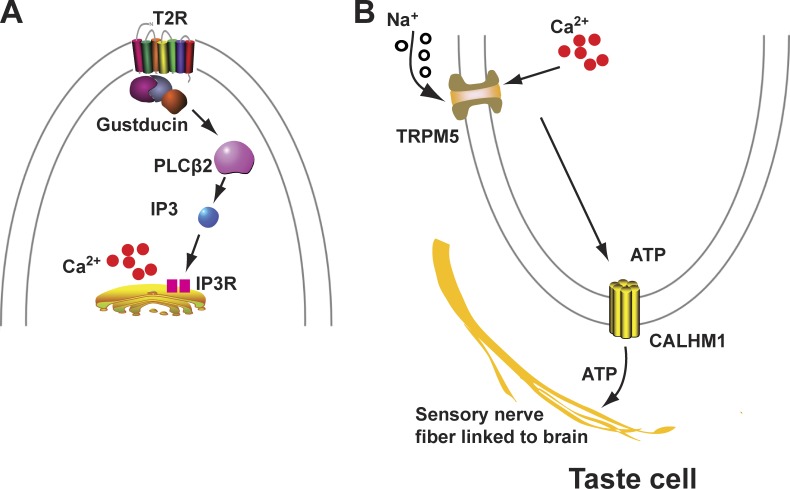
The canonical T2R signaling pathway. (A) The invariant portion of T2R-mediated signaling in the tongue and extraoral cells/tissues includes bitter compounds binding (outside the cell; not depicted) with the receptors to increase intracellular calcium. (B) The remaining components of the T2R pathway in the taste bud.
Figure 2.
Figure 2.
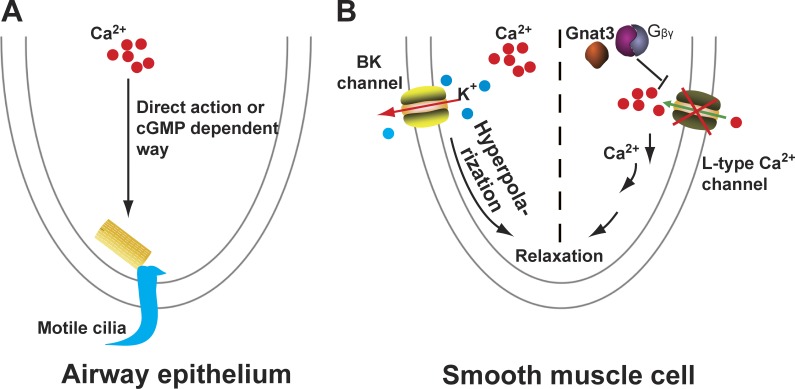
The cell-autonomous model of the T2R signaling cascade. (A) Bitter tastants increase cilia beat frequency in airway epithelium. (B) Bitter tastants relax precontracted airway smooth muscle cells. cGMP, cyclic guanosine monophosphate.
Figure 3.
Figure 3.
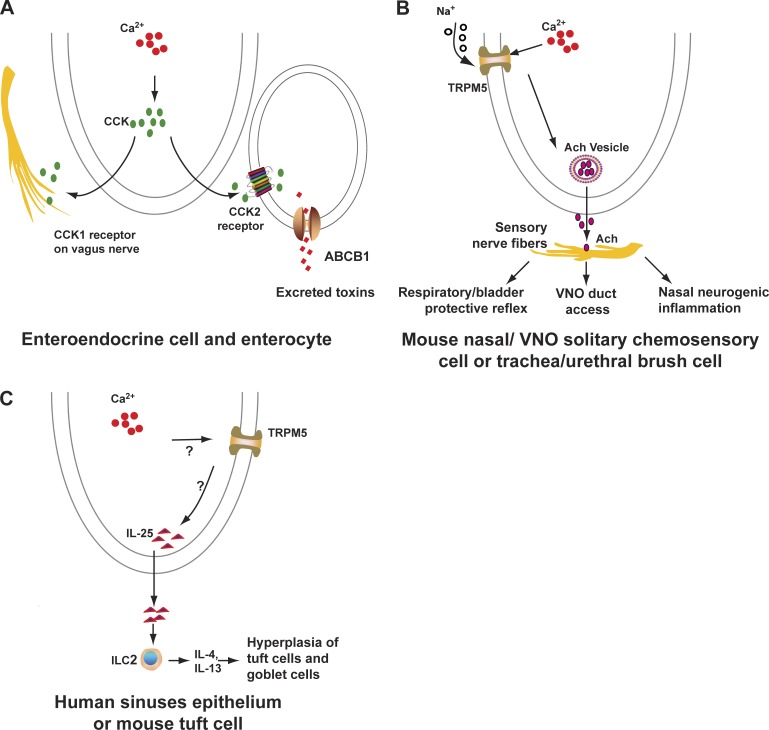
The paracrine model of the T2R signaling cascade. (A) In the gut, dietary toxins or bitter compounds from bacteria activate T2Rs in EECs to release the peptide hormone CCK, which acts through CKK2 receptors in the neighboring enterocytes to promote ABCB1 to pump bitter-tasting toxins out of the enterocytes (right). Alternatively, CCK released by EECs can also activate CCK1 receptors on sensory fibers of the vagus nerve to send signals to the brain to limit food intake (left). (B) The paracrine model also operates in mouse SCCs from the nasal organ or VNO and in brush cells from the trachea and bladder, where bitter compounds or N-acyl homoserine lactones, bacterial quorum-sensing molecules, activate bitter-taste signaling to release Ach, which in turn activates sensory fibers to (a) initiate a protective reflex, leading to a decrease in respiratory rate or an increase in bladder contraction; (b) close the VNO duct; or (c) induce neurogenic inflammation in the nasal cavity. (C) In tuft cells from the gut, parasites activate the canonical taste cascade and release IL-25, which in turn increases the number of ILC2s and boosts the secretion of type 2 immune cytokines IL-13 and IL-4; these cytokines subsequently promote the hyperplasia of tuft cells and goblet cells.
Figure 4.
Figure 4.
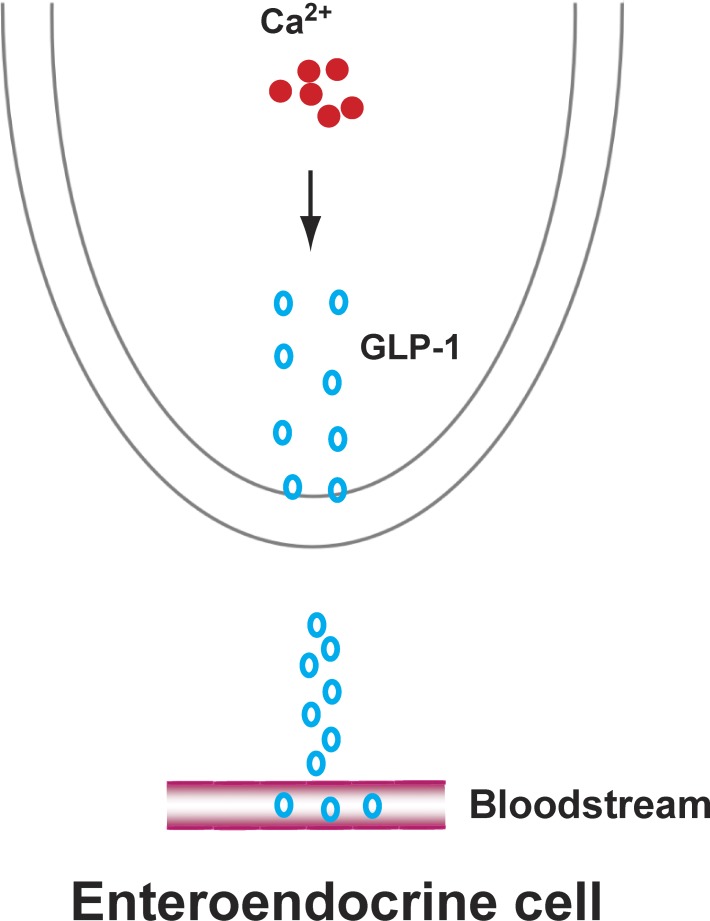
The endocrine model of the T2R signaling pathway in EECs. These cells secrete GLP-1, which diffuses across the extracellular fluids to enter the circulation, and in turn stimulate the release of insulin from pancreatic β-cells.

References

    1. Adappa N.D., Zhang Z., Palmer J.N., Kennedy D.W., Doghramji L., Lysenko A., Reed D.R., Scott T., Zhao N.W., Owens D., et al. 2014. The bitter taste receptor T2R38 is an independent risk factor for chronic rhinosinusitis requiring sinus surgery. Int. Forum Allergy Rhinol. 4:3–7. 10.1002/alr.21253 - DOI - PMC - PubMed
    1. Adappa N.D., Farquhar D., Palmer J.N., Kennedy D.W., Doghramji L., Morris S.A., Owens D., Mansfield C., Lysenko A., Lee R.J., et al. 2016a TAS2R38 genotype predicts surgical outcome in nonpolypoid chronic rhinosinusitis. Int. Forum Allergy Rhinol. 6:25–33. 10.1002/alr.21666 - DOI - PMC - PubMed
    1. Adappa N.D., Truesdale C.M., Workman A.D., Doghramji L., Mansfield C., Kennedy D.W., Palmer J.N., Cowart B.J., and Cohen N.A.. 2016c Correlation of T2R38 taste phenotype and in vitro biofilm formation from nonpolypoid chronic rhinosinusitis patients. Int. Forum Allergy Rhinol. 6:783–791. 10.1002/alr.21803 - DOI - PMC - PubMed
    1. Adappa N.D., Workman A.D., Hadjiliadis D., Dorgan D.J., Frame D., Brooks S., Doghramji L., Palmer J.N., Mansfield C., Reed D.R., and Cohen N.A.. 2016b T2R38 genotype is correlated with sinonasal quality of life in homozygous ΔF508 cystic fibrosis patients. Int. Forum Allergy Rhinol. 6:356–361. 10.1002/alr.21675 - DOI - PMC - PubMed
    1. Ahlman H., and Nilsson O.. 2001. The gut as the largest endocrine organ in the body. Ann. Oncol. 12(Suppl 2):S63–S68. 10.1093/annonc/12.suppl_2.S63 - DOI - PubMed

Substances