


Central cord syndrome in a patient with systemic sclerosis and cervical calcinosis: case report and review of literature
- PMID: 28053731
- PMCID: PMC5129387
- DOI: 10.1038/scsandc.2015.29
Central cord syndrome in a patient with systemic sclerosis and cervical calcinosis: case report and review of literature
Erratum in
-
Erratum for Spinal Cord Series and Cases content published prior to July 2016.Spinal Cord Ser Cases. 2016 Jul 21;2:16019. doi: 10.1038/scsandc.2016.19. eCollection 2016. Spinal Cord Ser Cases. 2016. PMID: 31265710 Free PMC article.
Abstract
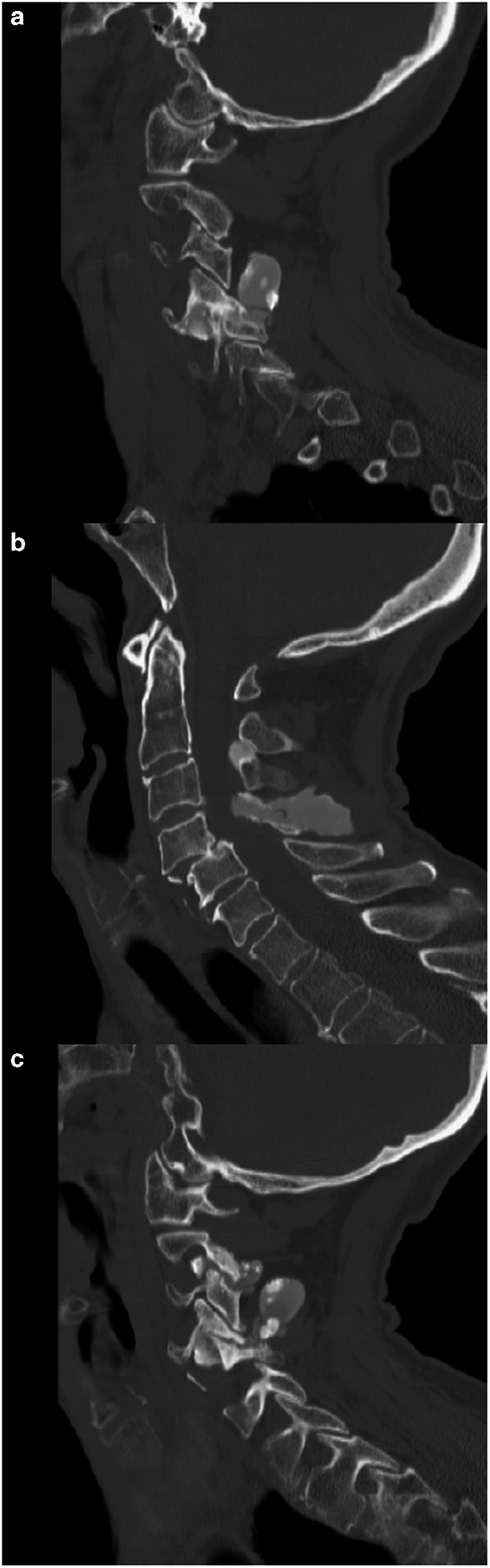
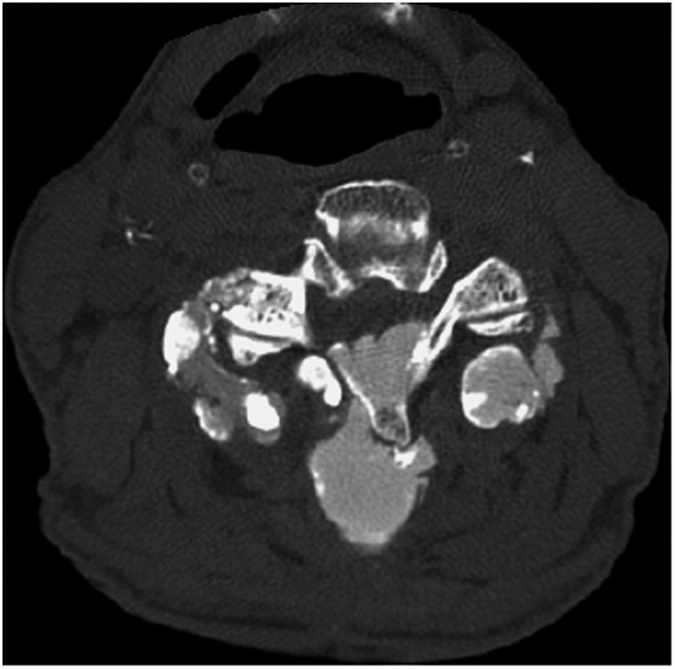
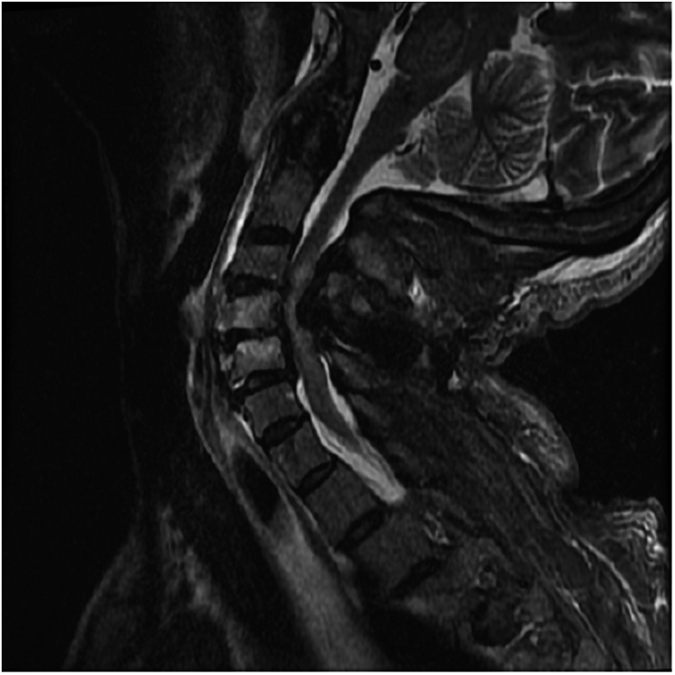
Systemic sclerosis, or scleroderma, rarely involves the cervical spine. The disorder can induce dystrophic calcinosis that can cause spinal canal stenosis and spinal instability. An association between this pathology with acute traumatic central cord syndrome and dural erosion is rare. This case report highlights such an association and postulates the underlying mechanisms. A 57-year-old female, with a history of chronic obstructive pulmonary disease (COPD), schizophrenia and systemic sclerosis, presented with weakness in all extremities after a minor fall. Imaging demonstrated a calcified soft-tissue mass at C4/5 causing severe cord compression, cord edema spanning C3-C6, calcified soft-tissue masses at right C2/C3 facet joint and bilateral C4/5 facet joints, and significant subluxation at C4/5. Patient underwent C4-C7 laminectomies, and C3-T1 fixation and fusion. The calcinosis appeared to erode through the dura, which necessitated dura repair once the calcionsis was carefully debulked. The patient recovered well, and improved clinically with rehabilitation. Dystrophic calcinosis from underlying systemic sclerosis can cause significant chronic cervical stenosis, which may reduce the threshold for acute traumatic cervical cord syndrome under minor trauma. Moreover, dystrophic calcinosis may exhibit a propensity for dural erosion, possibly through chronic adhesions secondary to chronic inflammation. Aggressive removal of the calcinosis may breach the dura. Consequently, subtotal debulking may be reasonable if the spinal canal is adequately decompressed after laminectomies.
Keywords: Chronic inflammation; Neuroscience.
Figures
References
-
- Elhai M , Avouac J , Kahan A , Allanore Y . Systemic sclerosis at the crossroad of polyautoimmunity. Autoimmun Rev 2013; 12, pp 1052–1057. - PubMed
-
- Allanore Y , Avouac J , Kahan A . Systemic sclerosis: an update in 2008. Joint Bone Spine 2008; 75, pp 650–655. - PubMed
-
- Arginteanu MS , Perin NI . Paraspinal calcinosis associated with progressive systemic sclerosis. Case report. J Neurosurg 1997; 87, pp 761–763. - PubMed
-
- Schweitzer ME , Cervilla V , Manaster BJ , Gerharter J , Dalinka M , Peck WW et al. Cervical paraspinal calcification in collagen vascular diseases. AJR Am J Roentgenol 1991; 157, pp 523–525. - PubMed
-
- Van de Perre S , Vanhoenacker FM , Op de Beeck B , Gielen JL , De Schepper AM . Paraspinal cervical calcifications associated with scleroderma. JBR-BTR 2003; 86, pp 80–82. - PubMed
LinkOut - more resources
Full Text Sources
Other Literature Sources
Miscellaneous
