


Comparison of Doxycycline, Minocycline, Doxycycline plus Albendazole and Albendazole Alone in Their Efficacy against Onchocerciasis in a Randomized, Open-Label, Pilot Trial
- PMID: 28056021
- PMCID: PMC5215804
- DOI: 10.1371/journal.pntd.0005156
Comparison of Doxycycline, Minocycline, Doxycycline plus Albendazole and Albendazole Alone in Their Efficacy against Onchocerciasis in a Randomized, Open-Label, Pilot Trial
Abstract
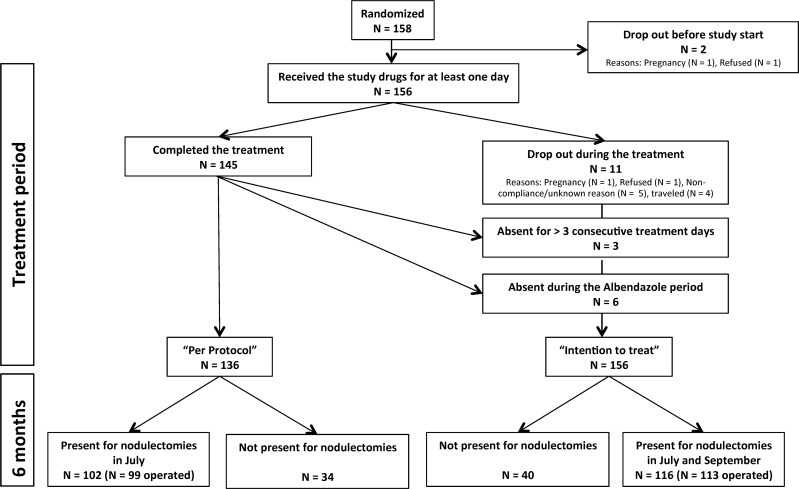
The search for new macrofilaricidal drugs against onchocerciasis that can be administered in shorter regimens than required for doxycycline (DOX, 200mg/d given for 4-6 weeks), identified minocycline (MIN) with superior efficacy to DOX. Further reduction in the treatment regimen may be achieved with co-administration with standard anti-filarial drugs. Therefore a randomized, open-label, pilot trial was carried out in an area in Ghana endemic for onchocerciasis, comprising 5 different regimens: the standard regimen DOX 200mg/d for 4 weeks (DOX 4w, N = 33), the experimental regimens MIN 200mg/d for 3 weeks (MIN 3w; N = 30), DOX 200mg/d for 3 weeks plus albendazole (ALB) 800mg/d for 3 days (DOX 3w + ALB 3d, N = 32), DOX 200mg/d for 3 weeks (DOX 3w, N = 31) and ALB 800mg for 3 days (ALB 3d, N = 30). Out of 158 randomized participants, 116 (74.4%) were present for the follow-up at 6 months of whom 99 participants (63.5%) followed the treatment per protocol and underwent surgery. Histological analysis of the adult worms in the extirpated nodules revealed absence of Wolbachia in 98.8% (DOX 4w), 81.4% (DOX 3w + ALB 3d), 72.7% (MIN 3w), 64.1% (DOX 3w) and 35.2% (ALB 3d) of the female worms. All 4 treatment regimens showed superiority to ALB 3d (p < 0.001, p < 0.001, p = 0.002, p = 0.008, respectively), which was confirmed by real-time PCR. Additionally, DOX 4w showed superiority to all other treatment arms. Furthermore DOX 4w and DOX 3w + ALB 3d showed a higher amount of female worms with degenerated embryogenesis compared to ALB 3d (p = 0.028, p = 0.042, respectively). These results confirm earlier studies that DOX 4w is sufficient for Wolbachia depletion and the desired parasitological effects. The data further suggest that there is an additive effect of ALB (3 days) on top of that of DOX alone, and that MIN shows a trend for stronger potency than DOX. These latter two results are preliminary and need confirmation in a fully randomized controlled phase 2 trial.
Trial registration: ClinicalTrials.gov #06010453.
Conflict of interest statement
The author has declared that no competing interests exist.
Figures


References
-
- WHO. Meeting of the international task force for disease eradication. Wkly Epidem Rec. 2014;11;89(15):153–60. - PubMed
-
- Coffeng LE, Stolk WA, Zoure HG, Veerman JL, Agblewonu KB, Murdoch ME, et al. African Programme For Onchocerciasis Control 1995–2015: model-estimated health impact and cost. PLoS neglected tropical diseases. 2013;7(1):e2032 PubMed Central PMCID: PMC3561133. 10.1371/journal.pntd.0002032 - DOI - PMC - PubMed
-
- WHO. African Programme for Onchocerciasis Control—report of the sixth meeting of national task forces, October 2009. Wkly Epidemiol Rec. 2010;85(4):23–8. Epub 2010/01/26. - PubMed
-
- Tekle AH, Zoure HG, Noma M, Boussinesq M, Coffeng LE, Stolk WA, et al. Progress towards onchocerciasis elimination in the participating countries of the African Programme for Onchocerciasis Control: epidemiological evaluation results. Infect Dis Poverty. 2016;5(1):66 PubMed Central PMCID: PMCPMC4924267. 10.1186/s40249-016-0160-7 - DOI - PMC - PubMed
Publication types
MeSH terms
Substances
Associated data
LinkOut - more resources
Full Text Sources
Other Literature Sources
Miscellaneous
