Review
. 2018 Feb;19(2):504-518.
doi: 10.1111/mpp.12533. Epub 2017 Mar 9.

Chloroplast: the Trojan horse in plant-virus interaction

Affiliations
Review

Chloroplast: the Trojan horse in plant-virus interaction

Dhriti Bhattacharyya et al. Mol Plant Pathol. 2018 Feb.

Abstract

The chloroplast is one of the most dynamic organelles of a plant cell. It carries out photosynthesis, synthesizes major phytohormones, plays an active part in the defence response and is crucial for interorganelle signalling. Viruses, on the other hand, are extremely strategic in manipulating the internal environment of the host cell. The chloroplast, a prime target for viruses, undergoes enormous structural and functional damage during viral infection. Indeed, large proportions of affected gene products in a virus-infected plant are closely associated with the chloroplast and the process of photosynthesis. Although the chloroplast is deficient in gene silencing machinery, it elicits the effector-triggered immune response against viral pathogens. Virus infection induces the organelle to produce an extensive network of stromules which are involved in both viral propagation and antiviral defence. From studies over the last few decades, the involvement of the chloroplast in the regulation of plant-virus interaction has become increasingly evident. This review presents an exhaustive account of these facts, with their implications for pathogenicity. We have attempted to highlight the intricacies of chloroplast-virus interactions and to explain the existing gaps in our current knowledge, which will enable virologists to utilize chloroplast genome-based antiviral resistance in economically important crops.

Keywords: chloroplast; defence; infection; interaction; replication; translation; virus.


Conflict of interest statement

The authors declare that they do not have any conflicts of interest.

Figures
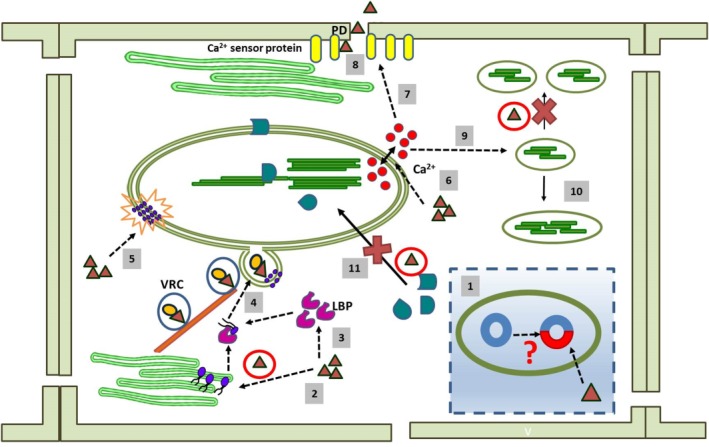
Figure 1
Figure 1
Conceptual depiction of different aspects of chloroplast–virus interaction. For simplified representation, the same symbols have been used for different viruses (filled red triangles). During the course of evolution, viruses have probably replaced some of the genes in the chloroplast with their own genetic material; this might be reflected by the plastid affinity of viruses (1). Viruses alter the lipid biosynthesis (lipid molecules are indicated by blue circles) (2) and lipid trafficking pathway by the overexpression of lipid‐binding proteins (LBPs) (3). These alterations aid in membrane invagination, vesicle formation (4) and rearrangement of the membrane lipid bilayer (5). Viral infection affects Ca2+ (Ca2+ ions indicated by red circles) signalling mediated by the chloroplast (6). This might affect the biochemical properties of synaptotagmin (SYTA)‐like Ca2+ sensor proteins (7) which, in turn, help the viral component to move through the plasmodesmata (PD) for cell‐to‐cell movement (8). A change in the Ca2+ level also hampers normal chloroplast division (9), and large, abnormally shaped chloroplasts are formed (10). Viral proteins sequester various chloroplast‐localized proteins (chloroplast‐localized proteins are indicated by green geometric shapes) in the cytosol (11); this again damages the organelle structurally and functionally. VRC, virus replication complex.
Figure 2
Figure 2
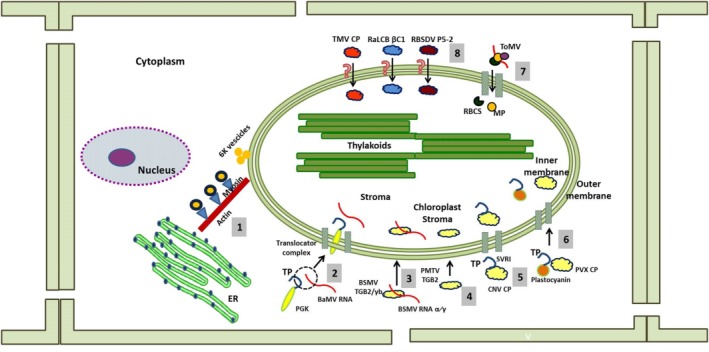
Different strategies adopted by different viruses to send their nucleic acid and/or protein products into the chloroplast. Vesicles induced by the 6K protein of Turnip mosaic virus (TuMV) follow the endoplasmic reticulum (ER)–Golgi vesicular transport pathway to reach the chloroplast using the actomyosin motility system (1). The 3′ untranslated region (UTR) of Bamboo mosaic virus (BaMV) RNA binds with the transit peptide of p51, a chloroplast phosphoglycerate kinase (chl‐PGK), to pass through the membranes of the chloroplast (2). TGB2, the movement protein of Barley stripe mosaic virus (BSMV) and Potato mop‐top virus (PMTV), shows different properties when localized inside the chloroplast in terms of being associated with or without the respective nucleic acids (3, 4). The arm domain of Cucumber necrosis virus (CNV) coat protein (CP) has an embedded sequence identical to the transit peptide (TP) of chloroplast proteins, which helps the viral protein to cross the translocation machinery (5). The Potato virus X (PVX) CP interacts with the TP of plastocyanine to reach the organelle (6). The movement protein (MP) of Tomato mosaic virus (ToMV) interacts with the small subunit of RuBisCO and localizes to the chloroplast (7). The mechanisms used by a few proteins, such as Tobacco mosaic virus (TMV) CP, Radish leaf curl betasatellite (RaLCB) βC1 and Rice black‐streaked dwarf virus (RBSDV) P5‐2, to pass through the translocation machinery are yet not known (8). RBCS, small subunit of RuBisCO; SVRI, R‐arm region plus the first 4 aa [SVRI] of the shell [S] domain of CNV coat protein.
Figure 3
Figure 3
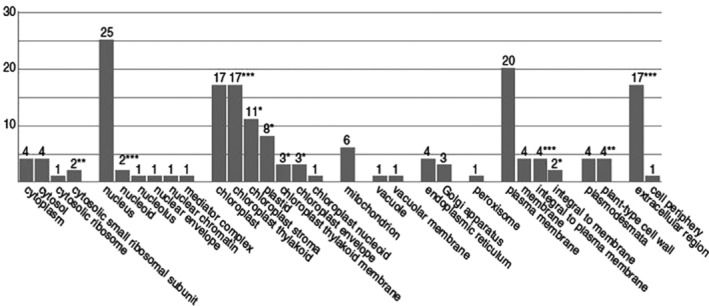
Organelle‐wise distribution of differentially expressed down‐regulated genes in tobacco during Cucumber mosaic virus infection. The graph shows that chloroplast‐related gene products comprise the highest percentage of differentially expressed genes. The figure is borrowed from the study of Mochizuki et al. (2014b) with permission.
Figure 4
Figure 4
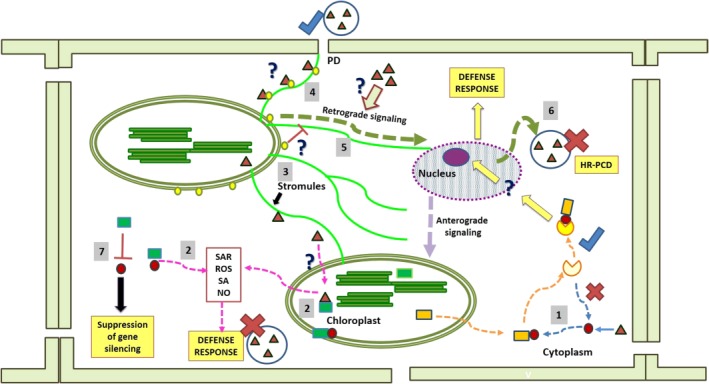
Conceptual depiction of the major lines of antiviral defence conferred by the chloroplast. For simplified representation, the same symbols have been used for different viruses (filled red triangles) and their gene products (filled red circles). Similarly filled green squares are used for interacting chloroplast proteins. Crosses are used to highlight an unfavourable reaction from the viewpoint of viruses, whereas blue ticks are used for favourable reactions. A detailed description is given in the text. N receptor‐interacting protein 1 (NRIP1) is originally located in the chloroplast and, on Tobacco mosaic virus (TMV) infection, it is recruited to the cytoplasm. The innate immunity of the plant against TMV is elicited by the activation of the cytoplasm/nucleus‐localized N‐immune receptor through the NRIP1–TMV p50 complex. The resultant active immune complex initiates the nucleus‐mediated defence response (1). Gene products of various viruses interact with different chloroplast proteins inside the organelle or cytoplasm and elicit the basal defence response (2). Virus infection causes the induction/enhanced accumulation of tubular channels of ‘stromules’ (3). Through chloroplast unusual positioning protein1 (CHUP1), viruses attach themselves to stromules and perform intra‐ and intercellular movements (4). Through stromules, the hypersensitive response‐mediated retrograde signal is transduced from the chloroplast to the nucleus (5) and programmed cell death takes place (6). By interacting with the viral suppressor of gene silencing, chloroplast proteins interfere with the virus counter‐defence mechanism (7). HR‐PCD, hypersensitive response‐programmed cell death; NO, nitric oxide; PD, plasmodesmata; ROS, reactive oxygen species; SA, salicylic acid; SAR, systemic acquired resistance.

References

    1. Abbink, T.E. , Peart, J.R. , Mos, T.N. , Baulcombe, D.C. and Bol, J.F. (2002) Silencing of a gene encoding a protein component of the oxygen‐evolving complex of photosystem II enhances virus replication in plants. Virology, 295, 307–319. - PubMed
    1. Ahlquist, P. , Noueiry, A.O. , Lee, W.M. , Kushner, D.B. and Dye, B.T. (2003) Host factors in positive‐strand RNA virus genome replication. J. Virol. 77, 8181–8186. - PMC - PubMed
    1. Andersson, B. and Aro, E.M. (1997) Proteolytic activities and proteases of plant chloroplasts. Physiol. Plant. 100, 780–793.
    1. Ashraf, M. and Harris, P.J.C. (2013) Photosynthesis under stressful environments: an overview. Photosynthetica, 51, 163–190.
    1. Balachandran, S. , Hull, R.J. , Vaadia, Y. , Wolf, S. and Lucas, W.J. (1995) Alteration in carbon partitioning induced by the movement protein of Tobacco mosaic virus originates in the mesophyll and is independent of change in the plasmodesmal size exclusion limit. Plant Cell Environ. 18, 1301–1310.

Publication types

MeSH terms

LinkOut - more resources