


Comparison of global myocardial strain assessed by cardiovascular magnetic resonance tagging and feature tracking to infarct size at predicting remodelling following STEMI
- PMID: 28056808
- PMCID: PMC5217595
- DOI: 10.1186/s12872-016-0461-6
Comparison of global myocardial strain assessed by cardiovascular magnetic resonance tagging and feature tracking to infarct size at predicting remodelling following STEMI
Abstract
Background: To determine if global strain parameters measured by cardiovascular magnetic resonance (CMR) acutely following ST-segment Elevation Myocardial Infarction (STEMI) predict adverse left ventricular (LV) remodelling independent of infarct size (IS).
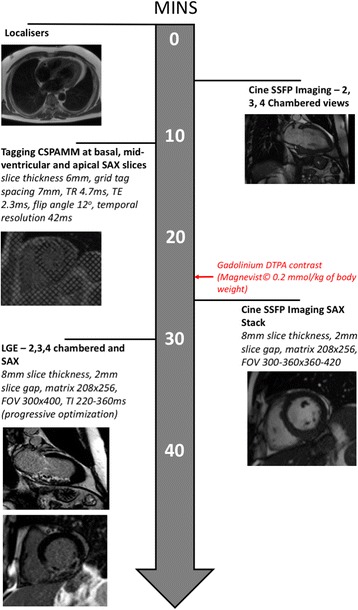
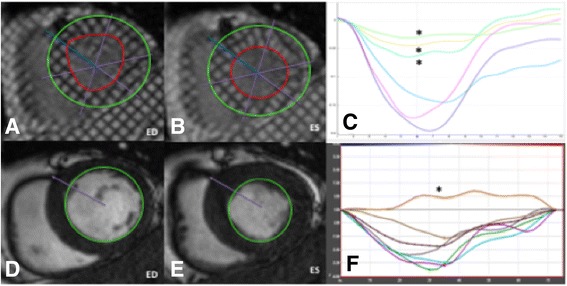
Methods: Sixty-five patients with acute STEMI (mean age 60 ± 11 years) underwent CMR at 1-3 days post-reperfusion (baseline) and at 4 months. Global peak systolic circumferential strain (GCS), measured by tagging and Feature Tracking (FT), and global peak systolic longitudinal strain (GLS), measured by FT, were calculated at baseline, along with IS. On follow up scans, volumetric analysis was performed to determine the development of adverse remodelling - a composite score based on development of either end-diastolic volume index [EDVI] ≥20% or end-systolic volume index [ESVI] ≥15% at follow-up compared to baseline.
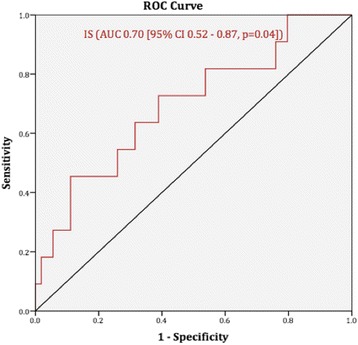
Results: The magnitude of GCS was higher when measured using FT (-21.1 ± 6.3%) than with tagging (-12.1 ± 4.3; p < 0.001 for difference). There was good correlation of strain with baseline LVEF (r 0.64-to 0.71) and IS (ρ -0.62 to-0.72). Baseline strain parameters were unable to predict development of adverse LV remodelling. Only baseline IS predicted adverse remodelling - Odds Ratio 1.05 (95% CI 1.01-1.10, p = 0.03), area under the ROC curve 0.70 (95% CI 0.52-0.87, p = 0.04).
Conclusion: Baseline global strain by CMR does not predict the development of adverse LV remodelling following STEMI.
Keywords: Cardiac magnetic resonance; Feature tracking; Remodelling; ST-elevation myocardial infarction; Strain; Tagging.
Figures
References
-
- Cohn JN, Ferrari R, Sharpe N. Cardiac remodeling--concepts and clinical implications: a consensus paper from an international forum on cardiac remodeling. Behalf of an International Forum on Cardiac Remodeling. J Am Coll Cardiol. 2000;35(3):569–582. doi: 10.1016/S0735-1097(99)00630-0. - DOI - PubMed
-
- Bolognese L, Neskovic AN, Parodi G, Cerisano G, Buonamici P, Santoro GM, Antoniucci D. Left ventricular remodeling after primary coronary angioplasty: patterns of left ventricular dilation and long-term prognostic implications. Circulation. 2002;106(18):2351–2357. doi: 10.1161/01.CIR.0000036014.90197.FA. - DOI - PubMed
-
- Zwanenburg JJM. Mapping Asynchrony of Circumferential Shortening in the Human Heart with High Temporal Resolution MRI Tagging. Amsterdam: Vrije University; 2005.
Publication types
MeSH terms
Grants and funding
LinkOut - more resources
Full Text Sources
Other Literature Sources
Miscellaneous
