. 2017 Jan 5;18(1):3.
doi: 10.1186/s12931-016-0493-6.

Gene profile of fibroblasts identify relation of CCL8 with idiopathic pulmonary fibrosis

Affiliations

Gene profile of fibroblasts identify relation of CCL8 with idiopathic pulmonary fibrosis

Jong-Uk Lee et al. Respir Res. .

Abstract

Background: Idiopathic pulmonary fibrosis (IPF) is characterized by the complex interaction of cells involved in chronic inflammation and fibrosis. Global gene expression of a homogenous cell population will identify novel candidate genes.

Methods: Gene expression of fibroblasts derived from lung tissues (8 IPF and 4 controls) was profiled, and ontology and functional pathway were analyzed in the genes exhibiting >2 absolute fold changes with p-values < 0.05. CCL8 mRNA and protein levels were quantified using real-time PCR and ELISA. CCL8 localization was evaluated by immunofluorescence staining.

Results: One hundred seventy eight genes differentially expressed and 15 genes exhibited >10-fold change. Among them, 13 were novel in relation with IPF. CCL8 expression was 22.8-fold higher in IPF fibroblasts. The levels of CCL8 mRNA and protein were 3 and 9-fold higher in 14 IPF fibroblasts than those in 10 control fibroblasts by real-time PCR and ELISA (p = 0.022 and p = 0.026, respectively). The CCL8 concentrations in BAL fluid was significantly higher in 86 patients with IPF than those in 41 controls, and other interstitial lung diseases including non-specific interstitial pneumonia (n = 22), hypersensitivity pneumonitis (n = 20) and sarcoidosis (n = 19) (p < 0.005, respectively). Cut-off values of 2.29 pg/mL and 0.43 pg/mL possessed 80.2 and 70.7% accuracy for the discrimination of IPF from NC and the other lung diseases, respectively. IPF subjects with CCL8 levels >28.61 pg/mL showed shorter survival compared to those with lower levels (p = 0.012). CCL8 was expressed by α-SMA-positive cells in the interstitium of IPF.

Conclusions: Transcriptome analysis identified several novel IPF-related genes. Among them, CCL8 is a candidate molecule for the differential diagnosis and prediction of survival.

Keywords: CCL8; Gene expression; IPF; Transcriptome.


Figures
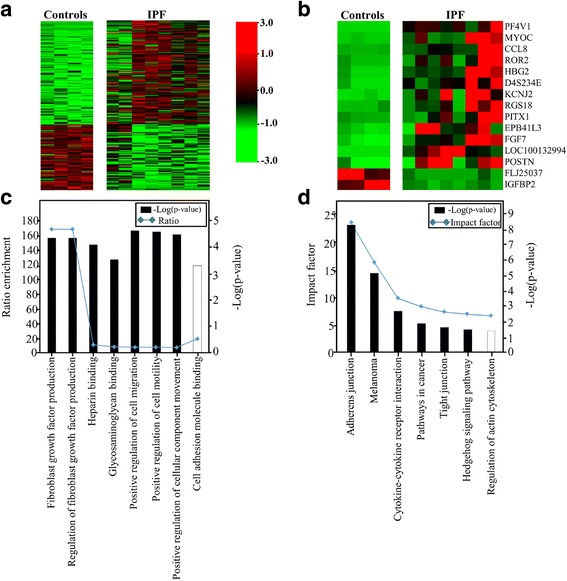
Fig. 1
Fig. 1
Gene expression profiles of fibroblasts derived from the lung tissues of 8 patients with IPF and 4 controls. a A heat map of 178 genes differentially expressed between the two groups (p-value <0.05 and absolute fold-change ratio >2 by t-test and TNoM). The maximum value (red) of each gene was set to 3, the minimum value to −3, and the remaining values were linearly fitted in the range. b A heat map of top 15 genes differentially expressed between the two groups (p-value < 0.05 by t-test and TNoM, absolute fold-change ratio >10). c The top 8 significantly perturbed Gene Ontology nodes in the IPF patients versus the controls. Left, statistical significance of the perturbation as determined by a gene set test; right, ratio of enrichment. The significance of differences between the dataset and the canonical pathway was measured as a ratio. Solid and open bars represent upregulation and downregulation, respectively. d Biological pathway analysis of differentially expressed gene sets related to IPF (corrected gamma p-value < 0.05). P-values and impact factors are plotted on the left and right axes, respectively
Fig. 2
Fig. 2
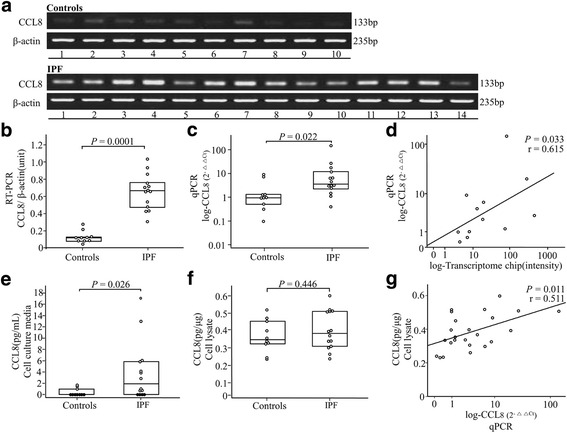
CCL8 mRNA and protein levels in lung tissue-derived fibroblasts from 14 IPF patients and 10 controls. (a) RT-PCR, (b) densitometry of the CCL8 RT-PCR band intensity normalized to that of β-actin, (c) real-time PCR, and (d) correlations of the CCL8 mRNA levels of 12 subjects determined by the transcriptome chip with those by real-time PCR. e, f CCL8 protein level of Culture media and cell lysate, and (g) correlations of the CCL8 protein levels and CCL8 mRNA levels of 24 subjects determined by the ELISA with those by real-time PCR. The data were presented as median values with 25 and 75% quartiles
Fig. 3
Fig. 3
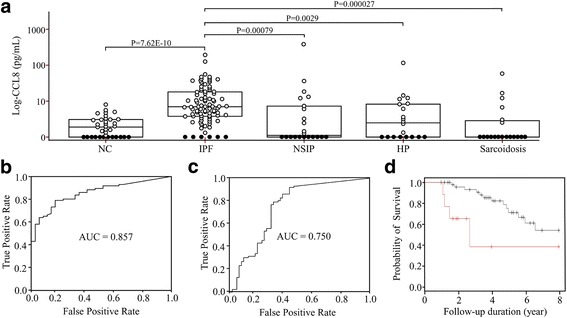
CCL8 protein concentrations in BAL fluids and ROC curves. a CCL8 protein was detected in 25 of 41 normal controls, 80 of 86 IPF patients, 11 of 22 NSIP patients, 8 of 20 HP patients and 13 of 19 sarcoidosis patients. Open and closed circles indicate CCL8 protein levels detected (>1.5pg/mL) and those below the lower limit of detection, respectively. The data were presented as median values with 25 and 75% quartiles. b ROC curve of the CCL8 protein concentration between the two groups. A cut-off value of 2.17pg/mL had 80.2% accuracy, 86.0% specificity, and 65.7% sensitivity for differentiating IPF patients from controls. c ROC curve of the CCL8 protein concentration between the other interstitial lung diseases groups. A cut-off value 0.53pg/mL had 70.7% accuracy, 91.9% specificity, 57.4% sensitivity between the IPF patients and the other interstitial lung diseases group. d A Kaplan-Meier plot of 69 subjects with IPF followed up for 1to 8 years. The percent survival rate was markedly lower in the group with a CCL8 level of >28.61 pg/mL (red line) compared with that in the group with a CCL8 level of <28.61 pg/mL (black line) (hazard ratio = 3.93, CI: 1.25–12.39, p = 0.012)
Fig. 4
Fig. 4
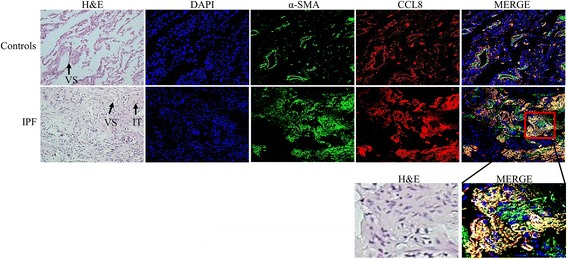
Representative double immunofluorescence-stained images of IPF and control lung tissues. CCL8 and α-smooth muscle actin (α-SMA) were stained using PE- (red) and FITC-conjugated antibodies (green), respectively. A proportion of interstitial fibroblasts (IT) and the peribronchial and vascular area (VS) showed staining for both CCL8 and α-SMA (magnification, 200×)

References

    1. American_Thoracic_Society Idiopathic pulmonary fibrosis: diagnosis and treatment. International consensus statement. American Thoracic Society (ATS), and the European Respiratory Society (ERS) Am J Respir Crit Care Med. 2000;161:646–64. doi: 10.1164/ajrccm.161.2.ats3-00. - DOI - PubMed
    1. Kim DS, Collard HR, King TE., Jr Classification and natural history of the idiopathic interstitial pneumonias. Proc Am Thorac Soc. 2006;3:285–92. doi: 10.1513/pats.200601-005TK. - DOI - PMC - PubMed
    1. Wynn TA. Integrating mechanisms of pulmonary fibrosis. J Exp Med. 2011;208:1339–50. doi: 10.1084/jem.20110551. - DOI - PMC - PubMed
    1. Zuo F, Kaminski N, Eugui E, Allard J, Yakhini Z, Ben-Dor A, Lollini L, Morris D, Kim Y, DeLustro B, et al. Gene expression analysis reveals matrilysin as a key regulator of pulmonary fibrosis in mice and humans. Proc Natl Acad Sci U S A. 2002;99:6292–7. doi: 10.1073/pnas.092134099. - DOI - PMC - PubMed
    1. Selman M, Pardo A, Barrera L, Estrada A, Watson SR, Wilson K, Aziz N, Kaminski N, Zlotnik A. Gene expression profiles distinguish idiopathic pulmonary fibrosis from hypersensitivity pneumonitis. Am J Respir Crit Care Med. 2006;173:188–98. doi: 10.1164/rccm.200504-644OC. - DOI - PMC - PubMed

Publication types