


Combined use of the Consolidated Framework for Implementation Research (CFIR) and the Theoretical Domains Framework (TDF): a systematic review
- PMID: 28057049
- PMCID: PMC5217749
- DOI: 10.1186/s13012-016-0534-z
Combined use of the Consolidated Framework for Implementation Research (CFIR) and the Theoretical Domains Framework (TDF): a systematic review
Abstract
Background: Over 60 implementation frameworks exist. Using multiple frameworks may help researchers to address multiple study purposes, levels, and degrees of theoretical heritage and operationalizability; however, using multiple frameworks may result in unnecessary complexity and redundancy if doing so does not address study needs. The Consolidated Framework for Implementation Research (CFIR) and the Theoretical Domains Framework (TDF) are both well-operationalized, multi-level implementation determinant frameworks derived from theory. As such, the rationale for using the frameworks in combination (i.e., CFIR + TDF) is unclear. The objective of this systematic review was to elucidate the rationale for using CFIR + TDF by (1) describing studies that have used CFIR + TDF, (2) how they used CFIR + TDF, and (2) their stated rationale for using CFIR + TDF.
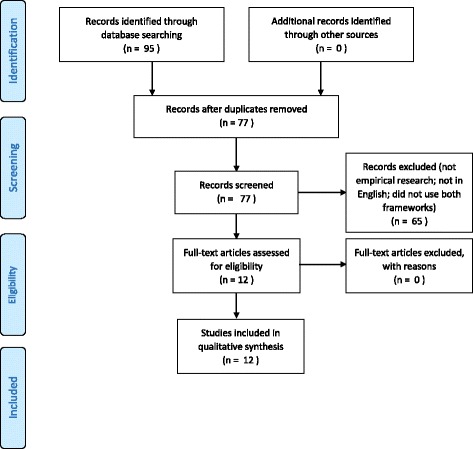
Methods: We undertook a systematic review to identify studies that mentioned both the CFIR and the TDF, were written in English, were peer-reviewed, and reported either a protocol or results of an empirical study in MEDLINE/PubMed, PsycInfo, Web of Science, or Google Scholar. We then abstracted data into a matrix and analyzed it qualitatively, identifying salient themes.
Findings: We identified five protocols and seven completed studies that used CFIR + TDF. CFIR + TDF was applied to studies in several countries, to a range of healthcare interventions, and at multiple intervention phases; used many designs, methods, and units of analysis; and assessed a variety of outcomes. Three studies indicated that using CFIR + TDF addressed multiple study purposes. Six studies indicated that using CFIR + TDF addressed multiple conceptual levels. Four studies did not explicitly state their rationale for using CFIR + TDF.
Conclusions: Differences in the purposes that authors of the CFIR (e.g., comprehensive set of implementation determinants) and the TDF (e.g., intervention development) propose help to justify the use of CFIR + TDF. Given that the CFIR and the TDF are both multi-level frameworks, the rationale that using CFIR + TDF is needed to address multiple conceptual levels may reflect potentially misleading conventional wisdom. On the other hand, using CFIR + TDF may more fully define the multi-level nature of implementation. To avoid concerns about unnecessary complexity and redundancy, scholars who use CFIR + TDF and combinations of other frameworks should specify how the frameworks contribute to their study.
Trial registration: PROSPERO CRD42015027615.
Keywords: Consolidated Framework for Implementation Research; Implementation frameworks; Implementation theories; Systematic review; Theoretical Domains Framework.
References
Publication types
MeSH terms
Grants and funding
LinkOut - more resources
Full Text Sources
Other Literature Sources
Medical
