Review
. 2017 Mar 1:230:384-401.
doi: 10.1016/j.ijcard.2016.12.097. Epub 2016 Dec 21.

Genomic translational research: Paving the way to individualized cardiac functional analyses and personalized cardiology

Affiliations
Review

Genomic translational research: Paving the way to individualized cardiac functional analyses and personalized cardiology

Ares Pasipoularides. Int J Cardiol. .

Abstract

For most of Medicine's past, the best that physicians could do to cope with disease prevention and treatment was based on the expected response of an average patient. Currently, however, a more personalized/precise approach to cardiology and medicine in general is becoming possible, as the cost of sequencing a human genome has declined substantially. As a result, we are witnessing an era of precipitous advances in biomedicine and bourgeoning understanding of the genetic basis of cardiovascular and other diseases, reminiscent of the resurgence of innovations in physico-mathematical sciences and biology-anatomy-cardiology in the Renaissance, a parallel time of radical change and reformation of medical knowledge, education and practice. Now on the horizon is an individualized, diverse patient-centered, approach to medical practice that encompasses the development of new, gene-based diagnostics and preventive medicine tactics, and offers the broadest range of personalized therapies based on pharmacogenetics. Over time, translation of genomic and high-tech approaches unquestionably will transform clinical practice in cardiology and medicine as a whole, with the adoption of new personalized medicine approaches and procedures. Clearly, future prospects far outweigh present accomplishments, which are best viewed as a promising start. It is now essential for pluridisciplinary health care providers to examine the drivers and barriers to the clinical adoption of this emerging revolutionary paradigm, in order to expedite the realization of its potential. So, we are not there yet, but we are definitely on our way.

Keywords: CRISPR-Cas9 genetic–phenotypic screen; DNA microarrays; Genome-wide association studies (GWAS); Molecular genetic biomarkers; Molecular genomic decoding of phenotypic diversity; Next-generation genome sequencing (NGS); Omics-based tests; Personalized/precise medicine; Pharmacogenomics and pharmacogenetics.


Figures

Fig. 1
Fig. 1
Marble statue of Hippocrates, ancient Greek physician considered as the Father of Western Medicine, in the city of Larissa in Thessaly, on the mainland of Greece. He envisioned the need for a Personalized Medicine.
Fig. 2
Fig. 2
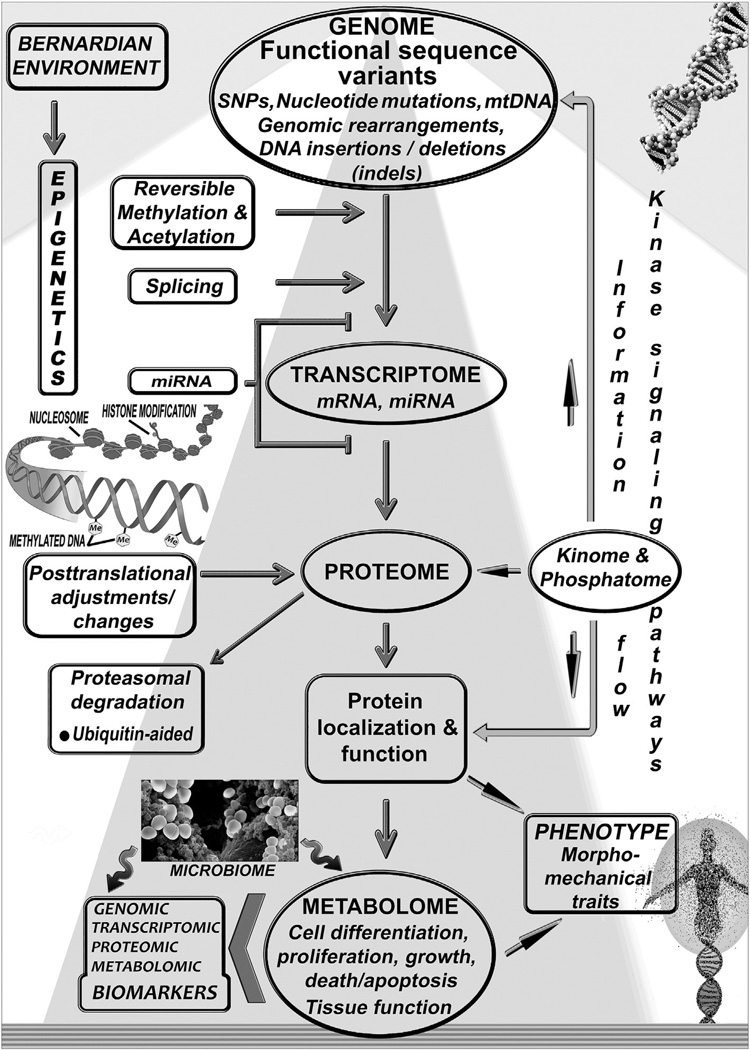
The genome integrates intrinsic and environmental signals. The Bernardian environment and epigenetic regulatory factors influence through (bidirectional) information flow and signaling pathways variable human gene transcription and expression, while protein levels and function are affected by various posttranslational adjustments. Epigenetic genome modifications allow the stable propagation of gene activity states from one cell generation to the next; since epigenetic states are reversible, they can be modified by environmental factors, which may contribute to modifiable changes between normal and abnormal phenotypes. Interfering with the activity of factors that modify the chromatin state can possibly affect the expression of unwanted genes. The human organism is effectively a “supraorganism,” an assemblage of human and microbial cells and genes and thus a blend of human and microbiome traits, including the metabolome. The relationship between different “-ome/-omics” components, protein levels, post-translational modification, protein localization and activity, leading to effects in cells and tissues and affecting phenotypic traits, is shown schematically in this general overview.
Fig. 3
Fig. 3
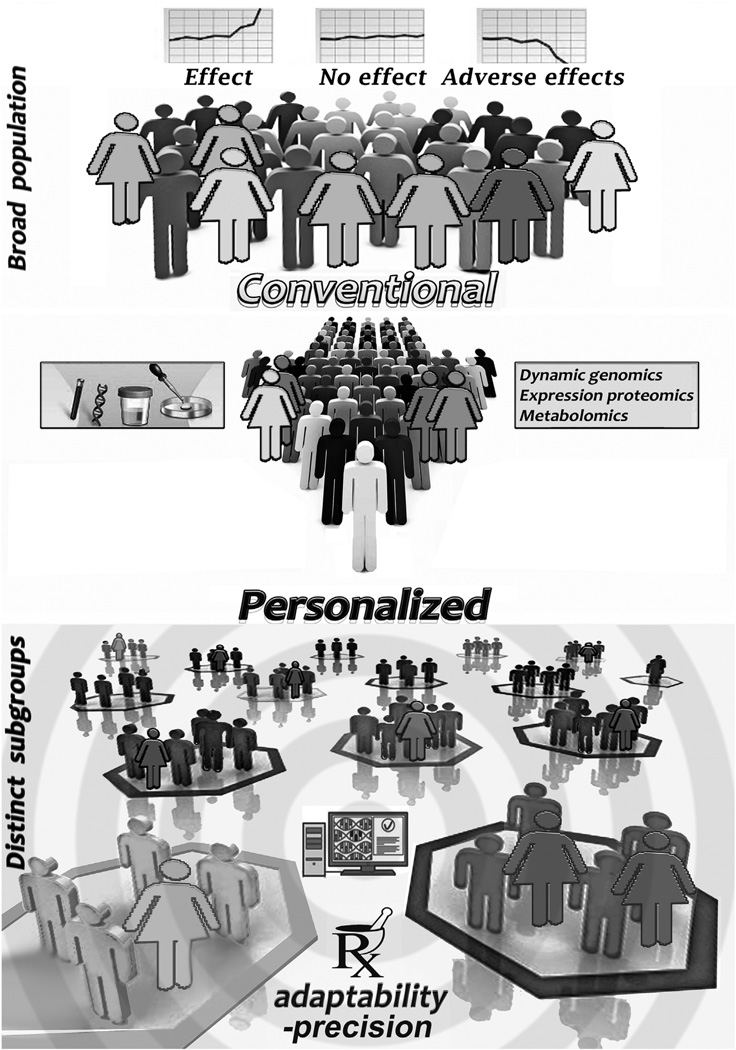
Substantial interindividual variability can emerge in the clinical response to accepted treatments for acute and chronic diseases. Genetic, metabolic and med history data can split patients into smaller groups, allowing treatments to be tailored with precision to the specific subgroups, so as to augment efficacy and minimize undesirable adverse effects.
Fig. 4
Fig. 4
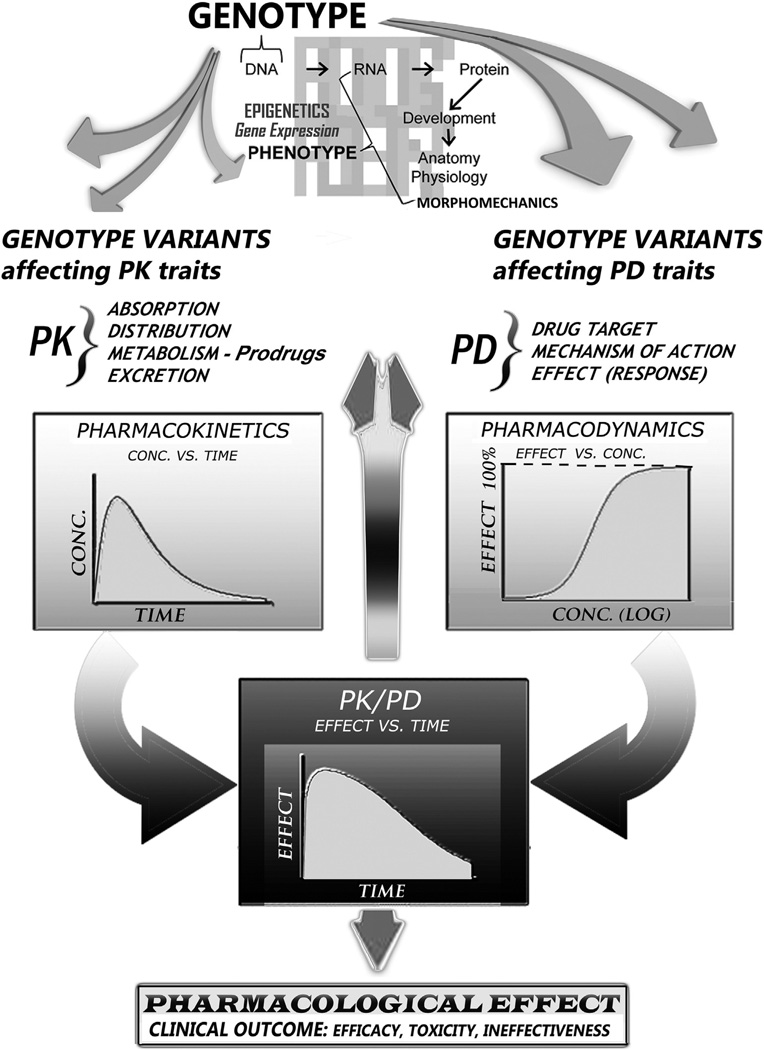
Pharmacokinetics (PK) studies the time course of drug absorption, distribution, metabolism, and excretion and then applies resulting principles to the safe and effective therapeutic management of drugs in an individual patient Pharmacodynamics (PD) concerns the relationship between drug concentration at the site of action and the resulting response, including the time-course of therapeutic and adverse effects. The effect of a drug present at the site of action is determined by its binding with a receptor; receptors present on cardiac muscle affect, e.g., the intensity of contraction. Genotypic and epigenetic variability affect drug response in several ways involving: varying receptor density on the cell surface; mechanisms by which a signal is transmitted within the cell by second messengers; or, complex factors controlling gene expression and protein production. This multilevel PD regulation results in variation of sensitivity to drug effect(s) from one individual to another and, combined with PK governing the amount of time that the drug is present at its action sites, also determines enhancement of or tolerance to drug actions and clinical outcome.

References

    1. van der Eijk PJ. Hippocrates: the protean father of medicine. Lancet. 2002;359(2285)
    1. Sykiotis GP, Kalliolias GD, Papavassiliou AG. Pharmacogenetic principles in the Hippocratic writings. J. Clin. Pharmacol. 2005;45:1218–1220. - PubMed
    1. Hippocrates. Loeb Classical Library, Hippocrates, Volumes I–VIII. Cambridge, MA: Harvard University Press [The name of each treatise is given in brackets in the text citation];
    1. Pontius JU, Mullikin JC, Smith DR, Agencourt Sequencing Team. Lindblad-Toh K, Gnerre S. et al. Initial sequence and comparative analysis of the cat genome. Genome Res. 2007;17:1675–1689. - PMC - PubMed
    1. Reiter LT, Potocki L, Chien S, Gribskov M, Bier EA. systematic analysis of human disease-associated gene sequences in Drosophila melanogaster . Genome Res. 2001;11:1114–1125. - PMC - PubMed